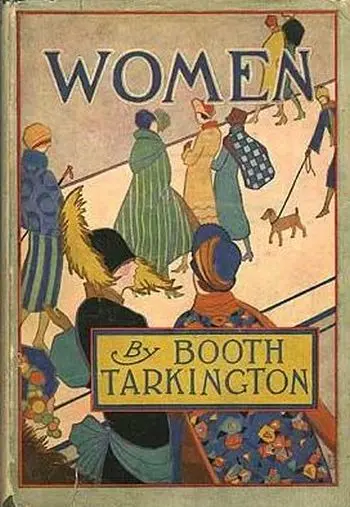
Women
Booth Tarkington
THE CLASSIC COLLECTION · 1919
"Ramsey Milholland" by Booth Tarkington is a novel written in the early 20th century that portrays the life and experiences of a young boy named Ramsey. The story explores themes of childhood, war, and the transition to adolescence, as seen through Ramsey's interactions with his grandfather, peers, and his own developing identity. The narrative unfolds against the backdrop of a small town in America, steeped in the traditions and lessons of the past, particularly centering around the solemnity of war commemorations and the innocence of youth. The opening of the novel introduces us to Ramsey Milholland and his grandfather, who are watching a Decoration Day parade together. Through their conversation, we witness the innocent curiosity of Ramsey as he questions his grandfather about the Civil War, showcasing his youthful bravado and naivety. The grandfather reflects on his war experience, revealing complexities in the perspectives of both soldiers and their valor. This blend of earnest dialogue and comedic interludes sets the stage for Ramsey's journey through childhood, where themes of loyalty, bravery, and the bittersweet nature of growing up begin to emerge. As Ramsey transitions into school life, the narrative foreshadows the trials he will face in navigating friendships and crushes, especially with a girl named Dora Yocum, establishing a groundwork for his development in the story.
Introduction adapted from the source catalogue; source summaries may be automatically generated.
Free to read · English · 40,571 words · No account needed
MAKE TIME FOR A GOOD BOOK
On by default. Untick to stop anonymous reading totals. Each page counts after 10 seconds in view. How this works.
Anonymous counting is on unless you have switched it off.
Fred Mitchell, crossing the campus one morning, ten days later, saw Dora standing near the entrance of her dormitory, where he would pass her unless he altered his course; and as he drew nearer her and the details of her face grew into distinctness, he was indignant with himself for feeling less and less indignation toward her in proportion to the closeness of his approach. The pity that came over him was mingled with an unruly admiration, causing him to wonder what unpatriotic stuff he could be made of. She was marked, but not whipped; she still held herself straight under all the hammering and cutting which, to his knowledge, she had been getting.
She stopped him, “for only a moment,” she said, adding with a wan profoundness: “That is, if you're not one of those who feel that I shouldn't be 'spoken to'?”
“No,” said Fred, stiffly. “I may share their point of view, perhaps, but I don't feel called upon to obtrude it on you in that manner.”
“I see,” she said, nodding. “I've wanted to speak with you about
Ramsey.”
“All right.”
She bit her lip, then asked, abruptly: “What made him do it?”
“Enlist as a private with the regulars?”
“No. What made him enlist at all?”
“Only because he's that sort,” Fred returned briskly. “He may be inexplicable to people who believe that his going out to fight for his country is the same thing as going out to commit a mur--”
She lifted her hand. “Couldn't you--”
“I beg your pardon,” Fred said at once. “I'm sorry, but I don't know just how to explain him to you.”
“Why?”
He laughed, apologetically. “Well, you see, as I understand it, you don't think it's possible for a person to have something within him that makes him care so much about his country that he--”
“Wait!” she cried. “Don't you think I'm willing to suffer a little rather than to see my country in the wrong? Don't you think I'm doing it?”
“Well, I don't want to be rude; but, of course, it seems to me that you're suffering because you think you know more about what's right and wrong than anybody else does.”
“Oh, no. But I--”
“We wouldn't get anywhere, probably, by arguing it,” Fred said. “You
asked me.”
“I asked you to tell my why he enlisted.”
“The trouble is, I don't think I can tell that to anybody who needs an answer. He just went, of course. There isn't any question about it. I always thought he'd be the first to go.”
“Oh, no!” she said.
“Yes, I always thought so.”
Your reading position is saved on this browser. Take it to another device with a library code. Reading pages adapt to text, rather than matching a printed edition.
Booth Tarkington
Booth Tarkington
Booth Tarkington
Booth Tarkington
BEHIND THE BOOK
This eBook is for the use of anyone anywhere in the United States and most other parts of the world at no cost and with almost no restrictions whatsoever. You may copy it, give it away or re-use it under the terms of the Project Gutenberg License included with this eBook or online at www.gutenberg.org. If you are not located in the United States, you will have to check the laws of the country where you are located before using this eBook. Read the source licence.
The original source file, including credits and licence, is retained by this library. Request an original-format copy at no charge. Please include the book title and Project Gutenberg identifier #2595.
KEEP YOUR CURIOSITY GOING
Coulson Kernahan

Maurice Baring
Frances Wright
Cécile Tormay

Frederic Jesup Stimson

W. H. P. (William Henry Pope) Jarvis