THE CLASSIC COLLECTION✦My diaries, being a personal narrative of events 1888-1914, Part 2 (1900-1914)CLASSIC FREE BOOKS
My diaries, being a personal narrative of events 1888-1914, Part 2 (1900-1914)
Wilfrid Scawen Blunt
THE CLASSIC COLLECTION · 1882
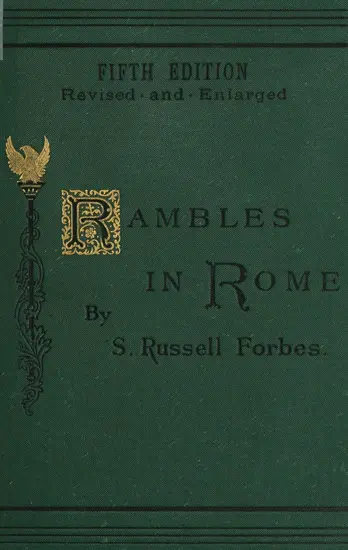
"Rambles in Rome" by S. Russell Forbes is an archaeological and historical guide written in the late 19th century. The work serves as a comprehensive companion for travelers to Rome, chronicling significant museums, galleries, churches, and ancient ruins while also providing insights into their historical contexts. This guide is likely aimed at visitors seeking to deepen their understanding of Rome’s rich heritage through concise commentary on its artifacts and landmarks. At the start of the guide, the author expresses the intent to provide visitors with practical descriptions of notable sites in Rome. He encourages readers to explore the city through a series of "Rambles," offering guidance on routes that showcase both the major attractions and hidden treasures. The opening chapters include introductory observations about Rome’s geography, hints for health and safety, and a brief history explaining the city's gradual decline into ruins, setting the stage for detailed explorations of specific locations in the subsequent sections.
Introduction adapted from the source catalogue; source summaries may be automatically generated.
Free to read · English · 135,448 words · No account needed
MAKE TIME FOR A GOOD BOOK
On by default. Untick to stop anonymous reading totals. Each page counts after 10 seconds in view. How this works.
Anonymous counting is on unless you have switched it off.
C. PUBLICO . L. Q. F. BIBULO . AED . PL. HONORIS
VIRTUTISQUE . CAUSSA . SENATUS
CONSULTO . POPULIQUE . IUSSU . LOCUS.
MONUMENTO . QUO . IPSE . POSTEREIQUE
EIUS . INFERRENTUR . PUBLICE . DATUS . EST.
It is of travertine stone and plain Doric architecture. There is some talk of pulling the house down, so that this interesting monument may be better seen.
Continuing our ramble down the street, we arrive, on the right, at the Church of S. Giuseppe dei Falegnami. It is built over part of
erected, according to Livy (i. 33) by Ancus Martius. "In order to suppress the terror, the boldness which the vicious assumed from hence (A.U.C. 121),[1] and which gained ground continually, a prison was built in the middle of the city, adjoining the Forum." Servius Tullius added a lower cell, called the TULLIANUM, 6½ feet high and 19 feet by 9. Prisoners who were condemned to be strangled or to die of hunger were thrust down the aperture; hence the phrase, "to cast into prison." Sallust ("Catiline," lv.) thus describes it:--
"There is a place in the prison which is called the Tullianum Dungeon. It is about 12 feet deep in the ground when you have ascended a little to the left.[2] It is secured round the sides by walls, and over it is a vaulted roof, connected with stone arches; but its appearance is disgusting and horrible, by reason of the filth, the obscurity, and the stench. When Lentulus had been let down into this place, certain men, to whom orders had been given, strangled him with a cord."
The upper part of the Mamertine Prison was partly rebuilt in the time of Tiberius, as we know from an inscription remaining in the cornice over the flight of steps under the church.
C. VIBIUS . C. F. RUFINUS . M. COCCEIUS . NERVA . COS . EX . S. C.
Consuls A.D. 23.
It seems to have been used exclusively for state prisoners. We have records of the following, amongst others, who were confined here:--
Manlius, who had defended the Capitol against the Gauls.--B.C. 382.
Quintus Pleminius, a prisoner for sedition.--B.C. 194.
Jugurtha, King of Numidia, who was starved to death B.C. 104. He exclaimed, when cast in, "By Hercules! how cold is this bath of yours!" (Plutarch, in "Caius Marius"), evidently speaking of the spring as existing in those days.
Catiline conspirators, strangled by order of the Consul Cicero.--B.C.
55.
Vercingetorix, King of the Gauls, by order of Julius Cæsar.
Sejanus, the minister of Tiberius.--A.D. 31.
Simon, the son of Giora, the defender of Jerusalem against
Vespasian.--A.D. 69.
In the centre of the upper chamber is the round aperture, covered by a grate, down which the prisoners were cast.
Your reading position is saved on this browser. Take it to another device with a library code. Reading pages adapt to text, rather than matching a printed edition.
BEHIND THE BOOK
This eBook is for the use of anyone anywhere in the United States and most other parts of the world at no cost and with almost no restrictions whatsoever. You may copy it, give it away or re-use it under the terms of the Project Gutenberg License included with this eBook or online at www.gutenberg.org. If you are not located in the United States, you will have to check the laws of the country where you are located before using this eBook. Read the source licence.
The original source file, including credits and licence, is retained by this library. Request an original-format copy at no charge. Please include the book title and Project Gutenberg identifier #43416.
KEEP YOUR CURIOSITY GOING
Wilfrid Scawen Blunt
Wilfrid Scawen Blunt

E. W. (Edgar Watson) Howe
Cécile Tormay

Moritz Busch
John L. Ransom