THE CLASSIC COLLECTION✦My diaries, being a personal narrative of events 1888-1914, Part 2 (1900-1914)CLASSIC FREE BOOKS
My diaries, being a personal narrative of events 1888-1914, Part 2 (1900-1914)
Wilfrid Scawen Blunt
THE CLASSIC COLLECTION · 1882
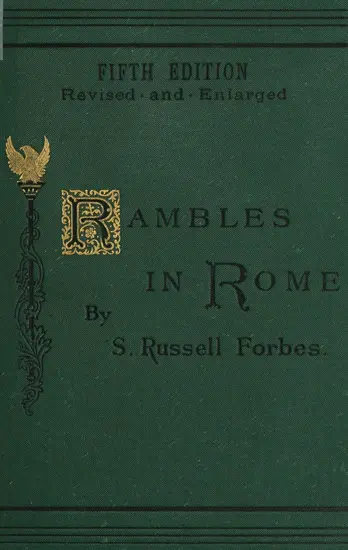
"Rambles in Rome" by S. Russell Forbes is an archaeological and historical guide written in the late 19th century. The work serves as a comprehensive companion for travelers to Rome, chronicling significant museums, galleries, churches, and ancient ruins while also providing insights into their historical contexts. This guide is likely aimed at visitors seeking to deepen their understanding of Rome’s rich heritage through concise commentary on its artifacts and landmarks. At the start of the guide, the author expresses the intent to provide visitors with practical descriptions of notable sites in Rome. He encourages readers to explore the city through a series of "Rambles," offering guidance on routes that showcase both the major attractions and hidden treasures. The opening chapters include introductory observations about Rome’s geography, hints for health and safety, and a brief history explaining the city's gradual decline into ruins, setting the stage for detailed explorations of specific locations in the subsequent sections.
Introduction adapted from the source catalogue; source summaries may be automatically generated.
Free to read · English · 135,448 words · No account needed
MAKE TIME FOR A GOOD BOOK
On by default. Untick to stop anonymous reading totals. Each page counts after 10 seconds in view. How this works.
Anonymous counting is on unless you have switched it off.
These ruins extend under the Doria Palace, and have nothing to do with any house. There were no houses on the Campus Martius in Paul's time. (See page 197.)
Just beyond, on the same side of the way, is
THE DORIA PALACE GALLERY (Palazzo Doria),
open on Tuesday and Friday from 10 till 2. Catalogues in each room.
Fee, half-franc.
FIRST ROOM contains four sarcophagi. A picture of the Deluge, by
Scarsellino.
SECOND ROOM.--4. Caritas Romana, by Valentin. (See page 191.) 24. Madonna and Child, by F. Francia. 28. Annunciation, by Lippi. 33. S. Agnese, by Guercino.
FOURTH ROOM.--Bust of Leo X., Doria.
FIFTH ROOM.--17. Money-Changers, by Quentin Matsys. 25. S. Joseph, by
Guercino.
SIXTH ROOM.--13. Madonna, by Carlo Maratta. 30. Sketch of a Boy.
SEVENTH ROOM.--8. Belisarius in the Desert, by Salvator Rosa. 19. Slaughter of the Innocents, by Mazzolini.
FIRST GALLERY.--3. Magdalen, by Annibale Caracci. 9. Holy Family, by Sassoferrato. 14. A Titian. 20. Three Ages of Man, by Titian. 25. Flight into Egypt, by Claude Lorraine. 45. Madonna, by Guido Reni. 50. Holy Family, by Giulio Romano.
SECOND GALLERY.--6. Madonna, by Francia. 14. Bartolo and Baldo, by Raphael. 24. Calvin, Luther, and Catherine, by Giorgione. 40. Herodias, by Pordenone. 50. Confessor, by Rubens. 53. Joanna of Arragon, School of Leonardo da Vinci. Bust of Andrea Doria. 80. Wife and Self, by Titian.
THIRD GALLERY.--5. Landscape, by Claude Lorraine. 12. The Mill, by same, a most extraordinary complication. 18. Pietà, by Caracci.
CABINET OF GEMS.--1. Portrait of a Letterato, by Lucas van Leyden. 2. Andrea Doria, by Sebastiano del Piombo. 3. Giannetto Doria, by Bronzino. 4. S. Philip Neri, by Barocci. 5. Innocent X., by Velasquez. 6. Entombment, by John Emelingk. Bust of Lady Mary Talbot.
Proceeding down the Corso, we reach the Piazza di Venezia. On the left is the Tolonia Palace, and on the right the Venetian Palace (now the Austrian Embassy), a building of the middle ages. On the right-hand side of the narrow street, in a line with the Corso, Via Morforio, is the
converted into a house, the lower part being shops. By descending into the vault, it will be seen that it is hewn out of the natural rock. The Claudii family "received, from the state, lands beyond the Anio for their followers, and a burying-place for themselves near the Capitol" (Suetonius, "Claudius," i. 1).
Adjoining is the house where Giulio Romano was born.
A few steps beyond, on the left-hand side of the same street, is the
The inscription records the virtue and public honour of a Roman magistrate of the time of the republic. It is supposed to be two thousand years old.
Your reading position is saved on this browser. Take it to another device with a library code. Reading pages adapt to text, rather than matching a printed edition.
BEHIND THE BOOK
This eBook is for the use of anyone anywhere in the United States and most other parts of the world at no cost and with almost no restrictions whatsoever. You may copy it, give it away or re-use it under the terms of the Project Gutenberg License included with this eBook or online at www.gutenberg.org. If you are not located in the United States, you will have to check the laws of the country where you are located before using this eBook. Read the source licence.
The original source file, including credits and licence, is retained by this library. Request an original-format copy at no charge. Please include the book title and Project Gutenberg identifier #43416.
KEEP YOUR CURIOSITY GOING
Wilfrid Scawen Blunt
Wilfrid Scawen Blunt

E. W. (Edgar Watson) Howe
Cécile Tormay

Moritz Busch
John L. Ransom