THE CLASSIC COLLECTION✦My diaries, being a personal narrative of events 1888-1914, Part 2 (1900-1914)CLASSIC FREE BOOKS
My diaries, being a personal narrative of events 1888-1914, Part 2 (1900-1914)
Wilfrid Scawen Blunt
THE CLASSIC COLLECTION · 1882
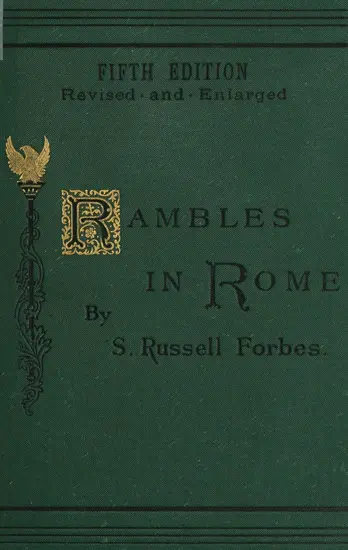
"Rambles in Rome" by S. Russell Forbes is an archaeological and historical guide written in the late 19th century. The work serves as a comprehensive companion for travelers to Rome, chronicling significant museums, galleries, churches, and ancient ruins while also providing insights into their historical contexts. This guide is likely aimed at visitors seeking to deepen their understanding of Rome’s rich heritage through concise commentary on its artifacts and landmarks. At the start of the guide, the author expresses the intent to provide visitors with practical descriptions of notable sites in Rome. He encourages readers to explore the city through a series of "Rambles," offering guidance on routes that showcase both the major attractions and hidden treasures. The opening chapters include introductory observations about Rome’s geography, hints for health and safety, and a brief history explaining the city's gradual decline into ruins, setting the stage for detailed explorations of specific locations in the subsequent sections.
Introduction adapted from the source catalogue; source summaries may be automatically generated.
Free to read · English · 135,448 words · No account needed
MAKE TIME FOR A GOOD BOOK
On by default. Untick to stop anonymous reading totals. Each page counts after 10 seconds in view. How this works.
Anonymous counting is on unless you have switched it off.
Built by Pius VII., in 1817, from the designs of Stern. The floor is composed of ancient mosaics, and is worthy of notice. The chief objects of interest are--5, Caryatide, supposed to be one of those which supported the portico of the Pandrosium at Athens, by Phidias; 8, Commodus; 9, Captive Dacian King; 11, Silenus; 14, Augustus, found in 1863 in the ruins of the Villa of Livia at Prima Porta; 17, Æsculapius; 20, Nerva; 23, Pudicitia, the goddess of modesty; 26, Titus; 92, Ganymedes, the cup-bearer of Jupiter; 44, Wounded Amazon; 47, Caryatide; 50, Diana; 53, Euripides; 56, Julia, daughter of Titus; 59, Plenty; 62, Demosthenes; 67, Athlete in the act of cleaning his arm with a strigil--the die, which he holds in his other hand, is an erroneous modern addition; 71, Amazon; 74, Clemency; 77, Antonia, the wife of Drusus the elder; 80, Plotina, wife of Trajan; 83, Ceres; 86, Fortune; 96, A. Marcus Antonius; 109, The Nile--the sixteen children are allegorical of the sixteen cubits at which the rise of the river begins to irrigate the land--one of the finest works of art in the Vatican, found near the Church of Minerva; 111, Julia, daughter of Titus; 114, Minerva; 117, Claudius; 120, Faun; 123, Lucius Verus; 126, Athlete; 129, Domitian; 132, Mercury. Passing through the iron gates, we enter
the walls of which are adorned with three thousand pagan and eleven hundred Christian inscriptions brought from various catacombs and cemeteries. Retracing our way through the Museum, a glass door on the right at the entrance of the Museum conducts us to
Ask the Custodian; fee, 50 cents each.
It was founded by Sixtus V., and contains 120,000 volumes, of which 25,000 are manuscripts. The magnificent great hall is 220 feet long, and contains many objects of interest, notably two fine candelabra of Sèvres china presented to Pius VII. by Napoleon I.; a vase of malachite and another of immense size, presented by Prince Demidoff; two vases of Meissen porcelain, presented by the Emperor of Germany; a large vase of porcelain china, presented by Napoleon III. to Pius IX. after it had been used as the font in the baptism of the Prince Imperial; a beautiful basin of Aberdeen granite, presented by the Duke of Northumberland.
The contents comprise a collection of lamps, glass vessels, gems, &c., found in the Catacombs. In the room beyond is a very interesting collection of Byzantine and medieval Italian paintings, a Russian calendar, and other interesting objects. At the end of this vista of rooms is a full-length seated portrait of Pius IX., painted on glass at Aix-la-Chapelle.
N.B.--The following collections at the Vatican are open only on Thursdays from nine till three; special permission is required.
Your reading position is saved on this browser. Take it to another device with a library code. Reading pages adapt to text, rather than matching a printed edition.
BEHIND THE BOOK
This eBook is for the use of anyone anywhere in the United States and most other parts of the world at no cost and with almost no restrictions whatsoever. You may copy it, give it away or re-use it under the terms of the Project Gutenberg License included with this eBook or online at www.gutenberg.org. If you are not located in the United States, you will have to check the laws of the country where you are located before using this eBook. Read the source licence.
The original source file, including credits and licence, is retained by this library. Request an original-format copy at no charge. Please include the book title and Project Gutenberg identifier #43416.
KEEP YOUR CURIOSITY GOING
Wilfrid Scawen Blunt
Wilfrid Scawen Blunt

E. W. (Edgar Watson) Howe
Cécile Tormay

Moritz Busch
John L. Ransom