THE CLASSIC COLLECTION✦My diaries, being a personal narrative of events 1888-1914, Part 2 (1900-1914)CLASSIC FREE BOOKS
My diaries, being a personal narrative of events 1888-1914, Part 2 (1900-1914)
Wilfrid Scawen Blunt
THE CLASSIC COLLECTION · 1882
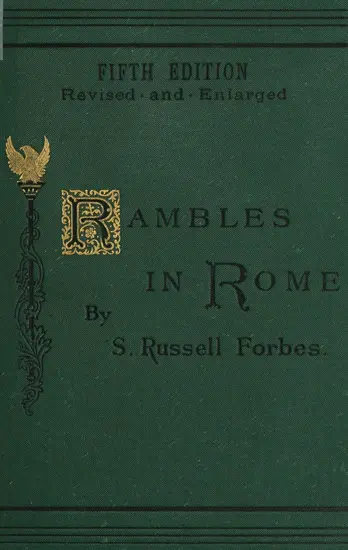
"Rambles in Rome" by S. Russell Forbes is an archaeological and historical guide written in the late 19th century. The work serves as a comprehensive companion for travelers to Rome, chronicling significant museums, galleries, churches, and ancient ruins while also providing insights into their historical contexts. This guide is likely aimed at visitors seeking to deepen their understanding of Rome’s rich heritage through concise commentary on its artifacts and landmarks. At the start of the guide, the author expresses the intent to provide visitors with practical descriptions of notable sites in Rome. He encourages readers to explore the city through a series of "Rambles," offering guidance on routes that showcase both the major attractions and hidden treasures. The opening chapters include introductory observations about Rome’s geography, hints for health and safety, and a brief history explaining the city's gradual decline into ruins, setting the stage for detailed explorations of specific locations in the subsequent sections.
Introduction adapted from the source catalogue; source summaries may be automatically generated.
Free to read · English · 135,448 words · No account needed
MAKE TIME FOR A GOOD BOOK
On by default. Untick to stop anonymous reading totals. Each page counts after 10 seconds in view. How this works.
Anonymous counting is on unless you have switched it off.
The gray peperino sarcophagus was discovered in the tomb of the Scipios on the Via Appia in 1780. It contained the remains of Scipio Barbatus. When it was opened, two thousand years after his death, the skeleton was found entire, with a ring upon one of the fingers. The ring passed into the hands of the Earl of Beverley, and the bones were removed to Padua by the Venetian senator, Angelo Quirini. On the wall are inscriptions found in the tomb. A bust of the poet Ennius surmounts the sarcophagus.
of Hercules. The work of Apollonius, son of Nestor of Athens. Found near the Theatre of Pompey. It is considered to be the most perfect resemblance to human flesh, and was greatly admired by Raphael and Michael Angelo, the latter declaring that he was its pupil. Descending the stairs we reach
containing numerous monuments of Greek and Roman art. On the left going down. 733, Recumbent Statue of Hercules; 683, Hygeia; 682, Antoninus Pius; 681, Minerva; 635, Hercules with Ajax, found near Pompey's Theatre; 589, Mercury; 588, Group of Bacchus and Ampelus; 544, Silenus; 495, A Cupid, by Praxiteles; 494, Tiberius; 493, Diadumenianus; 450, Mercury; 422, Bust of Demosthenes; 419-417, Busts of Caius and Lucius, nephews of Augustus; 418, Julia, his daughter; 416, Augustus as a Youth; 401, Colossal Head of Augustus; 400, Tiberius; 399, Head of Tiberius; 353, Nymph on a Rock; 294, Hercules Resting; 262, A Smiling Child; 242, Apollo Citharœdus; 241, Juno suckling Mars; 240, Britannicus; 197, Minerva, with modern helmet and enamelled eyes; 177, Polyhymnia; 175, Niobe in Flight from Diana; 122, Diana; 121, Clio, the historical muse and guardian of truth; 120, Priestess of Vesta; 85, The God of Sleep; 62, Hygeia, the goddess of health; 61, Urania; 15, A consular statue; 6, Autumn.--Gates to Corridor of Inscriptions.--Returning. 13, Winter; 19, Paris; 18, Apollo; 17, A Faun. Entrance to the Nuovo Braccio. 112, Venus of Cnidos; 124, Drusus; 181, Hecate; 179, Myth of Alcestis; 245, Polyhymnia; 244, Ocean; 287, Sleeping Fisher Boy; 298, Bacchus; 297, Athlete; 343a, Brutus who stabbed Cæsar; 355-357, Figures found at Tusculum; 358, Captive; 453, Meleager; 498, Clotho; 497, Sarcophagus, with Corn-mills; 484, Diana; 547, Isis; 548, a Vestal; 580, Præfica; 591, Claudius; 627, Venus and Mars; 639, Julia Lœmia; 686, Tuccia, the vestal virgin, carrying water in a sieve from the Tiber to the Forum. (See Dionysius, ii. 69.) On the border is S. K. Pello, "By this proof a sepulchre and a calumny are removed from me." 685, Sarcophagus, representing the manufacture of oil; 684, Æsculapius.
Your reading position is saved on this browser. Take it to another device with a library code. Reading pages adapt to text, rather than matching a printed edition.
BEHIND THE BOOK
This eBook is for the use of anyone anywhere in the United States and most other parts of the world at no cost and with almost no restrictions whatsoever. You may copy it, give it away or re-use it under the terms of the Project Gutenberg License included with this eBook or online at www.gutenberg.org. If you are not located in the United States, you will have to check the laws of the country where you are located before using this eBook. Read the source licence.
The original source file, including credits and licence, is retained by this library. Request an original-format copy at no charge. Please include the book title and Project Gutenberg identifier #43416.
KEEP YOUR CURIOSITY GOING
Wilfrid Scawen Blunt
Wilfrid Scawen Blunt

E. W. (Edgar Watson) Howe
Cécile Tormay

Moritz Busch
John L. Ransom