THE CLASSIC COLLECTION✦An outlaw’s diary: the CommuneCLASSIC FREE BOOKS
An outlaw’s diary: the Commune
Cécile Tormay
THE CLASSIC COLLECTION · 1886
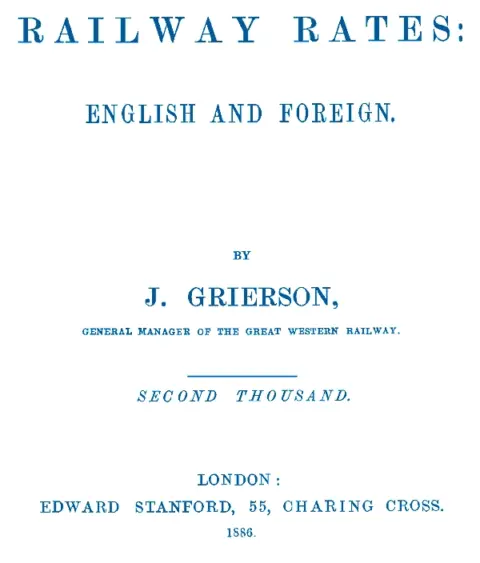
"Railway Rates: English and Foreign" by James Grierson is a scientific publication written in the late 19th century. It explores the principles, practices, and controversies surrounding railway rates in the United Kingdom compared to those in other countries, providing analysis and commentary on various rate-setting methods. Grierson, the General Manager of the Great Western Railway, delves into the complex interplay of interests between railway companies, traders, and consumers, aiming for an understanding that serves the needs of all parties involved in railway transportation. The opening of the text begins with a preface in which the author outlines the impetus for his examination of railway rates, citing public complaints and discussions regarding the contentious Railway and Canal Traffic Bill. He sets the stage by emphasizing the necessity of considering all stakeholders—traders, the public, and railway companies—when discussing and establishing rates. Grierson acknowledges that misconceptions surround the current practices and indicates his intent to present a balanced view that avoids hasty legislation or simplistic solutions. He warns against ignoring the complexities inherent in the operation of railways and the diverse needs of different trading communities, foreshadowing the detailed analysis to follow in subsequent sections.
Introduction adapted from the source catalogue; source summaries may be automatically generated.
Free to read · English · 78,139 words · No account needed
MAKE TIME FOR A GOOD BOOK
On by default. Untick to stop anonymous reading totals. Each page counts after 10 seconds in view. How this works.
Anonymous counting is on unless you have switched it off.
“For all Dung, Compost, and all sorts of Manure, Lime, and Limestone, and Salt, and all undressed materials for the Repair of Public Roads or Highways, the Sum of One Penny per Ton per mile;
“For all Coals, Coke, Culm, Charcoal, Cinders, Building, Pitching, and Paving Stones Dressed, Bricks, Tiles, Slates, Clay, Sand, Ironstone, Iron Ore, Pig, Bar, Rod, Hoop, Sheet, and all other similar Descriptions of wrought Iron and Castings not manufactured into utensils or other Articles of Merchandise, the Sum of Three Halfpence per Ton per Mile;
“For all Sugar, Grain, Corn, Flour, Dyewoods, Earthenware, Timber, Staves, and Deals, Metals (except Iron), Nails, Anvils, Vices, and Chains, the Sum of Twopence per Ton per Mile;
“For all Cotton and other Wools, Hides, Drugs, manufactured Goods, and all other Wares, Merchandise, Articles, Matters, or things, the Sum of Threepence per ton per Mile.
“And be it further enacted, That it shall be lawful for the said Company, and they are hereby empowered to provide Locomotive or Stationary Engines or other Power for the drawing or propelling of any Articles, Matters, or Things, Persons, Cattle, or Animals, upon the said Railway, and also along and upon any other Railway communicating therewith, and to receive, demand, and recover such Sums of Money for the Use of such Engines or other Power as the said Company shall think proper, in addition to the several other Rates, Tolls, or Sums by this Act authorised to be taken.
“And be it further enacted, That it shall be lawful for the said Company, and they are hereby authorised, if they shall think proper, to use and Employ Locomotive Engines or other Moving Power, and in Carriages or Wagons drawn or propelled thereby to Convey upon the said Railway and also along and upon any other Railway communicating therewith, all such Passengers, Cattle and other Animals
Goods, Wares, and Merchandise, Articles, Matters and Things, as shall be offered to them for that Purpose, and to make such reasonable Charges for such Conveyance as they may from Time to Time determine upon, in addition to the several Rates or Tolls by this Act authorised to be taken: Provided always, that it shall not be lawful for the said Company or for any Person using the said Railway as carriers to charge for the Conveyance of any Passenger upon the said Railway any greater Sum than the Sum of Threepence Halfpenny per Mile, including the Toll or Rate hereinbefore granted.”
By the Great Western Railway Company’s Act, 1847, the power of the Company in regard to rates and charges was reduced and limited,
Your reading position is saved on this browser. Take it to another device with a library code. Reading pages adapt to text, rather than matching a printed edition.
BEHIND THE BOOK
This eBook is for the use of anyone anywhere in the United States and most other parts of the world at no cost and with almost no restrictions whatsoever. You may copy it, give it away or re-use it under the terms of the Project Gutenberg License included with this eBook or online at www.gutenberg.org. If you are not located in the United States, you will have to check the laws of the country where you are located before using this eBook. Read the source licence.
The original source file, including credits and licence, is retained by this library. Request an original-format copy at no charge. Please include the book title and Project Gutenberg identifier #47719.
KEEP YOUR CURIOSITY GOING
Cécile Tormay

Moritz Busch
John L. Ransom
Frances Wright
Cécile Tormay

Mabel Potter Daggett