THE CLASSIC COLLECTION✦An outlaw’s diary: the CommuneCLASSIC FREE BOOKS
An outlaw’s diary: the Commune
Cécile Tormay
THE CLASSIC COLLECTION · 1886
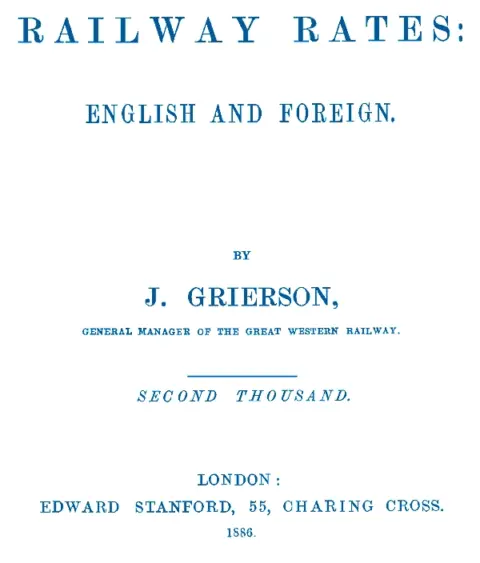
"Railway Rates: English and Foreign" by James Grierson is a scientific publication written in the late 19th century. It explores the principles, practices, and controversies surrounding railway rates in the United Kingdom compared to those in other countries, providing analysis and commentary on various rate-setting methods. Grierson, the General Manager of the Great Western Railway, delves into the complex interplay of interests between railway companies, traders, and consumers, aiming for an understanding that serves the needs of all parties involved in railway transportation. The opening of the text begins with a preface in which the author outlines the impetus for his examination of railway rates, citing public complaints and discussions regarding the contentious Railway and Canal Traffic Bill. He sets the stage by emphasizing the necessity of considering all stakeholders—traders, the public, and railway companies—when discussing and establishing rates. Grierson acknowledges that misconceptions surround the current practices and indicates his intent to present a balanced view that avoids hasty legislation or simplistic solutions. He warns against ignoring the complexities inherent in the operation of railways and the diverse needs of different trading communities, foreshadowing the detailed analysis to follow in subsequent sections.
Introduction adapted from the source catalogue; source summaries may be automatically generated.
Free to read · English · 78,139 words · No account needed
MAKE TIME FOR A GOOD BOOK
On by default. Untick to stop anonymous reading totals. Each page counts after 10 seconds in view. How this works.
Anonymous counting is on unless you have switched it off.
“For all Lead in Pigs or Sheets, Bar Iron, Wagon Tire, Timber, Staves, and Deals, and all other Goods, Commodities, Wares and Merchandises, such Sum as the said Company of Proprietors shall from time to time direct and appoint, not exceeding the Sum of Sixpence per Ton per Mile.
“For all the Articles, Matters, and Things for which a Tonnage is hereinbefore directed to be paid, which shall pass the Inclined Planes upon the said Hail ways or Tramroads, such Sum as the said Company of Proprietors shall appoint, not exceeding the Sum of One Shilling per Ton.
“And for all Coal which shall be shipped on board of any vessel or vessels in the Port of Stockton-upon-Tees aforesaid, for the purpose of exportation, such Sum as the said Company of Proprietors shall appoint, not exceeding the Sum of One Halfpenny per Ton per Mile.”
By the Liverpool and Manchester Railway Act, 1826, that Company were empowered to charge maximum rates for the whole distance, 31 miles 6 chains, viz.:--
“For all Lime, Limestone, and all sorts of Dung, Compost, and Manure, and all materials for the repair of the public roads and all Stone, Sand, Clay, Building, Pitching and Paving Stones, Tiles and Slates, and also for all Timber, Staves and Deals not exceeding Eight Shillings per Ton.
“For all Sugar, Corn, Grain and Flour, Dyewoods, Lead, Iron, and other metals not exceeding Nine Shillings per Ton.
“For all Cotton and other Wool, Hides, Drugs, Groceries and, manufactured goods not exceeding Eleven Shillings per Ton.
“For all Wines, Spirits, Vitriol, Glass, and other hazardous goods not exceeding Fourteen Shillings per Ton.
“And for any distance short of the whole length, not exceeding a rateable proportion of such several sums according to distance.
“And for all Coals, Coke, Culm, Charcoal and Cinders carried or conveyed along the same or any part thereof any sum not exceeding Twopence Halfpenny per Ton per Mile.
“And for all Persons, Cattle and other Animals, such reasonable charge as shall from time to time he determined by the said Company.”
In 1835 the Toll Clauses sanctioned by Parliament were generally as
follows:--
Great Western Railway Act, 1835, 5 and 6 William IV., cap. 107, s.
164, 166, 167.
“And be it further enacted, That it shall be lawful for the said Company to demand, receive, and recover, to and for the Use and Benefit of the said Company, for the Tonnage of all Articles, Matters and Things which shall be conveyed upon or along the said Railway, any Rates or Tolls not exceeding the following: (that is to say,)
Your reading position is saved on this browser. Take it to another device with a library code. Reading pages adapt to text, rather than matching a printed edition.
BEHIND THE BOOK
This eBook is for the use of anyone anywhere in the United States and most other parts of the world at no cost and with almost no restrictions whatsoever. You may copy it, give it away or re-use it under the terms of the Project Gutenberg License included with this eBook or online at www.gutenberg.org. If you are not located in the United States, you will have to check the laws of the country where you are located before using this eBook. Read the source licence.
The original source file, including credits and licence, is retained by this library. Request an original-format copy at no charge. Please include the book title and Project Gutenberg identifier #47719.
KEEP YOUR CURIOSITY GOING
Cécile Tormay

Moritz Busch
John L. Ransom
Frances Wright
Cécile Tormay

Mabel Potter Daggett