THE CLASSIC COLLECTION✦An outlaw’s diary: the CommuneCLASSIC FREE BOOKS
An outlaw’s diary: the Commune
Cécile Tormay
THE CLASSIC COLLECTION · 1886
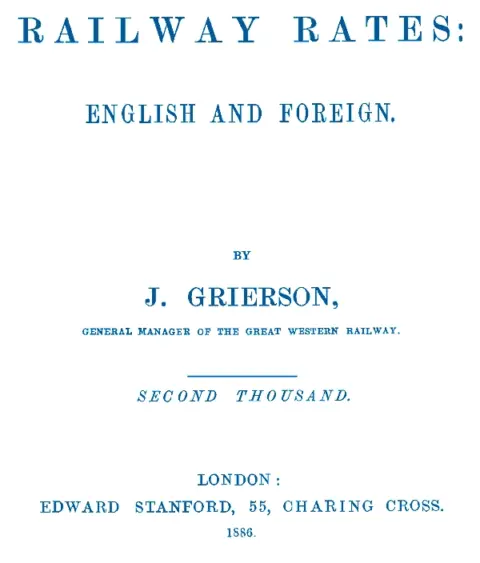
"Railway Rates: English and Foreign" by James Grierson is a scientific publication written in the late 19th century. It explores the principles, practices, and controversies surrounding railway rates in the United Kingdom compared to those in other countries, providing analysis and commentary on various rate-setting methods. Grierson, the General Manager of the Great Western Railway, delves into the complex interplay of interests between railway companies, traders, and consumers, aiming for an understanding that serves the needs of all parties involved in railway transportation. The opening of the text begins with a preface in which the author outlines the impetus for his examination of railway rates, citing public complaints and discussions regarding the contentious Railway and Canal Traffic Bill. He sets the stage by emphasizing the necessity of considering all stakeholders—traders, the public, and railway companies—when discussing and establishing rates. Grierson acknowledges that misconceptions surround the current practices and indicates his intent to present a balanced view that avoids hasty legislation or simplistic solutions. He warns against ignoring the complexities inherent in the operation of railways and the diverse needs of different trading communities, foreshadowing the detailed analysis to follow in subsequent sections.
Introduction adapted from the source catalogue; source summaries may be automatically generated.
Free to read · English · 78,139 words · No account needed
MAKE TIME FOR A GOOD BOOK
On by default. Untick to stop anonymous reading totals. Each page counts after 10 seconds in view. How this works.
Anonymous counting is on unless you have switched it off.
The minimum charge for Horses, Colts, Mules or Ponies by Passenger
Train is as for three heads.
The Goods Train rates are divided into three categories, viz.:--
1ST CATEGORY.--One Horse or one Mule, one or two Colts, Ponies, Oxen, Cows or Donkeys, one to five Pigs or Calves, one to ten Sheep, one to thirty Sucking Pigs.
2ND CATEGORY.--Two Horses or two Mules, three or four Colts, Ponies, Oxen, Cows or Donkeys, six to ten Pigs or Calves, eleven to twenty Sheep, thirty-one to sixty Sucking Pigs.
3RD CATEGORY.--Three Horses or three Mules, five or six Colts or Ponies, a Truck load[A] of small or large Cattle, sixty-one to one hundred Sucking Pigs.
Colts or Ponies exceeding 1 metre 30 (15 hands) in height are
considered and charged as Horses.
Senders may load as many head of Cattle into the Trucks as they please, but the Railways are exonerated from all responsibility for injuries, accidents on the road and loss of Cattle.
The rates of Tariff No. 6, 3rd Category, are increased by 25 per cent. if a larger number of Cattle is loaded into a Truck[131] than the quantity shown hereunder.
-------+-------+----------+----------+---------+----------+--------- Oxen. | Cows. | Donkeys. | Heifers. | Pigs or | Sheep or | Sucking | | | | Calves. | Goats. | Pigs. -------+-------+----------+----------+---------+----------+--------- Number.|Number.| Number. | Number. | Number. | Number. | Number. -------+-------+----------+----------+---------+----------+--------- 8 | 8 | 10 | 10 | 20 | 30 | 100 -------+-------+----------+----------+---------+----------+---------
[131] The bottom floor of a Belgian Cattle Truck generally measures 14 square metres, equal to 16·75 square yards.
The loading and unloading of animals, whether carried by Goods or Passenger Trains, is effected at the expense and entire responsibility of Senders and Consignees respectively.
Horses and Cattle must be accompanied by a man in charge. One man per consignment or per truck is conveyed free in the horse box or cattle trucks, but if he travels in another carriage, he pays the ordinary Passenger fare.
Dogs, irrespective of size, accompanying Passengers are charged 3rd
Class Passenger fare.
Small animals in cases, baskets or crates, are conveyed by ordinary Passenger Trains on the conditions of Tariff No. 2.
The Company do not deliver to “domicile,” and undertake no responsibility whatever in respect of these consignments.
The following statement shows the bases of the special tariffs:--
SPECIAL TARIFF NO. 1--For coal, coke, stones and earth sent direct
from pits for export.
1 to 84 kilometres, francs 2.20 per 1000 kilos. (minimum charge).
85 to 187 kilometres, franc 0.026 extra per kilometre.
188 to 300 kilometres, rate of 4th Class, Standard Scale, 1867.[132]
[132] See Note on pp. xl and xli.
301 kilometres and over, franc 0.02 extra per kilometre.
Your reading position is saved on this browser. Take it to another device with a library code. Reading pages adapt to text, rather than matching a printed edition.
BEHIND THE BOOK
This eBook is for the use of anyone anywhere in the United States and most other parts of the world at no cost and with almost no restrictions whatsoever. You may copy it, give it away or re-use it under the terms of the Project Gutenberg License included with this eBook or online at www.gutenberg.org. If you are not located in the United States, you will have to check the laws of the country where you are located before using this eBook. Read the source licence.
The original source file, including credits and licence, is retained by this library. Request an original-format copy at no charge. Please include the book title and Project Gutenberg identifier #47719.
KEEP YOUR CURIOSITY GOING
Cécile Tormay

Moritz Busch
John L. Ransom
Frances Wright
Cécile Tormay

Mabel Potter Daggett