THE CLASSIC COLLECTION✦An outlaw’s diary: the CommuneCLASSIC FREE BOOKS
An outlaw’s diary: the Commune
Cécile Tormay
THE CLASSIC COLLECTION · 1886
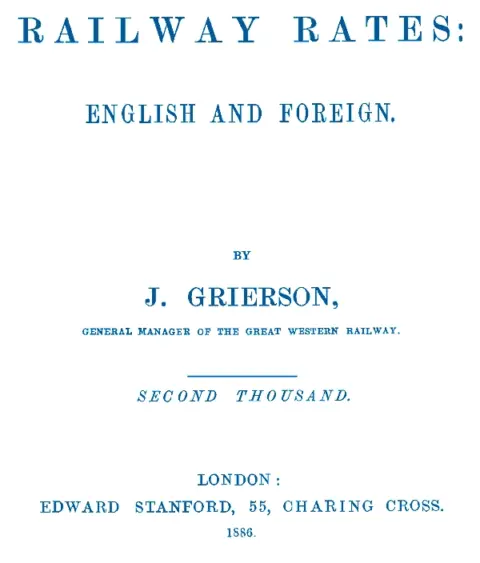
"Railway Rates: English and Foreign" by James Grierson is a scientific publication written in the late 19th century. It explores the principles, practices, and controversies surrounding railway rates in the United Kingdom compared to those in other countries, providing analysis and commentary on various rate-setting methods. Grierson, the General Manager of the Great Western Railway, delves into the complex interplay of interests between railway companies, traders, and consumers, aiming for an understanding that serves the needs of all parties involved in railway transportation. The opening of the text begins with a preface in which the author outlines the impetus for his examination of railway rates, citing public complaints and discussions regarding the contentious Railway and Canal Traffic Bill. He sets the stage by emphasizing the necessity of considering all stakeholders—traders, the public, and railway companies—when discussing and establishing rates. Grierson acknowledges that misconceptions surround the current practices and indicates his intent to present a balanced view that avoids hasty legislation or simplistic solutions. He warns against ignoring the complexities inherent in the operation of railways and the diverse needs of different trading communities, foreshadowing the detailed analysis to follow in subsequent sections.
Introduction adapted from the source catalogue; source summaries may be automatically generated.
Free to read · English · 78,139 words · No account needed
MAKE TIME FOR A GOOD BOOK
On by default. Untick to stop anonymous reading totals. Each page counts after 10 seconds in view. How this works.
Anonymous counting is on unless you have switched it off.
Goods sent in full truck loads may be loaded and unloaded at option by Senders and Consignees respectively, but if loaded by Senders they must be unloaded and carted by Consignees. Consignments under 5 tons and goods insured against damage or loss must in all cases be loaded and unloaded by the Railway.
The charge made by the Railway for loading and unloading is 10d. per ton of 1,000 kilos. If cranes or other loading appliances belonging to the Railway are used by Consignor or Consignee, a charge of 3d. per ton is made for their use.
The Railways on demand will verify the weight of the consignment as far as the appliances of the station will admit, a charge of franc 0.05 per 100 kilos. being made if the difference in the declared weight does not exceed 2 per cent. and the original charges are maintained.
TARIFF NO. 4 applies to the conveyance of Bullion, Bonds, Bank-notes, Title Deeds, &c., a false declaration of which, either in regard to weight, value, or nature of contents, is considered a fraud.
Carriage is charged upon 1,000 francs (£40) in value, any fraction of which sum is charged as for 1,000 francs, but if the charge so calculated is lower than it would be under the conditions of Tariff No. 2 the latter will be charged.
Additional services, viz., loading, unloading, booking and delivery to “domicile,” are included in the Tariff Rates.
TARIFF NO. 5 applies to carriages forwarded by Passenger Train; but at the option of the Sender, Carriages, as also Vans, Carts, Omnibuses, Tramway Cars, Engines and Threshing Machines, can be sent by Goods Train at the 2nd Class rate of Tariff No. 3, the minimum weight being:--
For 1 Vehicle--in pieces or on wheels--on one Truck 2,500 kilos. ” 2 Vehicles ” ” ” 4,000 ” ” 3 ” ” ” ” 5,500 ” ” 4 ” ” ” ” 7,000 ”
Vans, Carts, Omnibuses, &c., can also be charged at the 1st Class rate of Tariff No. 3, with 50 per cent. added as for bulky goods, if the latter is more advantageous to the Sender.
Loading and unloading are included in the Passenger Train rate, but are performed at Sender’s risk. In the case of Goods Train, those services are performed at the risk and expense of the Owner.
Carriages conveyed in covered Trucks specially provided for such traffic are charged 25 per cent. over and above the Ordinary rates, both by Passenger and Goods Train.
TARIFF NO. 6 applies to HORSES, CATTLE AND DOGS. Cattle is carried exclusively by Goods Train; Horses, Colts, Mules and Ponies are admitted for conveyance by Passenger Trains (Express Trains excepted), only in the two following cases, viz.:--
a. When the distance of the journey is 75 kilometres (46
miles) or more.
b. When the departure and arrival stations form the extreme points between which the Train runs.
Your reading position is saved on this browser. Take it to another device with a library code. Reading pages adapt to text, rather than matching a printed edition.
BEHIND THE BOOK
This eBook is for the use of anyone anywhere in the United States and most other parts of the world at no cost and with almost no restrictions whatsoever. You may copy it, give it away or re-use it under the terms of the Project Gutenberg License included with this eBook or online at www.gutenberg.org. If you are not located in the United States, you will have to check the laws of the country where you are located before using this eBook. Read the source licence.
The original source file, including credits and licence, is retained by this library. Request an original-format copy at no charge. Please include the book title and Project Gutenberg identifier #47719.
KEEP YOUR CURIOSITY GOING
Cécile Tormay

Moritz Busch
John L. Ransom
Frances Wright
Cécile Tormay

Mabel Potter Daggett