THE CLASSIC COLLECTION✦An outlaw’s diary: the CommuneCLASSIC FREE BOOKS
An outlaw’s diary: the Commune
Cécile Tormay
THE CLASSIC COLLECTION · 1912
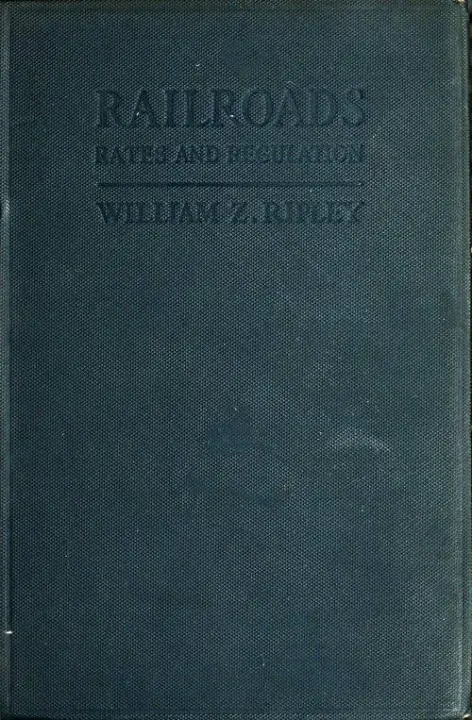
"Railroads: Rates and Regulations" by William Zebina Ripley is a scientific publication written in the early 20th century. This work serves as a treatise on the economics and regulation of railroads in the United States, exploring the extensive history of railroad transportation and its implications for commerce and society. The author examines the various factors that have influenced the construction, financing, and operational standards of railroads, as well as the political and social environment that shaped their development. The opening portion of the publication presents a detailed history of transportation in the United States, charting the evolution from early canals and toll roads to the advent of railroads. Ripley discusses the impact of geographical factors on transportation development, emphasizing how these elements fostered interaction between regions and necessitated advancements in transportation methods. He outlines significant milestones in railroad construction, governmental influences, and the increasing importance of railroads as fundamental elements of American commerce, setting the stage for a broader analysis of rates and regulations in subsequent chapters.
Introduction adapted from the source catalogue; source summaries may be automatically generated.
Free to read · English · 216,074 words · No account needed
MAKE TIME FOR A GOOD BOOK
On by default. Untick to stop anonymous reading totals. Each page counts after 10 seconds in view. How this works.
Anonymous counting is on unless you have switched it off.
In a List of References on Railways, published by the Congressional Library, 1907, special articles on experience by states, such as Dixon on Nebraska, Meyer on Wisconsin, Million on Missouri, etc., will be found under the names of states. Even more comprehensive is the collective catalogue prepared by the Bureau of Railway Economics, Chicago, 1912.
[799] Financial regulation will be discussed in vol. II.
[800] P. 452, supra. Also chaps. XXIII et seq. in our Railway
Problems.
[801] Vol II, in connection with capitalization and stock-watering.
[802] On the new Pennsylvania commission consult the Quarterly Journal of Economics, August, 1912.
[803] "The Wisconsin Idea," by Charles McCarthy, described by Van Hise in "Concentration and Control," 1912, p. 236.
[804] Huebner, op. cit., p. 147 has carefully tabulated all these
laws.
[805] The effect of Missouri distance tariffs upon rates over a large part of the Middle West is best instanced in the Missouri-Mississippi rate scheme. Cf. p. 128, supra, and especially chap. XX in our Railway Problems, rev. ed. Cf. also local and through tariffs at p. 394, supra; the Wabash decision, p. 451, supra; and the two-cent fare laws, p. 429, supra.
[806] P. 335, supra.
[807] P. 329, supra.
[808] Cf. p. 394, supra, the Texarkana, I. C. C. case, May, 1900; and 11 Idem, 180, for Arkansas. Also 13 Idem, 48; and 18 Idem, 415. For later cases, 22 Idem, 110; and 23 Idem, 404 and 688.
[809] Cf. p. 338, supra.
[811] P. 586, supra.
[812] Economic Bulletin, of the Amer. Econ. Ass., I; Annual Rep. I. C. C., 1907, p. 93; and Idem, 1908, pp. 71 and 76.
[814] The similar controversy in Minnesota regarding iron ore shipments seems to have been settled by voluntary abandonment of the claim to regulate by the state on Nov. 20, 1911. Cf. Minn. R. R. Com., Rep.
[815] Decision reprinted in our Railway Problems, rev. ed., chap. XXV.
See also volume II.
[816] Railroad Commission of Louisiana, etc.; 23 I.C.C. Rep., 31.
[817] Cf. p. 394, supra.
[818] Ibid., p. 34. A number of other cases are cited and compared by Hammond, Rate Theories, etc., 1911, p. 82 et seq.
[819] The most careful examination of this subject is in H. G. Moulton's Waterways Versus Railways, 1912.
[820] Cf. p. 45, supra.
[821] Cf. the Final Report of the U. S. Industrial Commission, 1901,
vol. XIX.
[822] Cf. the data published by the Bureau of Railway Economics, in Bulletin 21, 1911, on the relative cost of transportation upon the Erie Canal.
[823] Cf. p. 386, supra, on competition by river in the South.
[824] Cf. Moulton, op. cit.
[825] Cf. pp. 386, 590 and 612, supra. Data will be found in the U. S. Industrial Commission Report, 1900-1901, and the Senate (Elkins) Committee, 1905.
[826] The so-called Flour City case, recently decided in 1912 by the I. C. C. (not yet reported), held it to be the duty of these railroads to provide facilities for the handling of flour on through shipments of this sort.
[827] An excellent review of the situation in Railway Age Gazette,
LIII, pp. 199 and 249.
Your reading position is saved on this browser. Take it to another device with a library code. Reading pages adapt to text, rather than matching a printed edition.
BEHIND THE BOOK
This eBook is for the use of anyone anywhere in the United States and most other parts of the world at no cost and with almost no restrictions whatsoever. You may copy it, give it away or re-use it under the terms of the Project Gutenberg License included with this eBook or online at www.gutenberg.org. If you are not located in the United States, you will have to check the laws of the country where you are located before using this eBook. Read the source licence.
The original source file, including credits and licence, is retained by this library. Request an original-format copy at no charge. Please include the book title and Project Gutenberg identifier #47831.
KEEP YOUR CURIOSITY GOING
Cécile Tormay

Moritz Busch
John L. Ransom
Frances Wright
Cécile Tormay

Mabel Potter Daggett