THE CLASSIC COLLECTION✦An outlaw’s diary: the CommuneCLASSIC FREE BOOKS
An outlaw’s diary: the Commune
Cécile Tormay
THE CLASSIC COLLECTION · 1912
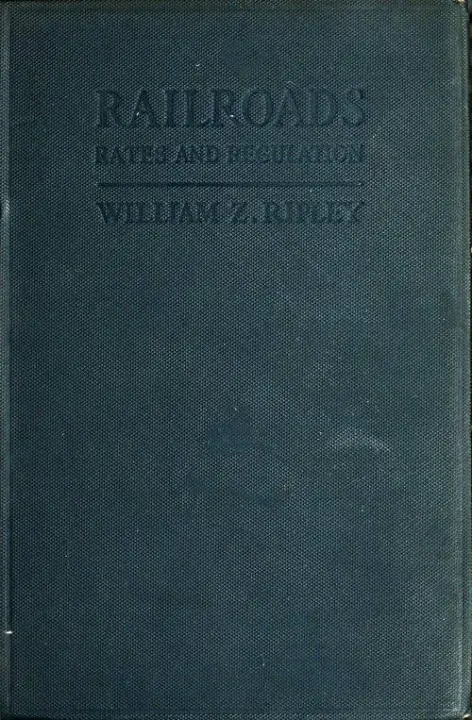
"Railroads: Rates and Regulations" by William Zebina Ripley is a scientific publication written in the early 20th century. This work serves as a treatise on the economics and regulation of railroads in the United States, exploring the extensive history of railroad transportation and its implications for commerce and society. The author examines the various factors that have influenced the construction, financing, and operational standards of railroads, as well as the political and social environment that shaped their development. The opening portion of the publication presents a detailed history of transportation in the United States, charting the evolution from early canals and toll roads to the advent of railroads. Ripley discusses the impact of geographical factors on transportation development, emphasizing how these elements fostered interaction between regions and necessitated advancements in transportation methods. He outlines significant milestones in railroad construction, governmental influences, and the increasing importance of railroads as fundamental elements of American commerce, setting the stage for a broader analysis of rates and regulations in subsequent chapters.
Introduction adapted from the source catalogue; source summaries may be automatically generated.
Free to read · English · 216,074 words · No account needed
MAKE TIME FOR A GOOD BOOK
On by default. Untick to stop anonymous reading totals. Each page counts after 10 seconds in view. How this works.
Anonymous counting is on unless you have switched it off.
Whether the "commodity clause" is to bring about a further separation of transportation from activities of carriers in other lines of business remains to be seen. It was doubtless intended to have a general application. Some roads, other than those in the anthracite coal fields, have taken steps to set off their subsidiary concerns. The Louisville & Nashville, for example, has distributed among its stockholders all the shares of the Louisville Properties Company. This is a Kentucky corporation to which the railroad had transferred its holdings of coal and other lands. It was expected at the time that its capital stock of $600,000 would be worth par. The Union Pacific has done even better. It voluntarily reconveyed to the United States considerable tracts of coal lands, where title had been called in question in the course of investigations as to such railroad ownership. While there has been no sign of the Pennsylvania Railroad disposing of its investments in the Cambria and Pennsylvania Steel Companies, made prior to 1906, it is clear that the interdiction of the law will render any further outside operations of this sort difficult if not impossible.
[629] Cf. the record for 1898-1900 at p. 486, supra.
[630] Annual Report I.C.C., 1909, p. 11.
[631] P. 324, supra.
[632] 16 I.C.C. Rep., 276, is a typical instance of voluntary correction of a maladjustment of rates, as soon as attention was officially called to it. Also, 21 Idem where several railroads being unable to agree upon the classification of live and dead locomotives, appeal to the Commission to decide the matter.
[633] L. G. McPherson, Railroad Freight Rates, 1909, pp. 275-300, examines these topically, but without individual detail.
[634] 12 I.C.C. Rep., 626.
[635] Cf. p. 325, infra, on classification.
[636] 14 I.C.C. Rep., 561. Another case of this sort decided for the railroad is in 15 I.C.C. Rep., 160.
[637] 15 I.C.C. Rep., 301.
[638] 21st Annual Report, I.C.C., p. 71: 12 I.C.C. Rep., 326.
[639] 86 Fed. Rep., 407.
[640] 21 I.C.C. Rep., 651; is an odd instance of a broken deadlock between carriers as to furnishing equipment for completing a shipment.
[641] 15 I.C.C. Rep., 160. Cf. p. 538, infra.
[642] 12 I.C.C. Rep., 21, and 23 Idem, 263.
[643] 14 I. C. C. Rep., 51.
[644] 15 I. C. C. Rep., 491.
[645] 16 I.C.C. Rep., 523.
[646] 15 I.C.C. Rep., 551.
[647] 16 I.C.C. Rep., 41.
[648] 12 I.C.C. Rep., 307.
[649] 15 I.C.C. Rep., 370.
[650] 15 I.C.C. Rep., 7.
[651] 15 I.C.C. Rep., 280.
[652] 13 I.C.C. Rep., 620.
[653] 13 I.C.C. Rep., 651.
[654] 14 I.C.C. Rep., 154.
[655] Economic Review, 1911, pp. 766-789, reviews this whole movement.
[656] 15 I.C.C. Rep., 79.
[657] 219 U. S., 433: Cf. p. 545, infra.
[658] Much data is in U. S. v. Union Pacific, etc., Supreme Court, No. 820, Oct. term, 1911, Appellants Brief of Facts, p. 558 et seq.
Your reading position is saved on this browser. Take it to another device with a library code. Reading pages adapt to text, rather than matching a printed edition.
BEHIND THE BOOK
This eBook is for the use of anyone anywhere in the United States and most other parts of the world at no cost and with almost no restrictions whatsoever. You may copy it, give it away or re-use it under the terms of the Project Gutenberg License included with this eBook or online at www.gutenberg.org. If you are not located in the United States, you will have to check the laws of the country where you are located before using this eBook. Read the source licence.
The original source file, including credits and licence, is retained by this library. Request an original-format copy at no charge. Please include the book title and Project Gutenberg identifier #47831.
KEEP YOUR CURIOSITY GOING
Cécile Tormay

Moritz Busch
John L. Ransom
Frances Wright
Cécile Tormay

Mabel Potter Daggett