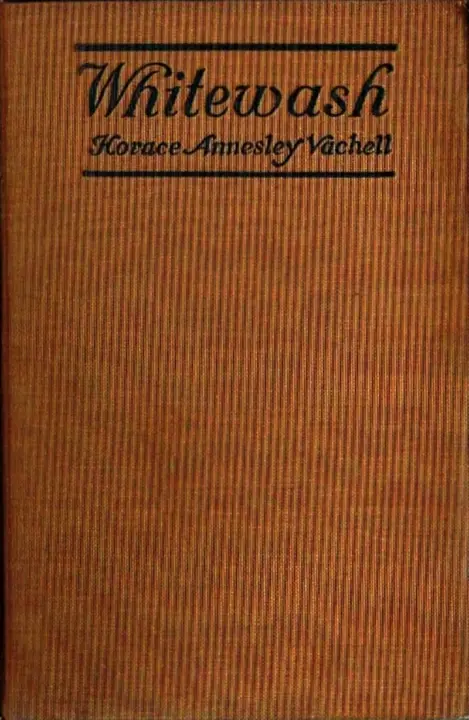
Whitewash
Horace Annesley Vachell
THE CLASSIC COLLECTION · 1900
"Quinneys’" by Horace Annesley Vachell is a novel written in the early 20th century. The story focuses on Joe Quinney, a young man who has recently inherited his father's antique shop and is stepping into his new role with a mix of exuberance and ambition. The narrative explores Joe's transformation as he navigates his newfound independence, relationships, and ambitions while grappling with the complexities of love and business. The opening of the novel introduces Joe Quinney as he reflects on his father's death and the newfound freedom that comes with it. As he returns home from the funeral, he is met with the implications of his inheritance and the potential it holds. The reader witnesses his inner conflict between the weight of family expectations and his desire to carve out his own identity in the antiques business. Interactions with local townsfolk illustrate the community's perception of Joe, while his budding romance with Susan Biddlecombe and their secret engagement adds a layer of personal stakes to Joe's journey. The vivid depiction of the world around him, along with his thoughts and aspirations, sets the stage for the character's growth and the challenges that lie ahead.
Introduction adapted from the source catalogue; source summaries may be automatically generated.
Free to read · English · 70,005 words · No account needed
MAKE TIME FOR A GOOD BOOK
On by default. Untick to stop anonymous reading totals. Each page counts after 10 seconds in view. How this works.
Anonymous counting is on unless you have switched it off.
Quinney supped simply at seven, and then he walked across the Cathedral Close, down a small street, known as Laburnum Row, and knocked at the door of a genteel, semi-detached cottage. The very respectable woman who opened the door drew down the corners of a pleasant mouth when she beheld the visitor. A note of melancholy informed her voice as she greeted him, but her sharp, brown eyes sparkled joyously as she said:
"Never expected to see you this evening, Mr. Quinney."
"I'm tired of doing the things that are expected," was the surprising reply. Then, with a flush, he blurted out, "Susan in?"
"Yes," said Mrs. Biddlecombe, leading the way into the parlour. "The
child's upstairs."
Mother and daughter had seen Quinney approaching, whereupon Mrs. Biddlecombe had remarked, "It's all right. You smooth your hair, dear, and slip on your blue gown."
Meanwhile, Quinney took the most comfortable chair, and stared with appraising eye at the furniture. Above the mantelpiece hung the portrait in water-colour of a handsome woman, obviously a lady, as the word was interpreted by the grandmothers of the present generation. This was Mrs. Biddlecombe's mother, the wife of a doctor, who had been bear-leader to a sprig of nobility, accomplishing with him the Grand Tour. In her turn, Mrs. Biddlecombe had married a medical gentleman (her word), who, unhappily, was called from the exercise of his profession in a promising suburb to a place invariably designated by Mrs. Biddlecombe as his last home. Later, the widow, left in very humble circumstances, had married beneath her rightful station in life a certain George Biddlecombe, a small builder and contractor, of Melchester, who, failing in business when Susan was some five years old, had died of disgust. Since this second bereavement, Mrs. Biddlecombe supported herself and her daughter by taking in lodgers, cleaning lace and fancy work. She was a stout, energetic creature, not much the worse for the wear and tear of a never-ending struggle to raise herself to the position which she had adorned before her second disastrous marriage.
"The funeral was well attended," she remarked.
"The old man was hardly what one might call popular," replied Quinney.
"He'll be missed in Melchester."
"Missed, but not regretted," the son replied grimly.
"Ah!" murmured Mrs. Biddlecombe, thinking of the builder and contractor.
Quinney pulled himself together, sitting upright in the arm-chair and
speaking firmly.
"I ain't here to talk about him. Less said on that subject the better. I'm my own master now, ma'am, able to please myself. Lord! How he hated my coming here!"
"I know, I know!"
Your reading position is saved on this browser. Take it to another device with a library code. Reading pages adapt to text, rather than matching a printed edition.
Horace Annesley Vachell
Horace Annesley Vachell
Horace Annesley Vachell
Horace Annesley Vachell
BEHIND THE BOOK
This eBook is for the use of anyone anywhere in the United States and most other parts of the world at no cost and with almost no restrictions whatsoever. You may copy it, give it away or re-use it under the terms of the Project Gutenberg License included with this eBook or online at www.gutenberg.org. If you are not located in the United States, you will have to check the laws of the country where you are located before using this eBook. Read the source licence.
The original source file, including credits and licence, is retained by this library. Request an original-format copy at no charge. Please include the book title and Project Gutenberg identifier #50596.
KEEP YOUR CURIOSITY GOING
Coulson Kernahan

Maurice Baring
Frances Wright
Cécile Tormay

Frederic Jesup Stimson

W. H. P. (William Henry Pope) Jarvis