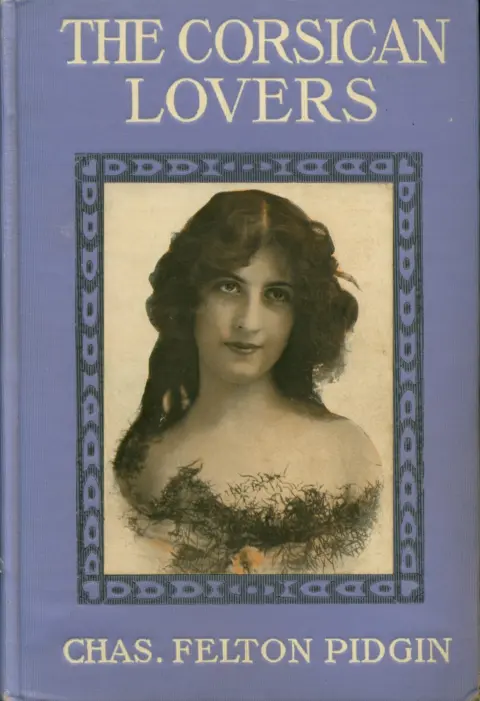
The Corsican Lovers
Charles Felton Pidgin
THE CLASSIC COLLECTION · 1904
"Quincy Adams Sawyer and Mason's Corner Folks" by Charles Felton Pidgin is a novel written in the early 20th century. It paints a vivid picture of New England home life through the eyes of its characters, notably Quincy Adams Sawyer, a young man from the city who arrives in the quaint village of Mason's Corner. The story weaves together themes of community, local gossip, and the contrast between urban sophistication and rural charm. The opening of the novel introduces readers to a festive atmosphere on New Year's Eve in Mason's Corner, where the local singing society gathers for their last rehearsal before a concert. The main character, Quincy Adams Sawyer, is introduced alongside other notable villagers, each with their own quirks and relationships. As the townspeople anticipate the arrival of their new boarder and the intertwining of lives, the narrative sets up a blend of humor and social commentary, focusing on Quincy’s interactions with the locals and the budding dynamics of attraction and rivalry, particularly concerning the Deacon's daughter, Huldy Ann. This rich characterization and vibrant setting promise an engaging exploration of small-town life.
Introduction adapted from the source catalogue; source summaries may be automatically generated.
Free to read · English · 148,422 words · No account needed
MAKE TIME FOR A GOOD BOOK
On by default. Untick to stop anonymous reading totals. Each page counts after 10 seconds in view. How this works.
Anonymous counting is on unless you have switched it off.
"If she will come, I will," Quincy replied.
"You will never repent it," said Aunt Ella. "Now let us go upstairs."
When they reached her room the cigars and cigarettes were again in
requisition.
"I kept my promise the other day, Quincy," said she, "when the three girls were here. What a sweet, rosy-cheeked, healthy, happy trio they were! I wasn't more than twenty myself that day. I give you my solemn promise, Quincy, that I won't smoke a cigarette nor drink a glass of wine while Alice is here,--until after she goes to bed; and then I'll eat a clove and air the room out thoroughly before I let her in in the morning."
Quincy was up early next morning, and at ten minutes of nine reached the lodging house in Myrtle Street. He had taken a carriage, for he knew Miss Very would have her luggage, probably a trunk. His call at the door was answered by a sharp-eyed, hatchet-faced woman, whose face was red with excitement. To Quincy's inquiry if Miss Very was in, the woman replied, "that she was in and was likely to stay in."
"I trust she is not sick," said Quincy.
"No! she ain't sick," the woman replied, "what you mean by sick; but there's worse things than bein' sick, especially when a poor widder has a big house rent to pay and coal seven dollars and a half a ton."
A small trunk, neatly strapped, stood in the hallway. Glancing into the stuffy little parlor, he saw a woman, apparently young, with her veil down, seated on a sofa, with a large valise on the floor and a hand bag at her side.
Quincy divined the situation at once. Stepping into the hallway, he closed the parlor door, and, turning to the woman, said, "How much?"
"Three dollars," replied the woman, "and it's cheap enough for--"
"A miserable little dark stuffy side room, without any heat, up three flights, back," broke in Quincy, as he passed her the money.
The woman was breathless with astonishment and anger. Taking advantage of this, Quincy opened the parlor door, first beckoning to the coachman to come in and get the trunk.
"Miss Very, I presume?" said Quincy, as he advanced towards the young
lady on the sofa.
She arose as he approached, and answered, "Yes, sir."
"Come with me, please," said he, grasping the valise. She hesitated; he understood why. "It's all right," he said, in a low tone. "I've settled with the landlady, and you can settle with me any time."
Your reading position is saved on this browser. Take it to another device with a library code. Reading pages adapt to text, rather than matching a printed edition.
Charles Felton Pidgin
BEHIND THE BOOK
This eBook is for the use of anyone anywhere in the United States and most other parts of the world at no cost and with almost no restrictions whatsoever. You may copy it, give it away or re-use it under the terms of the Project Gutenberg License included with this eBook or online at www.gutenberg.org. If you are not located in the United States, you will have to check the laws of the country where you are located before using this eBook. Read the source licence.
The original source file, including credits and licence, is retained by this library. Request an original-format copy at no charge. Please include the book title and Project Gutenberg identifier #16414.
KEEP YOUR CURIOSITY GOING
Coulson Kernahan

Maurice Baring
Frances Wright
Cécile Tormay

Frederic Jesup Stimson

W. H. P. (William Henry Pope) Jarvis