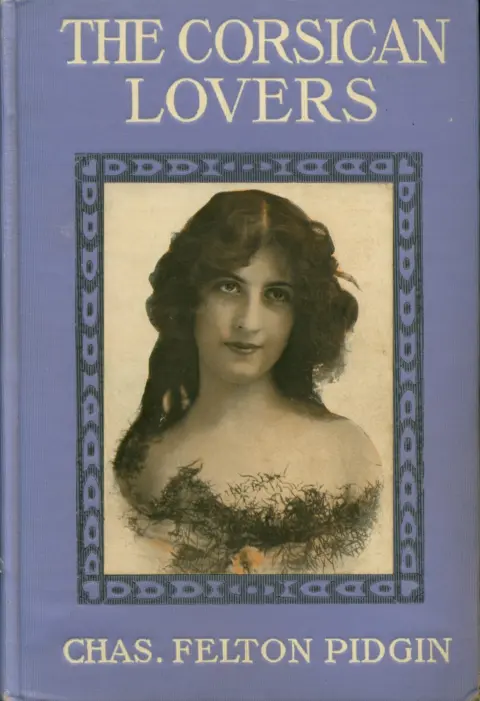
The Corsican Lovers
Charles Felton Pidgin
THE CLASSIC COLLECTION · 1904
"Quincy Adams Sawyer and Mason's Corner Folks" by Charles Felton Pidgin is a novel written in the early 20th century. It paints a vivid picture of New England home life through the eyes of its characters, notably Quincy Adams Sawyer, a young man from the city who arrives in the quaint village of Mason's Corner. The story weaves together themes of community, local gossip, and the contrast between urban sophistication and rural charm. The opening of the novel introduces readers to a festive atmosphere on New Year's Eve in Mason's Corner, where the local singing society gathers for their last rehearsal before a concert. The main character, Quincy Adams Sawyer, is introduced alongside other notable villagers, each with their own quirks and relationships. As the townspeople anticipate the arrival of their new boarder and the intertwining of lives, the narrative sets up a blend of humor and social commentary, focusing on Quincy’s interactions with the locals and the budding dynamics of attraction and rivalry, particularly concerning the Deacon's daughter, Huldy Ann. This rich characterization and vibrant setting promise an engaging exploration of small-town life.
Introduction adapted from the source catalogue; source summaries may be automatically generated.
Free to read · English · 148,422 words · No account needed
MAKE TIME FOR A GOOD BOOK
On by default. Untick to stop anonymous reading totals. Each page counts after 10 seconds in view. How this works.
Anonymous counting is on unless you have switched it off.
Mrs. Hawkins waited patiently until eight o'clock for the gentleman from Boston to come down to breakfast. She then waited impatiently from eight o'clock till nine. During that time she put the breakfast on the stove to keep it warm, and also made several trips to the front entry, where she listened to see if she could hear any signs of movement on the part of her new boarder.
When nine o'clock arrived she could restrain her impatience no longer,
and, going upstairs, she gave a sharp knock on the door of Quincy's
room.
"What is it?" answered a voice, somewhat sharply.
"It's nine o'clock, and your breakfast's most dried up," replied Mrs.
Hawkins.
"I don't wish for any breakfast," said the voice within the room, but in a much pleasanter tone. "What time do you have dinner?"
"Twelve o'clock," said Mrs. Hawkins.
"All right," answered the voice, cheerfully. "I'll take my breakfast and
dinner together."
"That beats all," said Mrs. Hawkins, as she entered the kitchen.
"What beats all?" asked Betsy Green, who worked for Mrs. Hawkins.
"It beats all," repeated Mrs. Hawkins, "how these city folks can sit up till twelve o'clock at night, and then go without their breakfast till noontime. I've fixed up somethin' pretty nice for him, and I don't propose to see it wasted."
"What are you goin' to do with it?" asked Betsy. "'Twon't keep till
to-morrer mornin'."
"I'm goin' to eat it myself," said Mrs. Hawkins. And suiting the action to the word, she transferred the appetizing breakfast to the kitchen table, and, taking a seat, began to devour it.
"Have you seen your sister, Samanthy, lately?" she asked.
"I was up there Sunday evening," replied Betsy, "and she said Mis' Putnam was failin' very fast. She keeps her bed all the time now, and Samanthy has to run up and down stairs, 'bout forty times a day. She won't let Miss Lindy do a thing for her."
"Well, if I was Lindy," said Mrs. Hawkins, "I wouldn't do anything for her if she wanted me to. She used to abuse that child shamefully. Is Miss Lindy goin' to keep house arter her mother dies?"
"No," said Betsy, "she's got her things all packed up, and she told Samanthy she should leave town for well and good as soon as her mother was buried."
"I don't blame her," exclaimed Mrs. Hawkins. "Where's Samanthy goin'?"
"Oh, she says she wants to rest awhile afore she goes anywheres else to live. She's all run down."
"P'r'aps she'll go and stay with yer mother for a while."
"No," said Betsy, "she won't go there."
"Ain't yer mother 'n' her on good terms?"
Your reading position is saved on this browser. Take it to another device with a library code. Reading pages adapt to text, rather than matching a printed edition.
Charles Felton Pidgin
BEHIND THE BOOK
This eBook is for the use of anyone anywhere in the United States and most other parts of the world at no cost and with almost no restrictions whatsoever. You may copy it, give it away or re-use it under the terms of the Project Gutenberg License included with this eBook or online at www.gutenberg.org. If you are not located in the United States, you will have to check the laws of the country where you are located before using this eBook. Read the source licence.
The original source file, including credits and licence, is retained by this library. Request an original-format copy at no charge. Please include the book title and Project Gutenberg identifier #16414.
KEEP YOUR CURIOSITY GOING
Coulson Kernahan

Maurice Baring
Frances Wright
Cécile Tormay

Frederic Jesup Stimson

W. H. P. (William Henry Pope) Jarvis