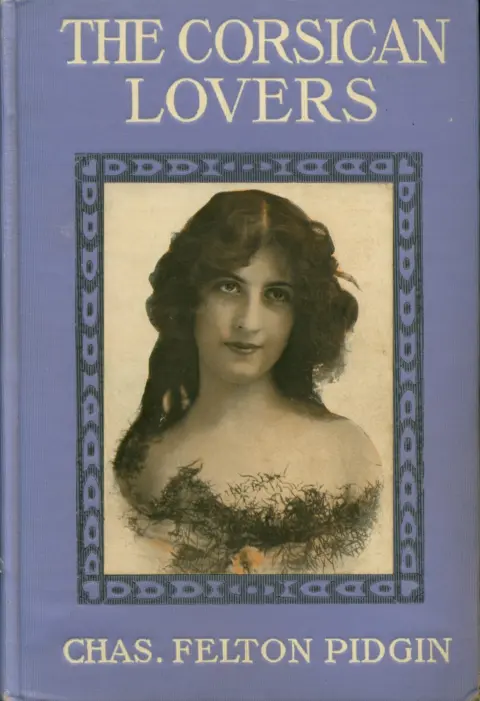
The Corsican Lovers
Charles Felton Pidgin
THE CLASSIC COLLECTION · 1904
"Quincy Adams Sawyer and Mason's Corner Folks" by Charles Felton Pidgin is a novel written in the early 20th century. It paints a vivid picture of New England home life through the eyes of its characters, notably Quincy Adams Sawyer, a young man from the city who arrives in the quaint village of Mason's Corner. The story weaves together themes of community, local gossip, and the contrast between urban sophistication and rural charm. The opening of the novel introduces readers to a festive atmosphere on New Year's Eve in Mason's Corner, where the local singing society gathers for their last rehearsal before a concert. The main character, Quincy Adams Sawyer, is introduced alongside other notable villagers, each with their own quirks and relationships. As the townspeople anticipate the arrival of their new boarder and the intertwining of lives, the narrative sets up a blend of humor and social commentary, focusing on Quincy’s interactions with the locals and the budding dynamics of attraction and rivalry, particularly concerning the Deacon's daughter, Huldy Ann. This rich characterization and vibrant setting promise an engaging exploration of small-town life.
Introduction adapted from the source catalogue; source summaries may be automatically generated.
Free to read · English · 148,422 words · No account needed
MAKE TIME FOR A GOOD BOOK
On by default. Untick to stop anonymous reading totals. Each page counts after 10 seconds in view. How this works.
Anonymous counting is on unless you have switched it off.
A peal of laughter greeted this sally, which rose to a shout when Strout took his souvenir out of the box. It proved to be a large sugar bee, very lifelike in appearance and having a little wad of paper rolled up and tucked under one of the wings.
As Strout spread out the slip of paper with his fingers, loud cries of "Eat it!" "Read it!" and "Pass it along!" came from the company. The Professor stood apparently undecided what course to pursue, when Tilly James, who was standing at his left, grabbed it from his fingers, and running to the end of the table, stood beside young Hill with an expression that seemed to say, "This is my young man, and I know he will protect me."
Loud cries of "Read it, Tilly!" came from all parts of the table.
"Not unless Professor Strout is willing," said Tilly with mock humility.
All eyes were turned upon Strout, who, seeing that he had nothing to gain by objecting, cried out, "Oh, go ahead; what do I care about such nonsense!"
Tilly then read with much dramatic expression the following poetical
effusion:
"How does the wicked bumblebee
Employ the shining hours,
In stinging folks that he dislikes,
Instead of sipping flowers."
Another loud laugh greeted this; largely due to the comical expression on Tilly James's face, which so far upset Quincy's habitual gravity that he was obliged to smile in spite of himself.
If Strout felt the shot he did not betray it, but turned to Huldy, who stood at his right, and said, "Now, Miss Mason, let me read your poetry for you, as they do it in the city."
Huldy hesitated, holding the slip of paper between her fingers, "Oh! that ain't fair," said Strout. "I've set you a good example, now you mustn't squeal. Come, walk right up to the trough."
"I'm no pig," protested Huldy.
As Strout leaned over to take the paper he said in an undertone, "No, you are a little dear;" whereat Huldy's face flushed a bright crimson.
Strout cleared his voice and then read:
"Come wreathe your face with smiles, my dear,
A husband you'll find within the year."
This was greeted with laughter, clapping of hands, and cries of "Who is
it, Huldy?"
The Professor looked at Huldy inquiringly, but she averted her eyes. He leaned over and said in an undertone, "May I keep this?"
Huldy looked up and said in a tone that was heard by every one at the table, "I don't care; if you like it better than that one about the bumblebee you can have it."
Your reading position is saved on this browser. Take it to another device with a library code. Reading pages adapt to text, rather than matching a printed edition.
Charles Felton Pidgin
BEHIND THE BOOK
This eBook is for the use of anyone anywhere in the United States and most other parts of the world at no cost and with almost no restrictions whatsoever. You may copy it, give it away or re-use it under the terms of the Project Gutenberg License included with this eBook or online at www.gutenberg.org. If you are not located in the United States, you will have to check the laws of the country where you are located before using this eBook. Read the source licence.
The original source file, including credits and licence, is retained by this library. Request an original-format copy at no charge. Please include the book title and Project Gutenberg identifier #16414.
KEEP YOUR CURIOSITY GOING
Coulson Kernahan

Maurice Baring
Frances Wright
Cécile Tormay

Frederic Jesup Stimson

W. H. P. (William Henry Pope) Jarvis