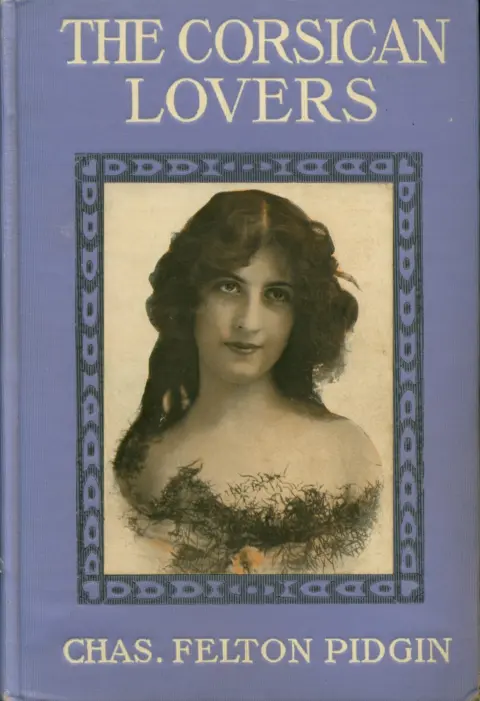
The Corsican Lovers
Charles Felton Pidgin
THE CLASSIC COLLECTION · 1904
"Quincy Adams Sawyer and Mason's Corner Folks" by Charles Felton Pidgin is a novel written in the early 20th century. It paints a vivid picture of New England home life through the eyes of its characters, notably Quincy Adams Sawyer, a young man from the city who arrives in the quaint village of Mason's Corner. The story weaves together themes of community, local gossip, and the contrast between urban sophistication and rural charm. The opening of the novel introduces readers to a festive atmosphere on New Year's Eve in Mason's Corner, where the local singing society gathers for their last rehearsal before a concert. The main character, Quincy Adams Sawyer, is introduced alongside other notable villagers, each with their own quirks and relationships. As the townspeople anticipate the arrival of their new boarder and the intertwining of lives, the narrative sets up a blend of humor and social commentary, focusing on Quincy’s interactions with the locals and the budding dynamics of attraction and rivalry, particularly concerning the Deacon's daughter, Huldy Ann. This rich characterization and vibrant setting promise an engaging exploration of small-town life.
Introduction adapted from the source catalogue; source summaries may be automatically generated.
Free to read · English · 148,422 words · No account needed
MAKE TIME FOR A GOOD BOOK
On by default. Untick to stop anonymous reading totals. Each page counts after 10 seconds in view. How this works.
Anonymous counting is on unless you have switched it off.
"Yes," she answered, as she passed a written sheet to him; "I wrote them before my eyes failed me. Perhaps you will find it hard to read them. Which one is that?" she asked.
"It is headed, 'On the Banks of the Tallahassee,'" replied Quincy.
"Oh!" cried Alice, "I didn't write that song myself. A gentleman friend, who is now dead, was the author of it. But he couldn't write a chorus and he asked me to do it for him. The idea of the chorus is moonlight on the river."
"Shall I read it?" asked Quincy.
"Only the chorus part, if you please," replied Alice, "and be as lenient as you can, good Mr. Judge, for that was my first offence."
Quincy, in a smooth, even voice, read the following words:
The moon's bright rays,
In a silver maze,
Fall on the rushing river;
Each ray of light
Like an arrow white
Drawn from a crystal quiver.
They romp and play,
In a wond'rous way,
On tree and shrub and flower;
And fill the night
With a radiant light,
That falls like a silver shower.
"You do not say anything," said Alice, as Quincy finished reading and
remained silent.
He replied, "You have conferred judicial functions upon me and a judge does not give his opinion until the evidence is all in."
"Ah! I see," said Alice. "My knowledge of metrical composition," she continued, "is very limited. What I know of it I learned from an old copy of Fowler's Grammar that I bought at Burnham's on School Street soon after I went to Boston. I have always called what you just read a poem. Is it one?" she asked, looking up with a smile.
"I think it is," replied Quincy, "and," he added inadvertently, "a very
pretty one, too."
"Oh! Mr. Judge," laughing outright "you have given aid and comfort to the prisoner before the evidence was all in."
And Quincy was forced to laugh heartily at the acuteness she had shown in forcing his opinion from him prematurely."
"Now, this one," said Alice, "I call a song. I know which one it is by the size and thickness of the paper." And she handed him a foolscap sheet.
Quincy took it and glanced over it a moment or two before he spoke, Alice leaning forward and listening intently for the first sound of his voice. Then Quincy uttered those ever pleasing words, "Sweet, Sweet Home," and delivered, with great expression, the words of the song.
"You read it splendidly," cried Alice, with evident delight. "Would it be presuming on your kindness if I asked you to read the refrain and chorus once more, Mr. Sawyer?"
Your reading position is saved on this browser. Take it to another device with a library code. Reading pages adapt to text, rather than matching a printed edition.
Charles Felton Pidgin
BEHIND THE BOOK
This eBook is for the use of anyone anywhere in the United States and most other parts of the world at no cost and with almost no restrictions whatsoever. You may copy it, give it away or re-use it under the terms of the Project Gutenberg License included with this eBook or online at www.gutenberg.org. If you are not located in the United States, you will have to check the laws of the country where you are located before using this eBook. Read the source licence.
The original source file, including credits and licence, is retained by this library. Request an original-format copy at no charge. Please include the book title and Project Gutenberg identifier #16414.
KEEP YOUR CURIOSITY GOING
Coulson Kernahan

Maurice Baring
Frances Wright
Cécile Tormay

Frederic Jesup Stimson

W. H. P. (William Henry Pope) Jarvis