THE CLASSIC COLLECTION✦The haunts of menCLASSIC FREE BOOKS
The haunts of men
Robert W. (Robert William) Chambers
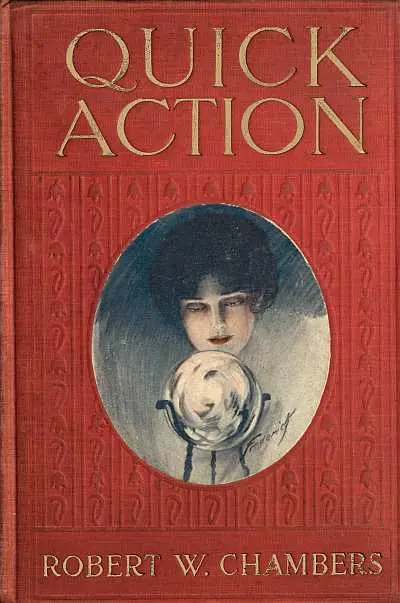
THE CLASSIC COLLECTION · 1914
"Quick Action" by Robert W. Chambers is a novel written in the early 20th century. The story is set against a backdrop of urban sophistication and intrigue, centering on Countess Athalie, who possesses an unusual gift for clairvoyance connected to a mysterious crystal sphere. The opening chapters introduce a gathering of notable characters amidst a blend of light-hearted dialogue and enchanting mystical elements, foreshadowing themes of love, identity, and personal freedom. At the start of the novel, we find ourselves in Countess Athalie's sky-drawing-room, illuminated only by the soft glow of her crystal sphere while a group of intriguing men engage in playful banter and card tricks. Athalie, with a dreamy disposition, casually reveals her clairvoyant abilities, hinting at deeper truths about her life and connections. As the conversation flows, we glimpse her perspective on love and fate, contrasting it with the straightforward, almost comedic interest of the other characters. The narrative unfolds to hint at Athalie's tumultuous past, intertwining with the budding romantic tension between her and the ambitious Delancy Jones, each character embodying desires for quick action and meaningful connections in a world that often seems indifferent to their feelings. The initial setup promises a compelling exploration of relationships intertwined with the allure of mysticism, making it a fascinating read for lovers of early 20th-century romance.
Introduction adapted from the source catalogue; source summaries may be automatically generated.
Free to read · English · 55,643 words · No account needed
MAKE TIME FOR A GOOD BOOK
On by default. Untick to stop anonymous reading totals. Each page counts after 10 seconds in view. How this works.
Anonymous counting is on unless you have switched it off.
That night at dinner he looked for the girl in vain. She did not enter the dining-car while he was there. Haunting the corridors afterward he saw no sign of her anywhere until, having received his necessaries in a brand new travelling satchel, and on his way to his stateroom, he caught a glimpse of her, pale and agitated, in conversation with the porter at her partly opened door.
She did not even glance at him as he entered his stateroom, but he could not avoid hearing what she was saying because her enunciation was so exquisitely distinct.
"Porter," she said in her low, sweet voice, "I have, somehow, made a very dreadful mistake somewhere. I have a man's overcoat here which does not belong to me. The cloth is exactly like the cloth of my own travelling ulster, and I must have forgotten that I had mine on when I took this."
"Ain't de gemman abohd de Speshul, Miss?" inquired the porter.
"I'm afraid not. I'm certain that I must have taken it in the station restaurant and brought it aboard the train."
"Ain't nuff'n in de pockets, is dey?" asked the porter.
"Yes; there's a wallet strapped with a rubber band. I didn't feel at liberty to open it. But I suppose I ought to in order to find out the owner's name if possible."
"De gemman's name ain't sewed inside de pocket, is it, Miss?"
"I didn't look," she said.
So the porter took the coat, turned it inside out, explored the inside pocket, found the label, and read:
"Snipps Brothers: December, 1913. George Z. Green."
A stifled exclamation from the girl checked him. Green also protruded his head cautiously from his own doorway.
The girl, standing partly in the aisle, was now leaning limply against the door-sill, her hand pressed convulsively to her breast, her face white and frightened.
"Is you ill, Miss?" asked the porter anxiously.
"I--no. Z--what name was that you read?"
"George Z. Green, Miss----"
"It--it can't be! Look again! It can't be!"
Her face was ashen to the lips; she closed her eyes for a second, swayed; then her hand clutched the door-sill; she straightened up with an effort and opened her eyes, which now seemed dilated by some powerful emotion.
"Let me see that name!" she said, controlling her voice with an obvious
effort.
The porter turned the pocket inside out for her inspection. There it
was:
"George Z. Green: 1008-1/2 Fifth Avenue, New York."
"If you knows de gemman, Miss," suggested the porter, "you all kin take dishere garmint back yo'se'f when you comes No'th."
"Thank you.... Then--I won't trouble you.... I'll--I'll ta-t-take it back myself--when I go North."
Your reading position is saved on this browser. Take it to another device with a library code. Reading pages adapt to text, rather than matching a printed edition.
Robert W. (Robert William) Chambers
Robert W. (Robert William) Chambers
Robert W. (Robert William) Chambers
Robert W. (Robert William) Chambers
BEHIND THE BOOK
This eBook is for the use of anyone anywhere in the United States and most other parts of the world at no cost and with almost no restrictions whatsoever. You may copy it, give it away or re-use it under the terms of the Project Gutenberg License included with this eBook or online at www.gutenberg.org. If you are not located in the United States, you will have to check the laws of the country where you are located before using this eBook. Read the source licence.
The original source file, including credits and licence, is retained by this library. Request an original-format copy at no charge. Please include the book title and Project Gutenberg identifier #37528.
KEEP YOUR CURIOSITY GOING
Coulson Kernahan

Maurice Baring
Frances Wright
Cécile Tormay

Frederic Jesup Stimson

W. H. P. (William Henry Pope) Jarvis