THE CLASSIC COLLECTION✦The haunts of menCLASSIC FREE BOOKS
The haunts of men
Robert W. (Robert William) Chambers
THE CLASSIC COLLECTION · 1914
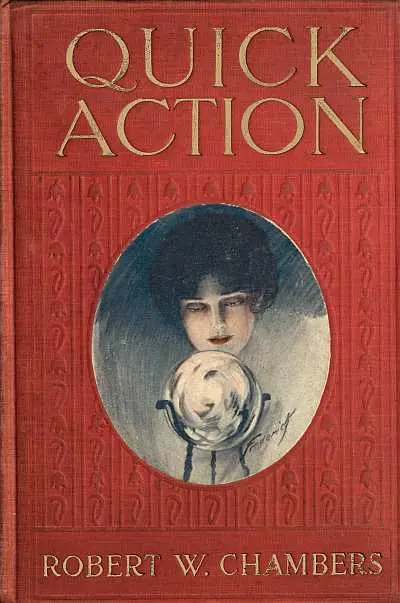
"Quick Action" by Robert W. Chambers is a novel written in the early 20th century. The story is set against a backdrop of urban sophistication and intrigue, centering on Countess Athalie, who possesses an unusual gift for clairvoyance connected to a mysterious crystal sphere. The opening chapters introduce a gathering of notable characters amidst a blend of light-hearted dialogue and enchanting mystical elements, foreshadowing themes of love, identity, and personal freedom. At the start of the novel, we find ourselves in Countess Athalie's sky-drawing-room, illuminated only by the soft glow of her crystal sphere while a group of intriguing men engage in playful banter and card tricks. Athalie, with a dreamy disposition, casually reveals her clairvoyant abilities, hinting at deeper truths about her life and connections. As the conversation flows, we glimpse her perspective on love and fate, contrasting it with the straightforward, almost comedic interest of the other characters. The narrative unfolds to hint at Athalie's tumultuous past, intertwining with the budding romantic tension between her and the ambitious Delancy Jones, each character embodying desires for quick action and meaningful connections in a world that often seems indifferent to their feelings. The initial setup promises a compelling exploration of relationships intertwined with the allure of mysticism, making it a fascinating read for lovers of early 20th-century romance.
Introduction adapted from the source catalogue; source summaries may be automatically generated.
Free to read · English · 55,643 words · No account needed
MAKE TIME FOR A GOOD BOOK
On by default. Untick to stop anonymous reading totals. Each page counts after 10 seconds in view. How this works.
Anonymous counting is on unless you have switched it off.
In the haze over bay and river enough rose and purple remained to veil the awakening glitter of the monstrous city sprawling supine between river, sound, and sea. And its incessant monotone pulsated, groaning, dying, ceaseless, interminable in the light-shot depths of its darkening streets.
The sky-drawing-room windows of the Countess Athalie were all wide open, but the only light in the room came from a crystal sphere poised on a tripod. It had the quality and lustre of moon-light, and we had never been able to find out its source, for no electric wires were visible, and one could move the tripod about the room.
The crystal sphere itself appeared to be luminous, yet it remained
perfectly transparent, whatever the source of its silvery
phosphorescence.
At any rate, it was the only light in the room except the dulled glimmer of our cigarettes, and its mild, mysterious light enabled us to see one another as through a glass darkly.
There were a number of men there that evening. I don't remember, now, who they all were. Some had dined early; others, during the evening, strolled away into the city to dine somewhere or other, drifting back afterward for coffee and sweetmeats and cigarettes in the sky-drawing-room of the Countess Athalie.
As usual the girl was curled up by the open window among her silken cushions, one smooth little gem-laden hand playing with the green jade god, her still dark eyes, which slanted a little, fixed dreamily upon infinite distance--or so it always seemed to us.
Through the rusty and corrugated arabesques of the iron balcony she could see, if she chose, the yellow flare where Sixth Avenue crossed the shabby street to the eastward. Beyond that, and parallel, a brighter glow marked Broadway. Further east street lamps stretched away into converging perspective, which vanished to a point in the faint nebular radiance above the East River.
All this the Countess Athalie could see if she chose. Perhaps she did see it. We never seemed to know just what she was looking at even when she turned her dark eyes on us or on her crystal sphere cradled upon its slender tripod.
But the sphere seemed to understand, for sometimes, under her still gaze, it clouded magnificently like a black opal--another thing we never understood, and therefore made light of.
"They have placed policemen before several houses on this street," remarked the Countess Athalie.
Stafford, tall and slim in his evening dress, relieved her of her coffee
cup.
"Has anybody bothered you?" he asked.
"Not yet."
Young Duane picked up a pack of cards at his elbow and shuffled them,
languidly.
"Where is the Ace of Diamonds, Athalie?" he asked.
Your reading position is saved on this browser. Take it to another device with a library code. Reading pages adapt to text, rather than matching a printed edition.
Robert W. (Robert William) Chambers
Robert W. (Robert William) Chambers

Robert W. (Robert William) Chambers
Robert W. (Robert William) Chambers
BEHIND THE BOOK
This eBook is for the use of anyone anywhere in the United States and most other parts of the world at no cost and with almost no restrictions whatsoever. You may copy it, give it away or re-use it under the terms of the Project Gutenberg License included with this eBook or online at www.gutenberg.org. If you are not located in the United States, you will have to check the laws of the country where you are located before using this eBook. Read the source licence.
The original source file, including credits and licence, is retained by this library. Request an original-format copy at no charge. Please include the book title and Project Gutenberg identifier #37528.
KEEP YOUR CURIOSITY GOING
Coulson Kernahan

Maurice Baring
Frances Wright
Cécile Tormay

Frederic Jesup Stimson

W. H. P. (William Henry Pope) Jarvis