THE CLASSIC COLLECTION✦The haunts of menCLASSIC FREE BOOKS
The haunts of men
Robert W. (Robert William) Chambers
THE CLASSIC COLLECTION · 1914
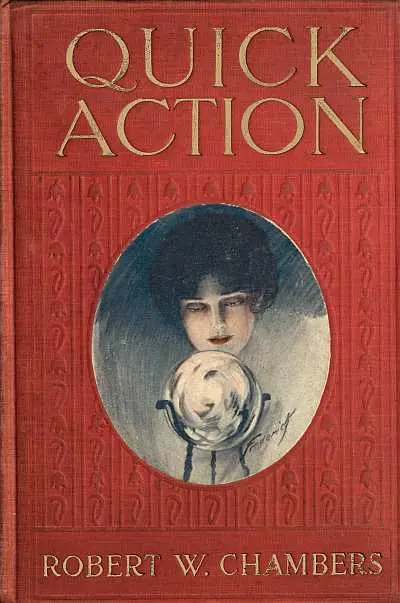
"Quick Action" by Robert W. Chambers is a novel written in the early 20th century. The story is set against a backdrop of urban sophistication and intrigue, centering on Countess Athalie, who possesses an unusual gift for clairvoyance connected to a mysterious crystal sphere. The opening chapters introduce a gathering of notable characters amidst a blend of light-hearted dialogue and enchanting mystical elements, foreshadowing themes of love, identity, and personal freedom. At the start of the novel, we find ourselves in Countess Athalie's sky-drawing-room, illuminated only by the soft glow of her crystal sphere while a group of intriguing men engage in playful banter and card tricks. Athalie, with a dreamy disposition, casually reveals her clairvoyant abilities, hinting at deeper truths about her life and connections. As the conversation flows, we glimpse her perspective on love and fate, contrasting it with the straightforward, almost comedic interest of the other characters. The narrative unfolds to hint at Athalie's tumultuous past, intertwining with the budding romantic tension between her and the ambitious Delancy Jones, each character embodying desires for quick action and meaningful connections in a world that often seems indifferent to their feelings. The initial setup promises a compelling exploration of relationships intertwined with the allure of mysticism, making it a fascinating read for lovers of early 20th-century romance.
Introduction adapted from the source catalogue; source summaries may be automatically generated.
Free to read · English · 55,643 words · No account needed
MAKE TIME FOR A GOOD BOOK
On by default. Untick to stop anonymous reading totals. Each page counts after 10 seconds in view. How this works.
Anonymous counting is on unless you have switched it off.
Spectral groups passed in clinging lingerie; here and there a ghost lingered to lean over the coquina wall, her lost gaze faintly accented by some level star. One of these, a slender young thing, paused near to Brown, resting gracefully against the wall.
All around her the whip-poor-wills were calling breathlessly; the perfume of oleander grew sweeter.
As for the girl herself, she resembled the tenth muse. Brown had never attempted to visualise his mistress; it had been enough for him that she was Thalomene, daughter of Zeus, and divinely fair.
But now, as he recognised the face he had noticed that evening in the dining-room, somehow he thought of his muse for the first time, concretely. Perhaps because the girl by the coquina wall was young, slim, golden haired, and Greek.
His impulse, without bothering to reason, was to hop from the wall and go over to where she was standing.
She looked around calmly as he approached, gave him a little nod in recognition of his lifted hat.
"I'm John Brown, 4th," he said. "I'm stopping at the Villa Hibiscus. Do
you mind my saying so?"
"No, I don't mind," she said.
"There is a vast amount of nonsense in formality and convention," said Brown. "If you don't mind ignoring such details, I have something important to say to you."
She looked at him unsmilingly. Probably it was the starlight in her eyes that made them glimmer as though with hidden laughter.
"I am," said Brown, pleasantly, "an author."
"Really," she said.
"When I say that I am an author," continued Brown seriously, "I mean in
the higher sense."
"Oh. What is the higher sense, Mr. Brown?" she asked.
"The higher sense does not necessarily imply authorship. I do not mean that I am a mere writer. I have written very little."
"Oh," she said.
"Very little," repeated Brown combatively. "You will look in vain among the crowded counters piled high with contemporary fiction for anything from my pen."
"Then perhaps I had better not look," she said so simply that Brown was a trifle disappointed in her.
"Some day, however," he said, "you may search, and, perhaps, not wholly
in vain."
"Oh, you are writing a book!"
"Yes," he said, "I am, so to speak, at work on a novel."
"Might one, with discretion, make further inquiry concerning your novel,
Mr. Brown?"
"You may."
"Thank you," she said, apparently a trifle disconcerted by the privilege
so promptly granted.
"You may," repeated Brown. "Shall I explain why?"
"Please."
"You will not mistake me, I am sure. Will you?"
She turned her pretty face toward him.
Your reading position is saved on this browser. Take it to another device with a library code. Reading pages adapt to text, rather than matching a printed edition.
Robert W. (Robert William) Chambers
Robert W. (Robert William) Chambers

Robert W. (Robert William) Chambers
Robert W. (Robert William) Chambers
BEHIND THE BOOK
This eBook is for the use of anyone anywhere in the United States and most other parts of the world at no cost and with almost no restrictions whatsoever. You may copy it, give it away or re-use it under the terms of the Project Gutenberg License included with this eBook or online at www.gutenberg.org. If you are not located in the United States, you will have to check the laws of the country where you are located before using this eBook. Read the source licence.
The original source file, including credits and licence, is retained by this library. Request an original-format copy at no charge. Please include the book title and Project Gutenberg identifier #37528.
KEEP YOUR CURIOSITY GOING
Coulson Kernahan

Maurice Baring
Frances Wright
Cécile Tormay

Frederic Jesup Stimson

W. H. P. (William Henry Pope) Jarvis