THE CLASSIC COLLECTION✦The haunts of menCLASSIC FREE BOOKS
The haunts of men
Robert W. (Robert William) Chambers
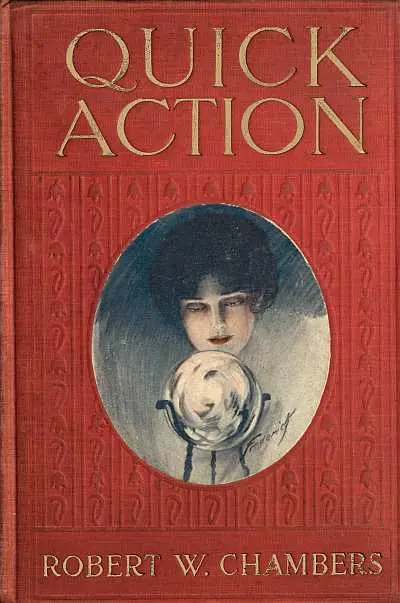
THE CLASSIC COLLECTION · 1914
"Quick Action" by Robert W. Chambers is a novel written in the early 20th century. The story is set against a backdrop of urban sophistication and intrigue, centering on Countess Athalie, who possesses an unusual gift for clairvoyance connected to a mysterious crystal sphere. The opening chapters introduce a gathering of notable characters amidst a blend of light-hearted dialogue and enchanting mystical elements, foreshadowing themes of love, identity, and personal freedom. At the start of the novel, we find ourselves in Countess Athalie's sky-drawing-room, illuminated only by the soft glow of her crystal sphere while a group of intriguing men engage in playful banter and card tricks. Athalie, with a dreamy disposition, casually reveals her clairvoyant abilities, hinting at deeper truths about her life and connections. As the conversation flows, we glimpse her perspective on love and fate, contrasting it with the straightforward, almost comedic interest of the other characters. The narrative unfolds to hint at Athalie's tumultuous past, intertwining with the budding romantic tension between her and the ambitious Delancy Jones, each character embodying desires for quick action and meaningful connections in a world that often seems indifferent to their feelings. The initial setup promises a compelling exploration of relationships intertwined with the allure of mysticism, making it a fascinating read for lovers of early 20th-century romance.
Introduction adapted from the source catalogue; source summaries may be automatically generated.
Free to read · English · 55,643 words · No account needed
MAKE TIME FOR A GOOD BOOK
On by default. Untick to stop anonymous reading totals. Each page counts after 10 seconds in view. How this works.
Anonymous counting is on unless you have switched it off.
"I mean," she said, "that you Americans have a capacity for conceiving, understanding, and performing everything you write about."
"Why do you think so?" asked Smith, a trifle red.
"Because if Englishmen could understand and do such things, our novelists would write about them. They never write about them. But you Americans do. You write thousands of most delightful novels about young men who do things unheard of, undreamed of, in England. Therefore, it is very clear to me that you Americans are quite capable of doing what you write about, and what your readers so ardently admire."
"I see," said Smith calmly. His ear-tips still burned.
"No doubt," said the girl, "many of the astonishing things you Americans write about are really done. Many astounding episodes in fiction are of not uncommon occurrence in real life."
"What kind of episodes?" asked Smith gravely.
"Why, any of them you write about. They all are astonishing enough. For example, your young men do not seem to know what fear is."
"No," said Smith, "they don't."
"And when they love," said the girl, "nothing can stop them."
"Nothing."
"Nothing!" she repeated, the soft glow coming into her cheeks again. "--Nothing! Neither rank nor wealth nor political considerations nor family prejudices, nor even the military!"
Smith bit his lip in silence. He had heard of irony; never had he dreamed it could be so crushing: he had heard of sarcasm; but the quiet sarcasm of this unknown young girl was annihilating him. Critics had carved him in his time; but the fine mincemeat which this pretty stranger was making of him promised to leave nothing more either to carve or to roast.
"Do you mind my talking to you?" she asked, noting the strained
expression of his features.
"No," he said, "go ahead."
"Because if I am tiring you----"
He said he was not tired.
"--or if it bores you to discuss your art with a foreigner who so truly
admires it----"
He shot a glance at her, then forced a laugh.
"I am not offended," he said. "What paper do you represent?"
"I?" she said, bewildered.
"Yes. You are a newspaper woman, are you not?"
"Do you mean a reporter?"
"Naturally."
"No," she said very seriously, "I am not a reporter. What an odd idea!"
"Do you think it odd?"
"Why, yes. Do not many admirers of your works express their pleasure in
them to you?"
Your reading position is saved on this browser. Take it to another device with a library code. Reading pages adapt to text, rather than matching a printed edition.
Robert W. (Robert William) Chambers
Robert W. (Robert William) Chambers
Robert W. (Robert William) Chambers
Robert W. (Robert William) Chambers
BEHIND THE BOOK
This eBook is for the use of anyone anywhere in the United States and most other parts of the world at no cost and with almost no restrictions whatsoever. You may copy it, give it away or re-use it under the terms of the Project Gutenberg License included with this eBook or online at www.gutenberg.org. If you are not located in the United States, you will have to check the laws of the country where you are located before using this eBook. Read the source licence.
The original source file, including credits and licence, is retained by this library. Request an original-format copy at no charge. Please include the book title and Project Gutenberg identifier #37528.
KEEP YOUR CURIOSITY GOING
Coulson Kernahan

Maurice Baring
Frances Wright
Cécile Tormay

Frederic Jesup Stimson

W. H. P. (William Henry Pope) Jarvis