
Life of Harriet Beecher Stowe Compiled From Her Letters and Journals by Her Son Charles Edward Stowe
Harriet Beecher Stowe
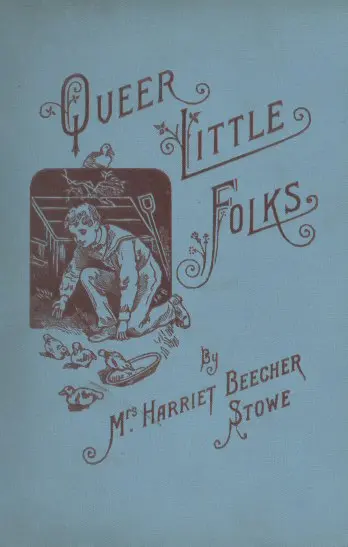
THE CLASSIC COLLECTION · 1886
"Queer Little Folks" by Harriet Beecher Stowe is a collection of whimsical stories likely written in the late 19th century. The book features a variety of charming animal characters, such as Mrs. Feathertop the hen and her experience with an unexpected brood of ducklings, presenting engaging tales that highlight the quirks and personalities of its cast. The opening of the book introduces readers to the delightful story of Mrs. Feathertop, a hen of good lineage who starts off seeming frivolous and unconcerned with family responsibilities. However, as she lays eggs and prepares for motherhood, the tale humorously unfolds the tensions between her and her neighbors, like the grumpy Mrs. Scratchard. Readers witness Mrs. Feathertop's transformation when she hatches a brood of ducklings amidst the chaos of gossiping neighbors and a well-meaning but somewhat oblivious husband, Mr. Gray Cock. This whimsical beginning sets the tone for charming anecdotes that both entertain and convey subtle messages about family life and community.
Introduction adapted from the source catalogue; source summaries may be automatically generated.
Free to read · English · 21,837 words · No account needed
MAKE TIME FOR A GOOD BOOK
On by default. Untick to stop anonymous reading totals. Each page counts after 10 seconds in view. How this works.
Anonymous counting is on unless you have switched it off.
“Well dear Miss Katy,” said the colonel, “if you ask my candid opinion as a friend, I should say not. There’s young Mosquito, who graduated last year, has gone into literature, and is connected with some of our leading papers, and they say he carries the sharpest pen of all the writers. It won’t do to offend him.”
“And so I suppose we must have his old aunts, and all six of his sisters, and all his dreadfully common relations.”
“It is a pity,” said the colonel; “but one must pay one’s tax to
society.”
Just at this moment the conference was interrupted by a visitor, Miss Keziah Cricket, who came in with her work-bag on her arm to ask a subscription for a poor family of Ants who had just had their house hoed up in clearing the garden-walks.
“How stupid of them,” said Katy, “not to know better than to put their house in the garden-walk; that’s just like those Ants.”
“Well, they are in great trouble; all their stores destroyed, and their father killed—cut quite in two by a hoe.”
“How very shocking! I don’t like to hear of such disagreeable things; it affects my nerves terribly. Well, I’m sure I haven’t anything to give. Mamma said yesterday she was sure she didn’t know how our bills were to be paid; and there’s my green satin with point-lace yet to come home.” And Miss Katy-did shrugged her shoulders and affected to be very busy with Colonel Katy-did, in just the way that young ladies sometimes do when they wish to signify to visitors that they had better leave.
Little Miss Cricket perceived how the case stood, and so hopped briskly off, without giving herself even time to be offended. “Poor extravagant little thing!” said she to herself, “it was hardly worth while to ask her.”
“Pray, shall you invite the Crickets?” said Colonel Katy-did.
“Who? I? Why, colonel, what a question! Invite the Crickets? Of what can you be thinking?”
“And shall you not ask the Locusts, and the Grasshoppers?”
“Certainly. The Locusts, of course,—a very old and distinguished family; and the Grasshoppers are pretty well, and ought to be asked. But we must draw a line somewhere,—and the Crickets! why, it’s shocking even to think of!”
“I thought they were nice, respectable people.”
“Oh, perfectly nice and respectable,—very good people, in fact, so far as that goes. But then you must see the difficulty.”
“My dear cousin, I am afraid you must explain.”
“Why, their colour, to be sure. Don’t you see?”
Your reading position is saved on this browser. Take it to another device with a library code. Reading pages adapt to text, rather than matching a printed edition.
Harriet Beecher Stowe

Harriet Beecher Stowe
Harriet Beecher Stowe

Harriet Beecher Stowe
BEHIND THE BOOK
This eBook is for the use of anyone anywhere in the United States and most other parts of the world at no cost and with almost no restrictions whatsoever. You may copy it, give it away or re-use it under the terms of the Project Gutenberg License included with this eBook or online at www.gutenberg.org. If you are not located in the United States, you will have to check the laws of the country where you are located before using this eBook. Read the source licence.
The original source file, including credits and licence, is retained by this library. Request an original-format copy at no charge. Please include the book title and Project Gutenberg identifier #2486.
KEEP YOUR CURIOSITY GOING
Coulson Kernahan

Maurice Baring
Frances Wright
Cécile Tormay

Frederic Jesup Stimson

W. H. P. (William Henry Pope) Jarvis