
Life of Harriet Beecher Stowe Compiled From Her Letters and Journals by Her Son Charles Edward Stowe
Harriet Beecher Stowe
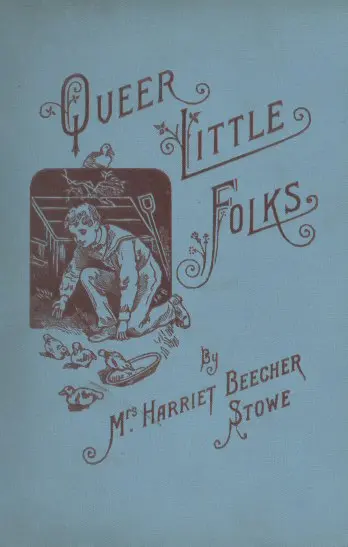
THE CLASSIC COLLECTION · 1886
"Queer Little Folks" by Harriet Beecher Stowe is a collection of whimsical stories likely written in the late 19th century. The book features a variety of charming animal characters, such as Mrs. Feathertop the hen and her experience with an unexpected brood of ducklings, presenting engaging tales that highlight the quirks and personalities of its cast. The opening of the book introduces readers to the delightful story of Mrs. Feathertop, a hen of good lineage who starts off seeming frivolous and unconcerned with family responsibilities. However, as she lays eggs and prepares for motherhood, the tale humorously unfolds the tensions between her and her neighbors, like the grumpy Mrs. Scratchard. Readers witness Mrs. Feathertop's transformation when she hatches a brood of ducklings amidst the chaos of gossiping neighbors and a well-meaning but somewhat oblivious husband, Mr. Gray Cock. This whimsical beginning sets the tone for charming anecdotes that both entertain and convey subtle messages about family life and community.
Introduction adapted from the source catalogue; source summaries may be automatically generated.
Free to read · English · 21,837 words · No account needed
MAKE TIME FOR A GOOD BOOK
On by default. Untick to stop anonymous reading totals. Each page counts after 10 seconds in view. How this works.
Anonymous counting is on unless you have switched it off.
“Well, then, and the Butterflies and the Moths. Now, there’s a trouble. There’s such an everlasting tribe of those Moths; and if you invite dull people they’re always sure all to come, every one of them. Still, if you have the Butterflies, you can’t leave out the Moths.”
“Old Mrs. Moth has been laid up lately with a gastric fever, and that may keep two or three of the Misses Moth at home,” said the colonel.
“Whatever could give the old lady such a turn?” said Miss Katy. “I thought she never was sick.”
“I suspect it’s high living. I understand she and her family ate up a whole ermine cape last month, and it disagreed with them.”
“For my part, I can’t conceive how the Moths can live as they do,” said Miss Katy, with a face of disgust. “Why, I could no more eat worsted and fur, as they do—”
“That is quite evident from the fairy-like delicacy of your appearance,” said the colonel. “One can see that nothing so gross or material has ever entered into your system.”
“I’m sure,” said Miss Katy, “mamma says she don’t know what does keep me alive; half a dewdrop and a little bit of the nicest part of a rose-leaf, I assure you, often last me for a day. But we are forgetting our list. Let’s see—the Fireflies, Butterflies, Moths. The Bees must come, I suppose.”
“The Bees are a worthy family,” said the colonel.
“Worthy enough, but dreadfully humdrum,” said Miss Katy. “They never talk about anything but honey and housekeeping; still, they are a class of people one cannot neglect.”
“Well, then, there are the Bumble-Bees.”
“Oh, I dote on them! General Bumble is one of the most dashing, brilliant fellows of the day.”
“I think he is shockingly corpulent,” said Colonel Katy-did, not at all pleased to hear him praised; “don’t you?”
“I don’t know but he is a little stout,” said Miss Katy; “but so distinguished and elegant in his manners—something quite martial and breezy about him.”
“Well, if you invite the Bumble-Bees, you must have the Hornets.”
“Those spiteful Hornets! I detest them!”
“Nevertheless, dear Miss Katy, one does not like to offend the Hornets.”
“No, one can’t. There are those five Misses Hornet—dreadful old maids!—as full of spite as they can live. You may be sure they will every one come, and be looking about to make spiteful remarks. Put down the Hornets, though.”
“How about the Mosquitoes!” said the colonel.
“Those horrid Mosquitoes—they are dreadfully plebeian! Can’t one cut
them?”
Your reading position is saved on this browser. Take it to another device with a library code. Reading pages adapt to text, rather than matching a printed edition.
Harriet Beecher Stowe

Harriet Beecher Stowe
Harriet Beecher Stowe

Harriet Beecher Stowe
BEHIND THE BOOK
This eBook is for the use of anyone anywhere in the United States and most other parts of the world at no cost and with almost no restrictions whatsoever. You may copy it, give it away or re-use it under the terms of the Project Gutenberg License included with this eBook or online at www.gutenberg.org. If you are not located in the United States, you will have to check the laws of the country where you are located before using this eBook. Read the source licence.
The original source file, including credits and licence, is retained by this library. Request an original-format copy at no charge. Please include the book title and Project Gutenberg identifier #2486.
KEEP YOUR CURIOSITY GOING
Coulson Kernahan

Maurice Baring
Frances Wright
Cécile Tormay

Frederic Jesup Stimson

W. H. P. (William Henry Pope) Jarvis