
The lost dirigible
Ralph Henry Barbour
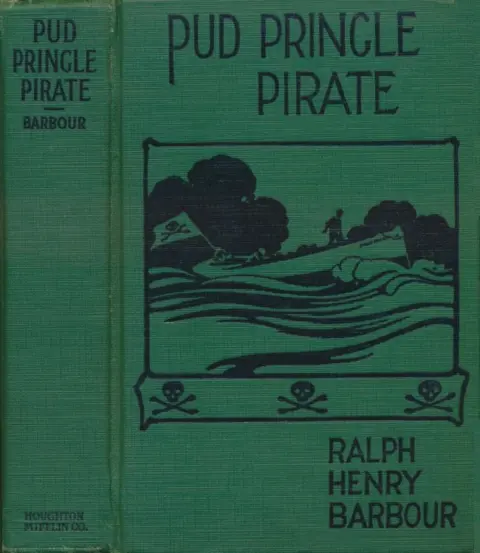
THE CLASSIC COLLECTION · 1926
"Pud Pringle, Pirate" by Ralph Henry Barbour is a novel written in the early 20th century. The story centers around Pud Pringle, a spirited and imaginative fifteen-year-old boy, and his adventures in a small American town and along its local river. The book likely explores themes of friendship, mischief, and adventure, as Pud—often accompanied by his friend Tim Daley and others—embarks on lighthearted escapades inspired by classic tales of piracy. The opening of "Pud Pringle, Pirate" introduces Pud as a humorous, good-natured youth living in Millville, who navigates everyday life with wit and a bit of mischief. The early chapters depict Pud's interactions with local townsfolk, his mother, and his close friend Tim, as they reconcile after a minor quarrel. Pud's fascination with pirates leads him and his friends to embark on a river journey in a small motorboat, which they rename with swashbuckling flair and stock with supplies in the spirit of true buccaneers. Much of the early action revolves around the preparation for their voyage, humorous exchanges, and the boys’ imaginative transformation of simple activities into make-believe pirate adventures. The tone is light and lively, promising gentle humor and youthful camaraderie set against a nostalgic small-town backdrop.
Introduction adapted from the source catalogue; source summaries may be automatically generated.
Free to read · English · 63,054 words · No account needed
MAKE TIME FOR A GOOD BOOK
On by default. Untick to stop anonymous reading totals. Each page counts after 10 seconds in view. How this works.
Anonymous counting is on unless you have switched it off.
The shanty-boat, the sagging wharf, and the waving men grew small in the distance. The forest closed in once more. At last the clearing passed from sight as the launch, chugging determinedly, rounded a shadowed bend in the river. Pud and Tim sighed with relief. Harmon, as solemn as an owl, perched on the stern and stared curiously at Gladys Ermintrude. The girl, preparatory to her flight, had somehow struggled into a very tight sweater of a deep orange shade which, beyond the shadow of a doubt, harmonized sadly with her tanned face and copper-hued hair. She had brought with her an ancient satchel encompassed, at one end, by a rusty-black strap and at the other a piece of clothes-line. It was the satchel that again aroused Pud’s sleeping suspicions.
‘Say, if you were kidnaped,’ he asked, ‘how’d you happen to bring all your clothes along with you?’
‘Sakes alive!’ exclaimed Gladys Ermintrude. ‘Why, those aren’t all my clothes! Why, I’ve just got a few simple things in the bag, hardly a change of attire.’
‘Just the same,’ persisted Pud, ‘if you were kidnaped――’
‘Gosh,’ expostulated Tim, who, being somewhat susceptible to feminine charm, chivalrously disapproved of Pud’s incredulous attitude, ‘why wouldn’t she take some duds with her?’
‘Well, because as a usual thing kidnaped folks don’t have time to pack bags. When you kidnap a person, you just grab him quick and throw him into a――an automobile and beat it!’
‘You don’t understand,’ said Gladys Ermintrude in a somewhat superior manner that increased Pud’s growing dislike. ‘You see, they came for me when I was all alone in the house, and after they had bound me up and thrown me helpless on――on the floor――’
‘Gosh!’ muttered Tim.
Harmon chortled, whether from horror or delight it would have been
difficult to say.
‘They got the bag and made me tell them what to put in it,’ continued Gladys Ermintrude. ‘But, sakes alive, I simply couldn’t think of half the things I really needed, and I came away without my negligee and――oh, several other things. I really don’t see how I managed to get along as well as I did!’
‘Well, then,’ said Pud, ‘what did they do it for?’
The girl’s eyes opened wide. ‘Why, for the reward, of course!’
‘Sure,’ assented Tim. ‘Folks always offer rewards, Pud.’
Pud looked unconvinced. ‘I wouldn’t,’ he said, eyeing Gladys Ermintrude with no enthusiasm. Then: ‘Who were those men?’ he asked.
‘They were’――the girl’s gaze wavered momentarily――‘they were a Mr. Liscomb and――’
‘But that’s your name!’ exclaimed Tim.
Your reading position is saved on this browser. Take it to another device with a library code. Reading pages adapt to text, rather than matching a printed edition.
Ralph Henry Barbour
Ralph Henry Barbour

Ralph Henry Barbour

Ralph Henry Barbour
BEHIND THE BOOK
This eBook is for the use of anyone anywhere in the United States and most other parts of the world at no cost and with almost no restrictions whatsoever. You may copy it, give it away or re-use it under the terms of the Project Gutenberg License included with this eBook or online at www.gutenberg.org. If you are not located in the United States, you will have to check the laws of the country where you are located before using this eBook. Read the source licence.
The original source file, including credits and licence, is retained by this library. Request an original-format copy at no charge. Please include the book title and Project Gutenberg identifier #75936.
KEEP YOUR CURIOSITY GOING
Coulson Kernahan

Maurice Baring
Frances Wright
Cécile Tormay

Frederic Jesup Stimson

W. H. P. (William Henry Pope) Jarvis