
The lost dirigible
Ralph Henry Barbour
THE CLASSIC COLLECTION · 1926
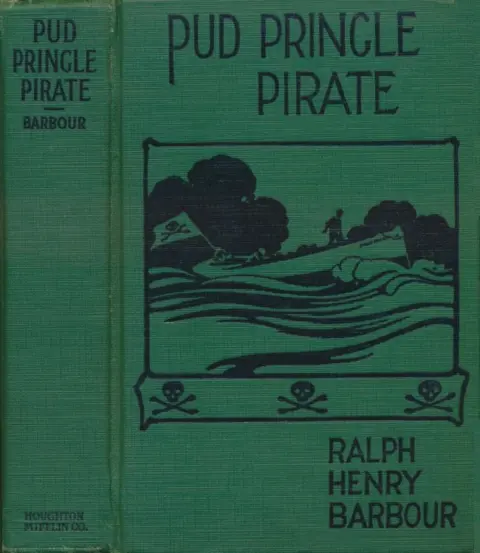
"Pud Pringle, Pirate" by Ralph Henry Barbour is a novel written in the early 20th century. The story centers around Pud Pringle, a spirited and imaginative fifteen-year-old boy, and his adventures in a small American town and along its local river. The book likely explores themes of friendship, mischief, and adventure, as Pud—often accompanied by his friend Tim Daley and others—embarks on lighthearted escapades inspired by classic tales of piracy. The opening of "Pud Pringle, Pirate" introduces Pud as a humorous, good-natured youth living in Millville, who navigates everyday life with wit and a bit of mischief. The early chapters depict Pud's interactions with local townsfolk, his mother, and his close friend Tim, as they reconcile after a minor quarrel. Pud's fascination with pirates leads him and his friends to embark on a river journey in a small motorboat, which they rename with swashbuckling flair and stock with supplies in the spirit of true buccaneers. Much of the early action revolves around the preparation for their voyage, humorous exchanges, and the boys’ imaginative transformation of simple activities into make-believe pirate adventures. The tone is light and lively, promising gentle humor and youthful camaraderie set against a nostalgic small-town backdrop.
Introduction adapted from the source catalogue; source summaries may be automatically generated.
Free to read · English · 63,054 words · No account needed
MAKE TIME FOR A GOOD BOOK
On by default. Untick to stop anonymous reading totals. Each page counts after 10 seconds in view. How this works.
Anonymous counting is on unless you have switched it off.
Pud’s serenity, though, was largely external. Inside, he was mildly disturbed. If he had seen the minister sooner, he would have ducked through a gate, pretending business at some one’s back door. Not that Pud disliked Mr. Tully. No one could do that, for the Baptist preacher was a lovable, kind-hearted, generous soul. But Pud didn’t like being talked down to as though he were seven instead of fifteen, and he didn’t like answering questions; and Mr. Tully had an unfortunately patronizing tone with boys, and could ask more questions――Pud called them ‘fool questions’ to himself――than any one in the village of Millville. Then, too, Pud had another reason for not caring to converse with Mr. Tully this morning, which was that Pud had failed to attend Sunday School three days since. Mr. Tully might not have noted the fact, or might have forgotten it, but Pud would have preferred not meeting the preacher.
‘Good morning, Anson,’ greeted Mr. Tully, smiling very heartily. ‘I hope you are well this beautiful morning, my boy.’
‘Yes, sir, thanks.’ Pud returned the smile with one of guileless sweetness and would have gone on. But Mr. Tully, beaming through his glasses, which, as usual, leaned at a rakish angle from his long, thin nose, continued:
‘Ah, returning from an errand to the store, doubtless.’ He glanced approvingly at the packages. ‘Being a help to your dear parents. Yes, yes. And how are they, my boy? Well, I trust? Your mother?’
‘Yes, sir, she’s all right.’
‘Eh! You don’t mean that your father is――ah――indisposed?’
‘He got up this morning, sir,’ replied Pud.
‘Dear me! Why, I hadn’t heard! What is his trouble?’
Pud’s clear brown eyes set themselves on that far distant point that in optics is termed infinity and assumed a sort of trance-like fixity. Had Mr. Tully known the boy a great deal better, the peculiarity of that gaze would have warned him.
‘The doctor,’ replied Pud, almost dreamily, ‘didn’t say.’
‘Well, well! And which doctor――But, of course, you have Doctor Timmons, don’t you? And so Doctor Timmons didn’t know what the trouble was?’
‘Well, he didn’t say,’ answered Pud cautiously. ‘And I guess if a doctor knows what’s the matter he’s going to tell, isn’t he, sir?’
‘Oh, undoubtedly, undoubtedly. Well, let us hope that your father’s illness is not――ah――serious. You say he is up to-day?’
‘Yes, sir, he got up, but he didn’t go to the office.’
Your reading position is saved on this browser. Take it to another device with a library code. Reading pages adapt to text, rather than matching a printed edition.
Ralph Henry Barbour
Ralph Henry Barbour

Ralph Henry Barbour

Ralph Henry Barbour
BEHIND THE BOOK
This eBook is for the use of anyone anywhere in the United States and most other parts of the world at no cost and with almost no restrictions whatsoever. You may copy it, give it away or re-use it under the terms of the Project Gutenberg License included with this eBook or online at www.gutenberg.org. If you are not located in the United States, you will have to check the laws of the country where you are located before using this eBook. Read the source licence.
The original source file, including credits and licence, is retained by this library. Request an original-format copy at no charge. Please include the book title and Project Gutenberg identifier #75936.
KEEP YOUR CURIOSITY GOING
Coulson Kernahan

Maurice Baring
Frances Wright
Cécile Tormay

Frederic Jesup Stimson

W. H. P. (William Henry Pope) Jarvis