
The lost dirigible
Ralph Henry Barbour
THE CLASSIC COLLECTION · 1926
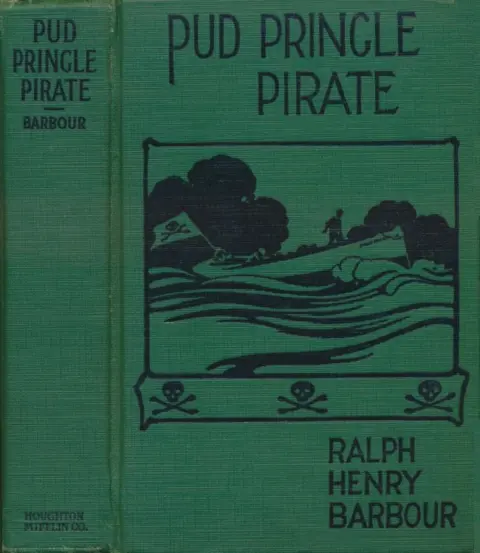
"Pud Pringle, Pirate" by Ralph Henry Barbour is a novel written in the early 20th century. The story centers around Pud Pringle, a spirited and imaginative fifteen-year-old boy, and his adventures in a small American town and along its local river. The book likely explores themes of friendship, mischief, and adventure, as Pud—often accompanied by his friend Tim Daley and others—embarks on lighthearted escapades inspired by classic tales of piracy. The opening of "Pud Pringle, Pirate" introduces Pud as a humorous, good-natured youth living in Millville, who navigates everyday life with wit and a bit of mischief. The early chapters depict Pud's interactions with local townsfolk, his mother, and his close friend Tim, as they reconcile after a minor quarrel. Pud's fascination with pirates leads him and his friends to embark on a river journey in a small motorboat, which they rename with swashbuckling flair and stock with supplies in the spirit of true buccaneers. Much of the early action revolves around the preparation for their voyage, humorous exchanges, and the boys’ imaginative transformation of simple activities into make-believe pirate adventures. The tone is light and lively, promising gentle humor and youthful camaraderie set against a nostalgic small-town backdrop.
Introduction adapted from the source catalogue; source summaries may be automatically generated.
Free to read · English · 63,054 words · No account needed
MAKE TIME FOR A GOOD BOOK
On by default. Untick to stop anonymous reading totals. Each page counts after 10 seconds in view. How this works.
Anonymous counting is on unless you have switched it off.
To Pud’s surprise, Mr. Liscomb was smiling in a very friendly fashion, and, seen close-to, was not at all the desperate-looking person Pud had thought him. Just the same, Pud’s suspicions were not wholly quieted, and, although he cleared his throat, no words came. At least, not from Pud; nor yet from Tim nor Harmon. Gladys Ermintrude, though, still had the power of speech.
‘Yes,’ she was saying, ‘these are the boys who were so very kind to me, Father. This is Pud and that one’s Ted――no, Tim, and that’s Harmon back there. Harmon cooks wonderfully, Father.’
‘Does, eh? Well, Tibbie, if I had a wonderful cook I’d look after him better. They’ve let him sit out in the sun until he’s all tanned up!’
Pud and Tim smiled embarrassedly, but Harmon gave the joke full value and exploded into ‘Yeah! Yeah! Yeah!’ Then he as suddenly subsided into silent solemnity. Mr. Liscomb chuckled and, one arm over his daughter’s shoulders, turned his gaze back to Pud.
‘You look mighty familiar to me,’ he said. ‘Live around here, Pud?’
‘No, sir, Millville,’ Pud managed.
‘Millville? Guess I don’t know any one in Millville. What’s the rest of
your name?’
‘Pringle,’ said Pud. ‘Anson Pringle.’
‘Anson Pringle? Then your father’s Pringle, of the Courant up there! You’re Anson Pringle, junior, eh?’
‘I suppose so,’ allowed Pud. ‘Folks call me Pud, usually.’
‘Well, well! Why, I know your father, son, know him right well. Both newspaper men, you see. I’m assistant editor of the Corbin Journal. You tell him you met Bill Liscomb, will you? Tell him you ran off with his girl!’ The speaker chuckled, and Pud ventured a doubtful grin.
‘She said――’ he murmured. ‘I mean, you see, we didn’t understand――exactly――’
‘Oh, that’s all right, Pud! You don’t need to apologize. Here’s the culprit right here.’ He gave Gladys Ermintrude a hug. ‘She’s a pretty good sport, boys, but she’s got an imagination about ten sizes too large for her, and she reads too many silly stories and sees too many foolish movies. But we’re going to change all that, aren’t we, Tibbs? We’re going to cut out the novels and most of the movies for awhile, eh?’
Gladys Ermintrude assented readily, even gayly.
Your reading position is saved on this browser. Take it to another device with a library code. Reading pages adapt to text, rather than matching a printed edition.
Ralph Henry Barbour
Ralph Henry Barbour

Ralph Henry Barbour

Ralph Henry Barbour
BEHIND THE BOOK
This eBook is for the use of anyone anywhere in the United States and most other parts of the world at no cost and with almost no restrictions whatsoever. You may copy it, give it away or re-use it under the terms of the Project Gutenberg License included with this eBook or online at www.gutenberg.org. If you are not located in the United States, you will have to check the laws of the country where you are located before using this eBook. Read the source licence.
The original source file, including credits and licence, is retained by this library. Request an original-format copy at no charge. Please include the book title and Project Gutenberg identifier #75936.
KEEP YOUR CURIOSITY GOING
Coulson Kernahan

Maurice Baring
Frances Wright
Cécile Tormay

Frederic Jesup Stimson

W. H. P. (William Henry Pope) Jarvis