
The lost dirigible
Ralph Henry Barbour
THE CLASSIC COLLECTION · 1926
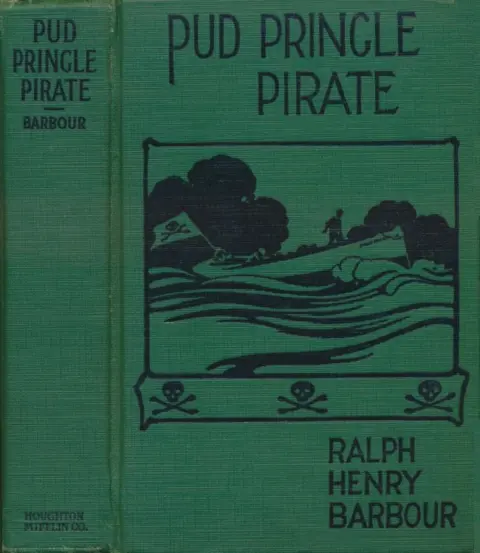
"Pud Pringle, Pirate" by Ralph Henry Barbour is a novel written in the early 20th century. The story centers around Pud Pringle, a spirited and imaginative fifteen-year-old boy, and his adventures in a small American town and along its local river. The book likely explores themes of friendship, mischief, and adventure, as Pud—often accompanied by his friend Tim Daley and others—embarks on lighthearted escapades inspired by classic tales of piracy. The opening of "Pud Pringle, Pirate" introduces Pud as a humorous, good-natured youth living in Millville, who navigates everyday life with wit and a bit of mischief. The early chapters depict Pud's interactions with local townsfolk, his mother, and his close friend Tim, as they reconcile after a minor quarrel. Pud's fascination with pirates leads him and his friends to embark on a river journey in a small motorboat, which they rename with swashbuckling flair and stock with supplies in the spirit of true buccaneers. Much of the early action revolves around the preparation for their voyage, humorous exchanges, and the boys’ imaginative transformation of simple activities into make-believe pirate adventures. The tone is light and lively, promising gentle humor and youthful camaraderie set against a nostalgic small-town backdrop.
Introduction adapted from the source catalogue; source summaries may be automatically generated.
Free to read · English · 63,054 words · No account needed
MAKE TIME FOR A GOOD BOOK
On by default. Untick to stop anonymous reading totals. Each page counts after 10 seconds in view. How this works.
Anonymous counting is on unless you have switched it off.
They were back at the clearing where they had rescued Gladys Ermintrude, and there, just as they had last seen it, was the faded green shanty-boat, with, as Pud uneasily discovered the next moment, smoke issuing from the stovepipe in its roof. The river was wide enough to let them pass well distant, and Pud instantly swung the launch’s bow toward the farther side. The tumble-down wharf, farther along, peered around the corner of the shanty-boat and Pud set his gaze on it and wished it were already abeam. Tim, too, had now recognized the scene and drew Pud’s attention.
‘S-sh!’ Pud whispered, motioning for silence. ‘They’re in there!’
‘Oh!’
Then a spot of color appeared on the shanty-boat’s narrow deck, a hand waved, and a friendly ‘Oo-hoo!’ came to them.
‘It’s Gladys Ermintrude,’ said Tim eagerly.
‘Well, what if it is?’ inquired Pud coldly, refraining from joining the other in signals of response.
‘Oo-hoo! Come on over!’ called Gladys Ermintrude.
Pud scowled. If only she had stayed inside a minute or two longer! Tim said, ‘Let’s see what she wants, Pud.’ Pud hesitated, muttered, and swung the launch across the stream. ‘All right,’ he said as they neared the shanty-boat and Gladys Ermintrude, ‘only don’t blame me if――if something happens!’
‘Hello,’ said Gladys Ermintrude gayly as they came close.
‘Hello,’ replied Tim.
‘Hello,’ echoed Harmon from the stern.
‘Huh,’ muttered Pud, and viewed her suspiciously. Then he turned his suspicions toward the interior, wondering whether the girl had been, as before, the sole occupant of the cabin. Gladys Ermintrude was explaining that she had been back there for two days and was having a perfectly glorious time.
‘Huh,’ said Pud. ‘What you been doing?’
‘Oh, lots of things,’ answered the girl brightly. ‘Fishing and hunting
and――’
‘Cooking,’ supplied Pud. ‘Your ma said you were a good cook.’
Gladys Ermintrude accepted the tribute with unconcealed delight, to Pud’s vast astonishment. ‘Well, I just am,’ she declared. ‘I made the grandest cake yesterday!’
Tim’s eyes grew luminous and he moistened his lips.
‘I wish you’d come then instead of to-day. Pa and Uncle Asa ate the last of it this morning.’
Tim’s eyes gloomed and he sighed. Tim had a notable weakness for cake.
‘I suppose,’ observed Pud, foiled in his first attempt to create confusion, but determined still, ‘you’ll be going into moving pictures this fall.’
‘Moving pictures? Oh, my, no! What a funny idea!’
‘I’ll say so,’ agreed Pud heartily, ‘but it was your idea and not mine. You said you were studying to be a screen star, didn’t you?’
Your reading position is saved on this browser. Take it to another device with a library code. Reading pages adapt to text, rather than matching a printed edition.
Ralph Henry Barbour
Ralph Henry Barbour

Ralph Henry Barbour

Ralph Henry Barbour
BEHIND THE BOOK
This eBook is for the use of anyone anywhere in the United States and most other parts of the world at no cost and with almost no restrictions whatsoever. You may copy it, give it away or re-use it under the terms of the Project Gutenberg License included with this eBook or online at www.gutenberg.org. If you are not located in the United States, you will have to check the laws of the country where you are located before using this eBook. Read the source licence.
The original source file, including credits and licence, is retained by this library. Request an original-format copy at no charge. Please include the book title and Project Gutenberg identifier #75936.
KEEP YOUR CURIOSITY GOING
Coulson Kernahan

Maurice Baring
Frances Wright
Cécile Tormay

Frederic Jesup Stimson

W. H. P. (William Henry Pope) Jarvis