READ · DISCOVER · ENJOYClassic literature · Always free
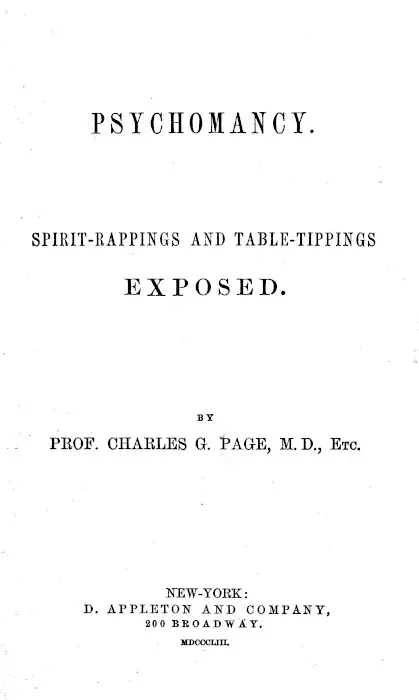
Psychomancy: Spirit-Rappings and Table-Tippings Exposed — digital edition cover

THE CLASSIC COLLECTION · 1853

Psychomancy: Spirit-Rappings and Table-Tippings Exposed

"Psychomancy: Spirit-Rappings and Table-Tippings Exposed" by Charles Grafton Page is a critical treatise written in the mid-19th century. The work delves into the phenomena of spirit communications and table movements, dismissed by the author as illusions rooted in human deception rather than genuine supernatural occurrences. Page argues against the credulity of society in regard to these practices, asserting they are little more than frauds perpetuated by charlatans for profit. The opening of the text sets a provocative tone, as Page challenges the widespread belief in spirit-rappings and table-tippings. He provides vivid descriptions of his own investigations into these practices, denouncing them as mere tricks executed by fraudsters, particularly the Fox sisters, who were among the first to popularize spiritualism in America. Through a series of experiments and observations, he strives to uncover the mechanics behind these phenomena, consistently attributing their origins to human agency rather than otherworldly forces. Page's writing is impassioned, urging readers to critically evaluate such miraculous claims through the lens of logic and science.

Introduction adapted from the source catalogue; source summaries may be automatically generated.

Start reading ↓

Free to read · English · 18,631 words · No account needed

MAKE TIME FOR A GOOD BOOK

Psychomancy: Spirit-Rappings and Table-Tippings Exposed

On by default. Untick to stop anonymous reading totals. Each page counts after 10 seconds in view. How this works.

Anonymous counting is on unless you have switched it off.

Psychomancy: Spirit-Rappings and Table-Tippings Exposed

The wide-spread and alarming mania of Spirit-rappings and table-tippings of the present day, is only a modification, or new garb, of devilish instrumentalities, operating through human machinations, which have infested society from time immemorial. We start with this proposition, harsh as it may sound to some, and if we should fail to sustain it by facts, reasoning, and common sense, to the entire satisfaction of all, we still say to the unbelievers in our doctrine, show us the proof to the contrary; and with a confidence firm as our belief in Holy Writ, and the unfailing laws of God, we challenge the exhibition to our senses of any performance with spirit-rappings, or table-tippings, which cannot be explained upon natural, and well known natural laws. We will here premise, that we do not attribute to Satan any direct agency in this matter other than has always been ascribed to him in the crimes and misdeeds of man from the fall down to this present time. That neither the "prince of the power of the air," nor his imps (unless they be in human shape), rap out intelligence by sounds, get under tables and tip them over, swing them round, or perform any of these extraordinary feats, which so many among us are determined to invest with supernatural character and origin. Nor do we consider that the arch-enemy of man has brought any new power or agency into operation to further his mischievous designs. FAR FROM IT. A new power? It would frustrate his schemes in their very inception. A new power? It is a lawful subject of pursuit, to the very exhaustion of mental resources. A new power? Its bare mention is an arousing signal to the devotees of science, and upon the first scintillation of plausibility, the midnight lamp will burn throughout Christendom, till its capabilities and subserviency to man's actual wants are unfolded. No! the tempter knows his game and tools, and perhaps his own limits, all too well to give to man a new and legitimate object of research, and thus divert investigation from hallucinating and mercenary sorceries to that which is lawful and truthful. He works with his own and old tools, upon and through that most successful instrumentality, over which, by long and dire experience, he has acquired such mighty ascendency--the human soul. This is his pliant tool, and here his stronghold. To those who regard the Scriptural account of the devil's existence and agency as allegorical, our argument, in its cardinal character and bearing, will apply with the same force, for they have only to invest the mind of man with all the force and attributes that the allegory gives to both combined, and we address ourselves to them with the same interest and hope of success as with those who believe the Scripture implicitly to the letter. To all alike, the deep, untiring, unending wiles of the human soul are familiar themes, and it matters but little to our present purpose, whether these impious transactions proceed from the main-spring of unaided, uninspired thought, or whether the unheeding thought is impressed by supernal powers. There is in the mind a strong and often morbid appetency for the supernatural and marvellous; a proneness to inquire beyond what is actually revealed; and, worse than this, a prurience of power, either real or specious, to exalt one above his fellow mortals, and give the weight of Divine authority to his words and acts. From this desire originates priestcraft, astrology and sorcery, and in the former habitude of the mind lies the secret of their success and perpetuation. It has been a real source of distress to us, to see professing Christians, even among our immediate friends, pushing their inquiries beyond the confines of realities into the spirit-world, forgetting or misapprehending the injunctions of Scripture forbidding us to look into such things, and unconscious of the fact, that their well-meant invocations of spirits by the tipping of tables and rappings, was, in every step and act of repetition, lending encouragement to the mercenary and nefarious schemes of a certain set of vile impostors, who originated the cheat, and were continuing its practice for the sake of filthy lucre. To them, and to all, we say Stop! ere this temerity be visited with the righteous judgments of an offended Deity, who has pronounced, in his holy oracles, in clear and unmistakable language, his malediction of sorcery and witchcraft; has set the bounds of human inquiry where time stops and eternity begins, and sealed up the future in impenetrable mystery; who has refused to the yearning hearts of fond and bereaved parents all knowledge of their dear departed, save the hopes and consolations of the Scripture. What! shall the GREAT JUDGMENT be anticipated, and the archives of eternal retribution be read by the knocking of sticks upon the floor, or the upsetting of tables? Shall eternity be made subordinate to time; the immortal to the mortal? Shall the silence of the grave be disturbed by grovelling mountebanks, or its stern abodes become vocal through these gross mediums of rappers and tippers? IMPIOUS! IMPIOUS! We need not quote Scripture against this unholy pursuit, for its anathemas are full and loud, and he who runs may read. We know there are those who are innocently engaged in the invocation of spirits, and who seem to take delight in holding converse with their departed friends, as they suppose. We ask them to pause, and consider well what they are doing! to look around, and see the devastation of human intellect, the fearful swellings of the madhouse rolls, the frightful deeds of blood and violence, and the stupendous frauds, all begotten of this monster mania! Are these the fruits of legitimate and holy deeds? Are these your consolations while at your spiritual shrines? Do they not bear evidence in themselves of their diabolical origin, and are they not warnings to you to beware, lest in your attempts to enter beyond the veil into the "Holy of Holies," you be struck down also? If these pests of society are beyond the reach of earthly tribunals, will you countenance and encourage their career? Shall we be met here with the assertion that there are religious maniacs, that religious excitement makes madmen, and leads to deeds of violence? We spurn the fallacy; and with proud defiance, armed with the Rock of Ages, we hurl back the apology in the very teeth of the casuist who made it, and, fearless of his replication, triumphantly assert that the true religion of Jesus Christ, whose first fruits and very essence is peace to the soul, NEVER DROVE ANY BODY MAD.

Your reading position is saved on this browser. Take it to another device with a library code. Reading pages adapt to text, rather than matching a printed edition.

BEHIND THE WORDS

About Charles Grafton Page

Charles Grafton Page (1812–1868). Explore Psychomancy: Spirit-Rappings and Table-Tippings Exposed in this collection. These books span history, philosophy, religion & spirituality.

Explore this author’s books →

THE READERS’ VERDICT

How did this story stay with you?

Not rated yet
Your rating for Psychomancy: Spirit-Rappings and Table-Tippings Exposed

Be the first to share your verdict.

One rating per browser, which you can change or remove. A necessary browser identifier remembers your vote. How ratings work

A GOOD STORY DESERVES COMPANY

Pass this book along.

A great read is even better when it’s shared.

SEND A LITTLE INSPIRATION

Share this book

BEHIND THE BOOK

Edition & source details.

Title
Psychomancy: Spirit-Rappings and Table-Tippings Exposed
Author
Charles Grafton Page
First publication (Open Library catalogue match)
1853
Digital edition publisher
Project Gutenberg
Gutenberg release date
2020-04-11
Language
English
Source edition imprint
Not stated in source catalogue
Source identifier
Project Gutenberg #61807
Contributors
No additional named contributors in source metadata

Public-domain source & licence

This eBook is for the use of anyone anywhere in the United States and most other parts of the world at no cost and with almost no restrictions whatsoever. You may copy it, give it away or re-use it under the terms of the Project Gutenberg License included with this eBook or online at www.gutenberg.org. If you are not located in the United States, you will have to check the laws of the country where you are located before using this eBook. Read the source licence.

Full source licence and obtaining an original copy

The original source file, including credits and licence, is retained by this library. Request an original-format copy at no charge. Please include the book title and Project Gutenberg identifier #61807.

the full Project Gutenberg License must appear
prominently whenever any copy of a Project Gutenberg work (any work
on which the phrase “Project Gutenberg” appears, or with which the
phrase “Project Gutenberg” is associated) is accessed, displayed,
performed, viewed, copied or distributed:

This eBook is for the use of anyone anywhere in the United States and most
other parts of the world at no cost and with almost no restrictions
whatsoever. You may copy it, give it away or re-use it under the terms
of the Project Gutenberg™ License included with this eBook or online
at www.gutenberg.org. If you
are not located in the United States, you will have to check the laws
of the country where you are located before using this eBook.

1.E.2. If an individual Project Gutenberg electronic work is
derived from texts not protected by U.S. copyright law (does not
contain a notice indicating that it is posted with permission of the
copyright holder), the work can be copied and distributed to anyone in
the United States without paying any fees or charges. If you are
redistributing or providing access to a work with the phrase “Project
Gutenberg” associated with or appearing on the work, you must comply
either with the requirements of paragraphs 1.E.1 through 1.E.7 or
obtain permission for the use of the work and the Project Gutenberg
trademark as set forth in paragraphs 1.E.8 or 1.E.9.

1.E.3. If an individual Project Gutenberg electronic work is posted
with the permission of the copyright holder, your use and distribution
must comply with both paragraphs 1.E.1 through 1.E.7 and any
additional terms imposed by the copyright holder. Additional terms
will be linked to the Project Gutenberg License for all works
posted with the permission of the copyright holder found at the
beginning of this work.

1.E.4. Do not unlink or detach or remove the full Project Gutenberg
License terms from this work, or any files containing a part of this
work or any other work associated with Project Gutenberg.

1.E.5. Do not copy, display, perform, distribute or redistribute this
electronic work, or any part of this electronic work, without
prominently displaying the sentence set forth in paragraph 1.E.1 with
active links or immediate access to the full terms of the Project
Gutenberg License.

1.E.6. You may convert to and distribute this work in any binary,
compressed, marked up, nonproprietary or proprietary form, including
any word processing or hypertext form. However, if you provide access
to or distribute copies of a Project Gutenberg work in a format
other than “Plain Vanilla ASCII” or other format used in the official
version posted on the official Project Gutenberg website
(www.gutenberg.org), you must, at no additional cost, fee or expense
to the user, provide a copy, a means of exporting a copy, or a means
of obtaining a copy upon request, of the work in its original “Plain
Vanilla ASCII” or other form. Any alternate format must include the
full Project Gutenberg License as specified in paragraph 1.E.1.

1.E.7. Do not charge a fee for access to, viewing, displaying,
performing, copying or distributing any Project Gutenberg works
unless you comply with paragraph 1.E.8 or 1.E.9.

1.E.8. You may charge a reasonable fee for copies of or providing
access to or distributing Project Gutenberg electronic works
provided that:

• You pay a royalty fee of 20% of the gross profits you derive from
the use of Project Gutenberg works calculated using the method
you already use to calculate your applicable taxes. The fee is owed
to the owner of the Project Gutenberg trademark, but he has
agreed to donate royalties under this paragraph to the Project
Gutenberg Literary Archive Foundation. Royalty payments must be paid
within 60 days following each date on which you prepare (or are
legally required to prepare) your periodic tax returns. Royalty
payments should be clearly marked as such and sent to the Project
Gutenberg Literary Archive Foundation at the address specified in
Section 4, “Information about donations to the Project Gutenberg
Literary Archive Foundation.”

• You provide a full refund of any money paid by a user who notifies
you in writing (or by e-mail) within 30 days of receipt that s/he
does not agree to the terms of the full Project Gutenberg™
License. You must require such a user to return or destroy all
copies of the works possessed in a physical medium and discontinue
all use of and all access to other copies of Project Gutenberg™
works.

• You provide, in accordance with paragraph 1.F.3, a full refund of
any money paid for a work or a replacement copy, if a defect in the
electronic work is discovered and reported to you within 90 days of
receipt of the work.

• You comply with all other terms of this agreement for free
distribution of Project Gutenberg™ works.


1.E.9. If you wish to charge a fee or distribute a Project
Gutenberg™ electronic work or group of works on different terms than
are set forth in this agreement, you must obtain permission in writing
from the Project Gutenberg Literary Archive Foundation, the manager of
the Project Gutenberg™ trademark. Contact the Foundation as set
forth in Section 3 below.

1.F.

1.F.1. Project Gutenberg volunteers and employees expend considerable
effort to identify, do copyright research on, transcribe and proofread
works not protected by U.S. copyright law in creating the Project
Gutenberg™ collection. Despite these efforts, Project Gutenberg™
electronic works, and the medium on which they may be stored, may
contain “Defects,” such as, but not limited to, incomplete, inaccurate
or corrupt data, transcription errors, a copyright or other
intellectual property infringement, a defective or damaged disk or
other medium, a computer virus, or computer codes that damage or
cannot be read by your equipment.

1.F.2. LIMITED WARRANTY, DISCLAIMER OF DAMAGES - Except for the “Right
of Replacement or Refund” described in paragraph 1.F.3, the Project
Gutenberg Literary Archive Foundation, the owner of the Project
Gutenberg™ trademark, and any other party distributing a Project
Gutenberg™ electronic work under this agreement, disclaim all
liability to you for damages, costs and expenses, including legal
fees. YOU AGREE THAT YOU HAVE NO REMEDIES FOR NEGLIGENCE, STRICT
LIABILITY, BREACH OF WARRANTY OR BREACH OF CONTRACT EXCEPT THOSE
PROVIDED IN PARAGRAPH 1.F.3. YOU AGREE THAT THE FOUNDATION, THE
TRADEMARK OWNER, AND ANY DISTRIBUTOR UNDER THIS AGREEMENT WILL NOT BE
LIABLE TO YOU FOR ACTUAL, DIRECT, INDIRECT, CONSEQUENTIAL, PUNITIVE OR
INCIDENTAL DAMAGES EVEN IF YOU GIVE NOTICE OF THE POSSIBILITY OF SUCH
DAMAGE.

1.F.3. LIMITED RIGHT OF REPLACEMENT OR REFUND - If you discover a
defect in this electronic work within 90 days of receiving it, you can
receive a refund of the money (if any) you paid for it by sending a
written explanation to the person you received the work from. If you
received the work on a physical medium, you must return the medium
with your written explanation. The person or entity that provided you
with the defective work may elect to provide a replacement copy in
lieu of a refund. If you received the work electronically, the person
or entity providing it to you may choose to give you a second
opportunity to receive the work electronically in lieu of a refund. If
the second copy is also defective, you may demand a refund in writing
without further opportunities to fix the problem.

1.F.4. Except for the limited right of replacement or refund set forth
in paragraph 1.F.3, this work is provided to you ‘AS-IS’, WITH NO
OTHER WARRANTIES OF ANY KIND, EXPRESS OR IMPLIED, INCLUDING BUT NOT
LIMITED TO WARRANTIES OF MERCHANTABILITY OR FITNESS FOR ANY PURPOSE.

1.F.5. Some states do not allow disclaimers of certain implied
warranties or the exclusion or limitation of certain types of
damages. If any disclaimer or limitation set forth in this agreement
violates the law of the state applicable to this agreement, the
agreement shall be interpreted to make the maximum disclaimer or
limitation permitted by the applicable state law. The invalidity or
unenforceability of any provision of this agreement shall not void the
remaining provisions.

1.F.6. INDEMNITY - You agree to indemnify and hold the Foundation, the
trademark owner, any agent or employee of the Foundation, anyone
providing copies of Project Gutenberg™ electronic works in
accordance with this agreement, and any volunteers associated with the
production, promotion and distribution of Project Gutenberg™
electronic works, harmless from all liability, costs and expenses,
including legal fees, that arise directly or indirectly from any of
the following which you do or cause to occur: (a) distribution of this
or any Project Gutenberg work, (b) alteration, modification, or
additions or deletions to any Project Gutenberg work, and (c) any
Defect you cause.

Section 2. Information about the Mission of Project Gutenberg

Project Gutenberg is synonymous with the free distribution of
electronic works in formats readable by the widest variety of
computers including obsolete, old, middle-aged and new computers. It
exists because of the efforts of hundreds of volunteers and donations
from people in all walks of life.

Volunteers and financial support to provide volunteers with the
assistance they need are critical to reaching Project Gutenberg’s
goals and ensuring that the Project Gutenberg collection will
remain freely available for generations to come. In 2001, the Project
Gutenberg Literary Archive Foundation was created to provide a secure
and permanent future for Project Gutenberg and future
generations. To learn more about the Project Gutenberg Literary
Archive Foundation and how your efforts and donations can help, see
Sections 3 and 4 and the Foundation information page at www.gutenberg.org.

Section 3. Information about the Project Gutenberg Literary Archive Foundation

The Project Gutenberg Literary Archive Foundation is a non-profit
501(c)(3) educational corporation organized under the laws of the
state of Mississippi and granted tax exempt status by the Internal
Revenue Service. The Foundation’s EIN or federal tax identification
number is 64-6221541. Contributions to the Project Gutenberg Literary
Archive Foundation are tax deductible to the full extent permitted by
U.S. federal laws and your state’s laws.

The Foundation’s business office is located at 41 Watchung Plaza #516,
Montclair NJ 07042, USA, +1 (862) 621-9288. Email contact links and up
to date contact information can be found at the Foundation’s website
and official page at www.gutenberg.org/contact

Section 4. Information about Donations to the Project Gutenberg
Literary Archive Foundation

Project Gutenberg™ depends upon and cannot survive without widespread
public support and donations to carry out its mission of
increasing the number of public domain and licensed works that can be
freely distributed in machine-readable form accessible by the widest
array of equipment including outdated equipment. Many small donations
($1 to $5,000) are particularly important to maintaining tax exempt
status with the IRS.

The Foundation is committed to complying with the laws regulating
charities and charitable donations in all 50 states of the United
States. Compliance requirements are not uniform and it takes a
considerable effort, much paperwork and many fees to meet and keep up
with these requirements. We do not solicit donations in locations
where we have not received written confirmation of compliance. To SEND
DONATIONS or determine the status of compliance for any particular state
visit www.gutenberg.org/donate.

While we cannot and do not solicit contributions from states where we
have not met the solicitation requirements, we know of no prohibition
against accepting unsolicited donations from donors in such states who
approach us with offers to donate.

International donations are gratefully accepted, but we cannot make
any statements concerning tax treatment of donations received from
outside the United States. U.S. laws alone swamp our small staff.

Please check the Project Gutenberg web pages for current donation
methods and addresses. Donations are accepted in a number of other
ways including checks, online payments and credit card donations. To
donate, please visit: www.gutenberg.org/donate.

Section 5. General Information About Project Gutenberg electronic works

Professor Michael S. Hart was the originator of the Project
Gutenberg concept of a library of electronic works that could be
freely shared with anyone. For forty years, he produced and
distributed Project Gutenberg eBooks with only a loose network of
volunteer support.

Project Gutenberg eBooks are often created from several printed
editions, all of which are confirmed as not protected by copyright in
the U.S. unless a copyright notice is included. Thus, we do not
necessarily keep eBooks in compliance with any particular paper
edition.

Most people start at our website which has the main PG search
facility: www.gutenberg.org.

This website includes information about Project Gutenberg,
including how to make donations to the Project Gutenberg Literary
Archive Foundation, how to help produce our new eBooks, and how to
subscribe to our email newsletter to hear about new eBooks.


KEEP YOUR CURIOSITY GOING

Your next chapter awaits.