
Last letters from the living dead man
David Patterson (Spirit) Hatch
THE CLASSIC COLLECTION · 1853
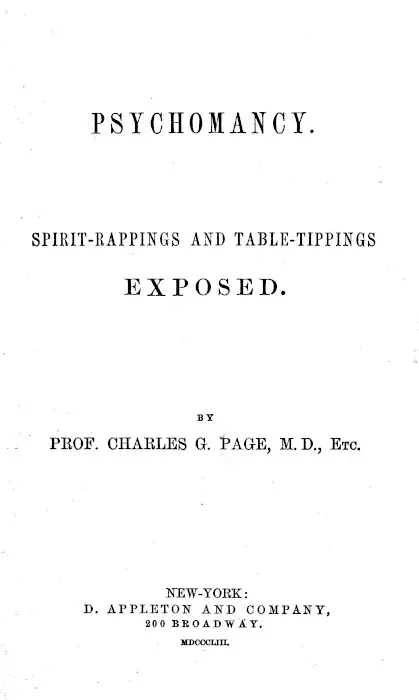
"Psychomancy: Spirit-Rappings and Table-Tippings Exposed" by Charles Grafton Page is a critical treatise written in the mid-19th century. The work delves into the phenomena of spirit communications and table movements, dismissed by the author as illusions rooted in human deception rather than genuine supernatural occurrences. Page argues against the credulity of society in regard to these practices, asserting they are little more than frauds perpetuated by charlatans for profit. The opening of the text sets a provocative tone, as Page challenges the widespread belief in spirit-rappings and table-tippings. He provides vivid descriptions of his own investigations into these practices, denouncing them as mere tricks executed by fraudsters, particularly the Fox sisters, who were among the first to popularize spiritualism in America. Through a series of experiments and observations, he strives to uncover the mechanics behind these phenomena, consistently attributing their origins to human agency rather than otherworldly forces. Page's writing is impassioned, urging readers to critically evaluate such miraculous claims through the lens of logic and science.
Introduction adapted from the source catalogue; source summaries may be automatically generated.
Free to read · English · 18,631 words · No account needed
MAKE TIME FOR A GOOD BOOK
On by default. Untick to stop anonymous reading totals. Each page counts after 10 seconds in view. How this works.
Anonymous counting is on unless you have switched it off.
We profess a profound reverence for all that is holy, and from our earliest recollection have been imbued with a deep dread of profanity in any shape, and approached this mockery of high Heaven with some reluctance, unwilling that our veneration should suffer so much violence. But we felt justified, in the full assurance that this thing was not of Heaven, but of men. For the sake of unravelling this imposture and illusion, for this purpose alone, we have put ourselves frequently in the attitude of dupes of these impostors, and feigning for a time conviction and conversion, have led them on till they were completely baffled in every attempt to perform their tricks, and the spirits became powerless and silent as the mortal tenements they once actuated. When we first sat down to a table with a few well-meaning and particular family friends to conjure spirits, we confess to a momentary feeling of horripilation, not from fear of meeting a visitor from another world, but from the impression that the very act was heaven-daring and profane. But when we came to utter the Rapper's Shibboleth, "If there are any spirits present, will they please to signify it by tipping the table?" the thoughts of sacrilege vanished, and were immediately supplanted by an irresistible sense of the ridiculous, and the smile and the laugh rose above all convictions of solemnity or irreverence. "Will the spirits please to tip the table?" was again and again reiterated, but no table tipped for us. Perhaps we are not "mediums," said one. "The spirits have declared that I am a medium," said another; but that Great Exorcist, common sense, was present and prevalent on this occasion; and the spirits would not communicate, and the table would not tip, certainly not, of itself. We introduced every variety of manipulation of crossing hands, interlocking fingers, and, in spite of all, and the most patient persistence, the table proved true to its lifeless character, and the universal law that "matter is inert, and cannot move of itself." What could have been the cause of this abortive conjuration? Were the spirits present, and not disposed to gratify a certain class of dilettanti who were present? Were they jesting and teazing, or in bad humor with our persons, our fixtures, or our espionage? For we had heard from very respectable sources, of the spirits jesting and taunting those present on such occasions. Or were they far away on some errand of duty, or busy and monopolized for some special tippings elsewhere? This last idea seems to be precluded by the fact that certain great spirits, such as Channing, Webster, Clay and Calhoun, who figure so largely on these occasions, rap and tip in different places at the same time. What mummery is all this to the mind that believes in the omnipresence of the Great God himself, who cannot look upon such practices but with abhorrence. Are you, Christian man or woman, one whit better for these doings than that woman with the familiar spirits, the Witch of Endor?[1] Are you not rather her disciple? and is she not held up to you for an example and a warning? Do you think that rappings and table-tippings give respectability to witchcraft? Is reading the future and the invisible world by rappings and tippings any better than the doings of yonder wretched crone, who works out in her concealed abode the same problems by packs of cards and mystical incantations? Are you not ministering encouragement to her hagship, and pursuing her very vocation, though under another name? Shall not this veritable beldame rise up in judgment, and plead in justification of fortune-telling the example of the Christian Church in spirit-rapping and table-tipping? Perhaps you think that these seeming wonders are fraught with more interest, novelty, and mystery, than the magical demonstrations of old. Why, in very truth, they are contemptibly insignificant when compared with the witcheries of old. Read Upham's letters on the witchcraft of the New England Colonies, Sir Walter Scott's demonology and witchcraft, and see how the rappings and tippings dwindle before the performances of the witches of yore. After reading these, study well Sir David Brewster's Natural Magic--a book that should be in the hands of every one who takes interest in these marvels of the day. There you will see how phenomena, at first sight inexplicable, are solved by the touch-stones of science and common sense. You will there find that sorcery was not to be stopped entirely by the gibbet, the gallows or the stake, but that the light of reason and science were most effectual in promoting its overthrow. Sir Walter Scott says of the opposers of witchcraft in the seventeenth century, that the "pursuers of exact science to its coy retreats were sure to be the first to discover that the most remarkable phenomena in nature are regulated by certain fixed laws, and cannot be rationally referred to supernatural agency" (meaning, of course, supernatural interference), "the sufficing cause to which superstition attributes all that is beyond her own narrow power of explanation. Each advance in natural knowledge teaches us, that it is the pleasure of the Creator to govern the world by the laws which he has imposed, and which in our times are not interrupted or suspended."
Your reading position is saved on this browser. Take it to another device with a library code. Reading pages adapt to text, rather than matching a printed edition.
BEHIND THE BOOK
This eBook is for the use of anyone anywhere in the United States and most other parts of the world at no cost and with almost no restrictions whatsoever. You may copy it, give it away or re-use it under the terms of the Project Gutenberg License included with this eBook or online at www.gutenberg.org. If you are not located in the United States, you will have to check the laws of the country where you are located before using this eBook. Read the source licence.
The original source file, including credits and licence, is retained by this library. Request an original-format copy at no charge. Please include the book title and Project Gutenberg identifier #61807.
KEEP YOUR CURIOSITY GOING
David Patterson (Spirit) Hatch

David Patterson (Spirit) Hatch

David Patterson (Spirit) Hatch
Cécile Tormay

Moritz Busch
Coulson Kernahan