THE CLASSIC COLLECTION✦Letters to an UnknownCLASSIC FREE BOOKS
Letters to an Unknown
Prosper Mérimée
THE CLASSIC COLLECTION · 1903
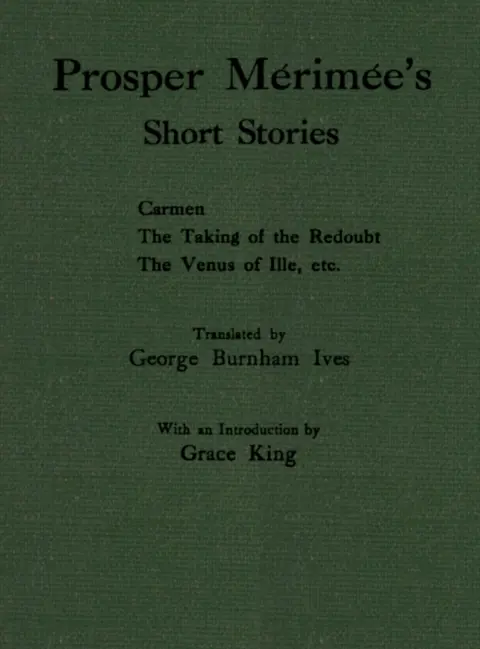
"Prosper Mérimée's Short Stories" by Prosper Mérimée is a collection of fictional narratives likely written during the mid-19th century. The collection features notable stories like "Carmen," "Mateo Falcone," and "The Venus of Ille," each showcasing Mérimée's mastery of narrative simplicity and vivid character portrayal. The stories explore themes of passion, conflict, and human nature, often set against exotic backdrops, with intriguing characters such as the gypsy Carmen, whose life and actions intricately weave through the moral and social fabric of her time. The opening of "Carmen" sets the stage with a protagonist who is an unnamed narrator, embarking on an archaeological expedition in Andalucía. During his journey, he stumbles upon a mysterious and attractive young man named Don José, who is armed and displays a proud demeanor. Their interaction begins with a casual exchange as they share cigars, leading the narrator to suspect José’s dubious nature as a smuggler or a highwayman. During their conversation, the narrator's guide reveals that José is in fact a notorious bandit with a substantial reward on his head. Ultimately, the opening section teases a budding relationship with the captivating figure of Carmen, hinting at themes of adventure, romance, and moral ambiguity that will unfold as the story progresses.
Introduction adapted from the source catalogue; source summaries may be automatically generated.
Free to read · English · 43,447 words · No account needed
MAKE TIME FOR A GOOD BOOK
On by default. Untick to stop anonymous reading totals. Each page counts after 10 seconds in view. How this works.
Anonymous counting is on unless you have switched it off.
This deliverance caused such an uproar, such noisy applause and such roars of laughter, that I thought that the ceiling would fall on our heads. There were only three sober faces at the table--those of the bride and groom, and my own. I had a terrible headache; and then, for some unknown reason, a wedding always depresses me. This one, in addition, disgusted me more or less.
The last couplets having been sung by the mayor’s deputy--and they were very free, I must say--we went to the salon to make merry over the retirement of the bride, who was soon to be escorted to her chamber, for it was near midnight.
M. Alphonse led me into a window recess, and said to me, averting his
eyes:
“You will laugh at me, but I don’t know what the matter is with me; I am bewitched! the devil has got hold of me!”
The first idea that came to my mind was that he believed himself to be threatened by some misfortune of the sort of which Montaigne and Madame de Sévigné speak:
“The sway of love is always full of tragic episodes,” etc.
“I supposed that accidents of that sort happened only to men of intellect,” I said to myself.--“You have drunk too much Collioure wine, my dear Monsieur Alphonse,” I said aloud. “I warned you.”
“Yes, that may be. But there is something much more terrible than
that.”
He spoke in a halting voice. I concluded that he was downright tipsy.
“You remember my ring?” he continued, after a pause.
“Well! has it been stolen?”
“No.”
“Then you have it?”
“No--I--I can’t take it off that infernal Venus’s finger!”
“Nonsense! you didn’t pull hard enough.”
“Yes, I did. But the Venus--she has bent her finger.”
He looked me in the eye with a haggard expression, leaning against the window-frame to avoid falling.
“What a fable!” I said. “You pushed the ring on too far. To-morrow you can recover it with a pair of pincers. But take care that you don’t injure the statue.”
“No, I tell you. The Venus’s finger is drawn in, bent; she has closed her hand--do you understand? She is my wife, apparently, as I have given her my ring. She refuses to give it back.”
I felt a sudden shiver, and for a moment I was all goose-flesh. Then, as he heaved a profound sigh, he sent a puff of alcoholic fumes into my face, and all my emotion vanished.
“The wretch is completely drunk,” I thought.
Your reading position is saved on this browser. Take it to another device with a library code. Reading pages adapt to text, rather than matching a printed edition.
BEHIND THE BOOK
This eBook is for the use of anyone anywhere in the United States and most other parts of the world at no cost and with almost no restrictions whatsoever. You may copy it, give it away or re-use it under the terms of the Project Gutenberg License included with this eBook or online at www.gutenberg.org. If you are not located in the United States, you will have to check the laws of the country where you are located before using this eBook. Read the source licence.
The original source file, including credits and licence, is retained by this library. Request an original-format copy at no charge. Please include the book title and Project Gutenberg identifier #67643.
KEEP YOUR CURIOSITY GOING
Coulson Kernahan

Maurice Baring
Frances Wright
Cécile Tormay

Frederic Jesup Stimson

W. H. P. (William Henry Pope) Jarvis