
Last letters from the living dead man
David Patterson (Spirit) Hatch
THE CLASSIC COLLECTION · 1812
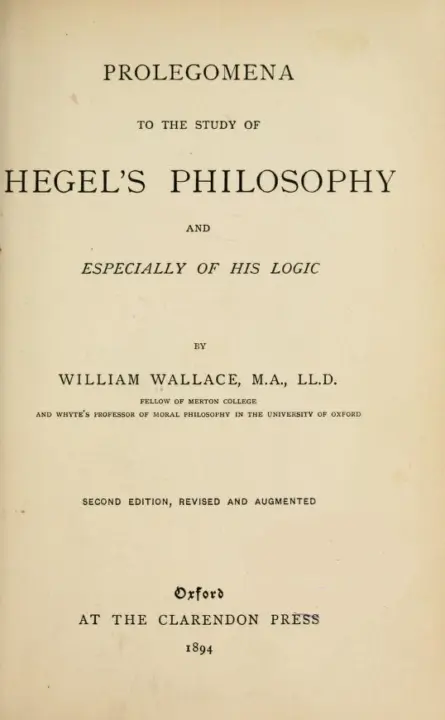
"Prolegomena to the Study of Hegel's Philosophy, and Especially of His Logic" by William Wallace is a philosophical treatise written in the late 19th century. This work serves as an introduction to the complex thought of Hegel, focusing particularly on his concepts of logic and how they relate to broader philosophical inquiries. Wallace aims to clarify and make accessible the often dense and abstract ideas attributed to Hegel, which have elicited varied interpretations and controversies among scholars. The opening of the text presents Wallace's preface, where he details the evolution of his own understanding of Hegel over two decades and outlines the challenges associated with Hegel's philosophy. He argues about the nature of Hegel's writings, contrasting the clarity sought in traditional sciences with the more intricate demands of Hegelian thought. The author acknowledges the difficulties readers face when engaging with Hegel, emphasizing the importance of patience and a willingness to abandon preconceived notions. Wallace highlights the relationship between Hegel's logic and the philosophical landscape of his time, suggesting that understanding Hegel is essential for grasping the evolution of modern philosophy and the responses to Kantian thought.
Introduction adapted from the source catalogue; source summaries may be automatically generated.
Free to read · English · 144,248 words · No account needed
MAKE TIME FOR A GOOD BOOK
On by default. Untick to stop anonymous reading totals. Each page counts after 10 seconds in view. How this works.
Anonymous counting is on unless you have switched it off.
This first sphere of thought, apparently so abstruse and unreal in its abstractions, had to be thus narrowly discussed because it presents all the difficulties and peculiarities of Hegel in their elementary form. They are clearly the fundamental problems of ancient Greek philosophy--of that first or fundamental philosophy which discusses Being and its intrinsic attributes or accidents. Modern superficiality has sometimes reproached these old thinkers (who, forsooth, 'knew no language but their own') for their tiresome insistence on this problem of Is and Is not. Compared, indeed, with what are called topics of interest, e. g. the Soul and the Hereafter, or the origins of the Cosmic process, tiresome such inquiry is. But it is the bitter lesson of experience that till such fundamentals are at least critically surveyed, the interesting topics will still (and in more than one sense) belong to the Unknowable. Herbart not less than Hegel sees it is the prime business of philosophical criticism (i. e. of philosophy) to examine thoroughly those primary notions on which the whole structure of thought rests. It is on the comprehension of the radical limitations latent in the seemingly simplest terms of thought, that the profoundest problems of human interest ultimately turn.
Thus, in the first place, the process of Being, as seen in the light of the whole system of Logic, shows that reality is truly known only as a trinity,--or perhaps rather as a duality in unity. This is the 'Notion' or 'Grasp' of Being. First, reality seems an unspecialised and self-centred being,--and that by itself is mere nothing: a mere universal. Second, it appears a specialised and differentiated being of some and other: a mere particular, limited by other particulars, and so finite. Third, as a combination of the two earlier stages: as wholeness with determinateness, as unity; and so an individual which is the true or complete and authentic character of all being. In the metaphysics of Being these three elements follow, one after another: but in the logic of the notion they interpenetrate, and each of them is the others and the total. The truth or the notion of being takes it in Being-for-self as a universalised particular or as an individual.--In the second place: the sphere of mere Being is that of mere identity: that of determinate being is the sphere of otherness, difference: that of self-determined being is the sphere of well-grounded existence.--Thirdly: the first sphere may be illustrated by the freedom of indeterminateness, expressed by the word 'may': the second by necessity or determinateness, expressed by the word 'must': and the third, by the freedom which even in its determinateness is self-determining, expressed by the word 'will.'--Fourthly: these steps illustrate the meaning of the Hegelian technical terms setzen: aufheben: an sich: für sich: Idealität: Realität. Thus Determinate Being or somewhat is an sich or implicitly (by implication) somewhat else: and the process of determinate being is to lay it down or express (setzen) it as such. When this explicitly-stated 'other' or limit is included in the Being, and reduced into a unity with somewhat in each Being-for-self, it is said to be 'aufgehoben'--uplifted, as it were, so that it is no longer a separate existent, but is still an efficient element. As being partly this, and partly that, now one, and now an other, which limits and is limited, determinate being is Realität. The characteristic of reality is externality of its parts, which are thus left side by side quasi-independent: that of ideality is unity and solidarity of function. When the mutual dependence of elements is tightened till it becomes equivalent to unity and totality, these elements are seen in their Ideality (Idealität). Such a total has the others in it as elements (Momente); they are there ideally (ideëller Weise,) as it were (in the loose analogical use of that term) organically: that is, they are denied the privilege, which their total has, of being-for-themselves. They do not enjoy the benefit of their own being, though their presence is felt.--Fifthly: Being-for-self is absolute negativity; i.e. the negation of negation. Determinate being was a negation of Being mere and simple: Being-for-self is the negation of this, and so a return to true affirmation, as including the element of negation.
Your reading position is saved on this browser. Take it to another device with a library code. Reading pages adapt to text, rather than matching a printed edition.
BEHIND THE BOOK
This eBook is for the use of anyone anywhere in the United States and most other parts of the world at no cost and with almost no restrictions whatsoever. You may copy it, give it away or re-use it under the terms of the Project Gutenberg License included with this eBook or online at www.gutenberg.org. If you are not located in the United States, you will have to check the laws of the country where you are located before using this eBook. Read the source licence.
The original source file, including credits and licence, is retained by this library. Request an original-format copy at no charge. Please include the book title and Project Gutenberg identifier #54992.
KEEP YOUR CURIOSITY GOING
David Patterson (Spirit) Hatch
Coulson Kernahan

Ralph Waldo Emerson
Frances Wright

Edwin Abbott Abbott

Joseph Droz