
Last letters from the living dead man
David Patterson (Spirit) Hatch
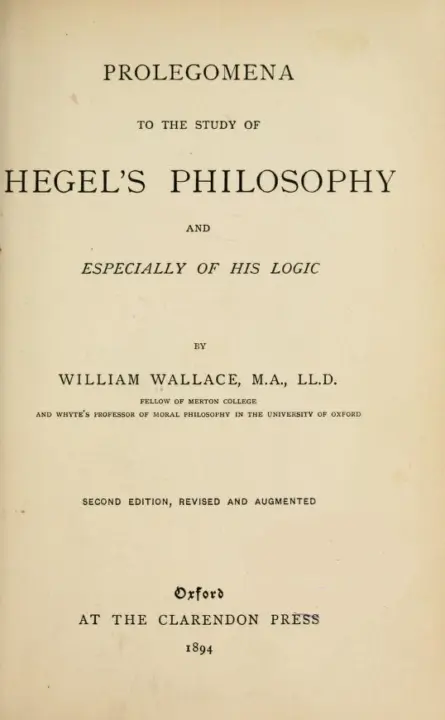
THE CLASSIC COLLECTION · 1812
"Prolegomena to the Study of Hegel's Philosophy, and Especially of His Logic" by William Wallace is a philosophical treatise written in the late 19th century. This work serves as an introduction to the complex thought of Hegel, focusing particularly on his concepts of logic and how they relate to broader philosophical inquiries. Wallace aims to clarify and make accessible the often dense and abstract ideas attributed to Hegel, which have elicited varied interpretations and controversies among scholars. The opening of the text presents Wallace's preface, where he details the evolution of his own understanding of Hegel over two decades and outlines the challenges associated with Hegel's philosophy. He argues about the nature of Hegel's writings, contrasting the clarity sought in traditional sciences with the more intricate demands of Hegelian thought. The author acknowledges the difficulties readers face when engaging with Hegel, emphasizing the importance of patience and a willingness to abandon preconceived notions. Wallace highlights the relationship between Hegel's logic and the philosophical landscape of his time, suggesting that understanding Hegel is essential for grasping the evolution of modern philosophy and the responses to Kantian thought.
Introduction adapted from the source catalogue; source summaries may be automatically generated.
Free to read · English · 144,248 words · No account needed
MAKE TIME FOR A GOOD BOOK
On by default. Untick to stop anonymous reading totals. Each page counts after 10 seconds in view. How this works.
Anonymous counting is on unless you have switched it off.
This Being-for-self is a kind of true infinite, which results by absorption of the finite. The false infinite, which has already come before us, is the endless range of finitude, passing from one finite to another, from somewhat to somewhat else, until satiety sets in with weariness. The true infinite is satisfaction,--the inclusion of the other being into self, so that it is no longer a limit, but a constituent part in the being. Such inclusion in the unity of an idea, of elements which are realistically separate, is termed 'ideality.' The antithesis is reduced to become an organic and dependent part. It still exists, but as no longer outside and independent. Thus in determinate being the determinateness is found in somewhat else: in being-for-self the determinateness is self-realisation. Being-for-self may be shortly expressed by 'one' or 'each': as determinate being a, or an, or by 'some': and Being simple has no nominal equivalent. As 'some' is always fractional or partial, 'each' is always a whole or unit. Mere Being has not the consistency of any noun or pronoun: it is the bare (impersonal) verb.
But 'each for self' expresses the sentiment of an armed neutrality with implicit leanings to universal war,--the bellum omnium contra omnes. Each is self-centred, independent, resting upon self, and not minding anything else,--which is now thrown out as indifferent into the background. Each is centripetal; anything else is for it a matter of no moment. If determinate being was something to be explained by something other, this is or professed to be self-explanatory, and rests upon itself. It seems purely affirmative, and promises to give a definite unity. But we cannot free thought from negation in this sphere, any more than in the earlier. We may, if we like, assert the absolute self-sufficingness, primariness, and unalterability of each; but a very little reflection shows the opposite to be true. The very notion of each is exclusiveness towards the rest: a negative and, as it were, polemical attitude towards others is the very basis of Being-for-self. One after one, they each rise to confront each, each excluding each, until their self-importance is reduced to be a mere point in a series of points, one amongst many. When that is clearly seen, their qualitative character has disappeared: and there is left only their quantity.[9] The negative attitude of each to each forms a sort of bond connecting them. If to the reference which connects we give the name of attraction, then we may say that the repulsion of each against each is exactly equal to their mutual attraction. And thus, in the language of Hobbes, the universal quarrel is only the other side of the general union in the great Leviathan: repulsion, in the shape of mutual fear, is the principle of attraction. Thus each for self is repeated endlessly: instead of the atom or unit we have a multitude, utterly indifferent to what each is for itself. The mere fact that it is, entitles it to count, and so constitutes quantity. Here we may shortly recapitulate the categories of Quality or Being Proper. It forms three steps or grades: those of indeterminate being: determinate being: self-determined being: or if we speak of them as processes, we have becoming: alteration: attraction and repulsion[10]. From the extreme of abstraction and concentration thought, under the form of Being, passes on to greater determinateness and development. The fixity of mere Being is seen to imply a distinction of elements, and a dependence of one upon the other: where the 'is' and 'is not' part from each other sufficiently to let us distinguish them. This is the stage of finitude: when we say that there is somewhat, but there are others, and imply that any one has an end, a limit, a negation in its nature. These words describe the finite scene,--a fragmentary being which makes an advance upon indeterminateness, but loses its wholeness and is always and necessarily leading on to something else. It is the revulsion from the vague and yet unspecified universal to definite and limited particulars. In the third stage the limit is uplifted and included in the particular, which now contains its negation in itself,--is (by accepting its dependence) independent, is its own ground, and may be called an individual. But an individual, again, implies an aggregate of ones, or a multitude. This being-for-self is an individual or atom: it is the basis of those higher developments known as subjectivity and personality. These are, as it were, higher multiples of it.
Your reading position is saved on this browser. Take it to another device with a library code. Reading pages adapt to text, rather than matching a printed edition.
BEHIND THE BOOK
This eBook is for the use of anyone anywhere in the United States and most other parts of the world at no cost and with almost no restrictions whatsoever. You may copy it, give it away or re-use it under the terms of the Project Gutenberg License included with this eBook or online at www.gutenberg.org. If you are not located in the United States, you will have to check the laws of the country where you are located before using this eBook. Read the source licence.
The original source file, including credits and licence, is retained by this library. Request an original-format copy at no charge. Please include the book title and Project Gutenberg identifier #54992.
KEEP YOUR CURIOSITY GOING
David Patterson (Spirit) Hatch
Coulson Kernahan

Ralph Waldo Emerson
Frances Wright

Edwin Abbott Abbott

Joseph Droz