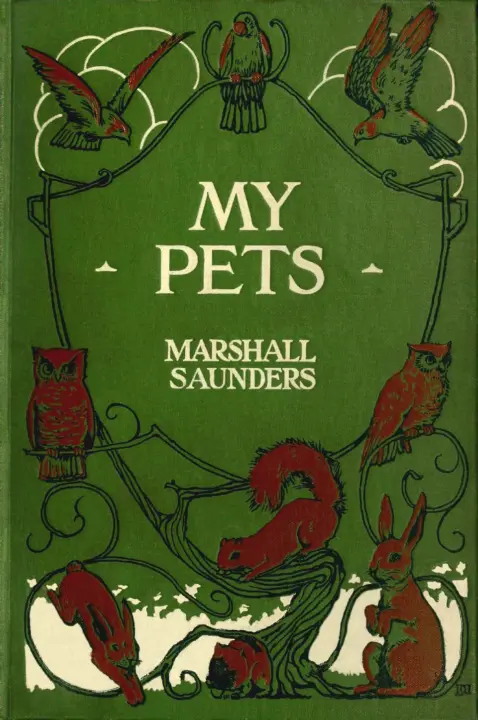
My pets
Marshall Saunders
THE CLASSIC COLLECTION · 1905
"Princess Sukey: The story of a pigeon and her human friends" by Marshall Saunders is a children's novel written in the early 20th century. The story revolves around Princess Sukey, a Jacobin pigeon who begins her life frail and abandoned but is rescued by a boy named Titus Sancroft. The book explores themes of compassion and friendship through the bond between the pigeon and her human companions, particularly focusing on how they navigate their troubles together. The opening of the story introduces Princess Sukey as she dreams by the fire, reflecting on her past and the series of events that led her to her new home. As a sickly chick, she is discarded by her father and nearly left to die when she is discovered by young Titus, who insists on saving her. Supported by a comical series of interactions with Titus, his grandfather Judge Sancroft, and the household staff, the narrative sets the stage for the unfolding relationship between the characters and Princess Sukey. It hints at the themes of kindness toward animals and the emotional journeys of both the boy and the bird as they cope with life’s challenges. The beginnings of friendship and the contrast between wealth and poverty become apparent, suggesting a rich layering of narrative to come.
Introduction adapted from the source catalogue; source summaries may be automatically generated.
Free to read · English · 84,299 words · No account needed
MAKE TIME FOR A GOOD BOOK
On by default. Untick to stop anonymous reading totals. Each page counts after 10 seconds in view. How this works.
Anonymous counting is on unless you have switched it off.
“Come, come,” said the Judge, humoring him; “to satisfy you we will make
a search.”
Quite a procession moved up the stairway—the Judge, holding Bethany’s hand, in advance, the two boys and the servants following.
Upon arriving in the upper hall and traversing it to the L beyond, where the servants’ bedrooms were over the kitchen and pantries, Dallas kept looking sharply about.
One peculiarity of the Judge was that he liked plenty of light. At night the electric lights were turned on in every hall and every room, whether occupied or not.
“I do not see the culprits,” said Dallas, “but I will call,” and he gave a tentative “Too whoo, whoo, whoo whoo!”
“Too whoo, whoo, whoo whoo,” said two little soft voices near them.
Dallas stuck his head out a window. “Ah, there are the miscreants, sitting on the limb of that tree.”
The branches of the big, leafless old elm brushed the hall window, and the little owls sitting there were calmly contemplating a rising moon.
The Judge let Bethany look at them, then he said: “See, Higby, there are your burglars. There are no traces of any others here. No man would be bold enough to pass through this lighted house, and if he did why should he attack you?”
“I-I-I saw him,” burst from Higby, “a b-b-big black man.”
The Judge looked down at Bethany. She was tightly clasping his hand, and the expression of her face was doubtful.
“They were owls that attacked you, Higby,” he said, decidedly; “don’t let me hear any more nonsense about a burglar. Come downstairs, children,” and he turned about.
Bethany would not let go his hand, even when they entered the study.
“I will read aloud a little to compose her thoughts before she goes to bed,” the Judge reflected. “No fairy tales to stimulate her imagination, but something that she will not understand,” and he took from his bookshelves a volume of Milton’s works.
He seated himself by the table, drew his reading light toward him, and began. After a time he looked down at the little figure sitting on the stool at his feet.
“I suppose you don’t understand this, Bethany,” he said, patronizingly.
“O, don’t speak, don’t speak, Daddy Grandpa,” she said, impatiently;
“please go on.”
She had lifted her head. Her face had lost its dreamy expression. It was glowing, radiant, and intensely interested. The Judge went on mechanically:
“‘There the companions of his fall, o’erwhelmed With floods and whirlwinds of tempestuous fire—’”
Why, the child was understanding what he read, he reflected with surprise, or, rather, she was putting her own interpretation upon it.
Your reading position is saved on this browser. Take it to another device with a library code. Reading pages adapt to text, rather than matching a printed edition.
Marshall Saunders
Marshall Saunders
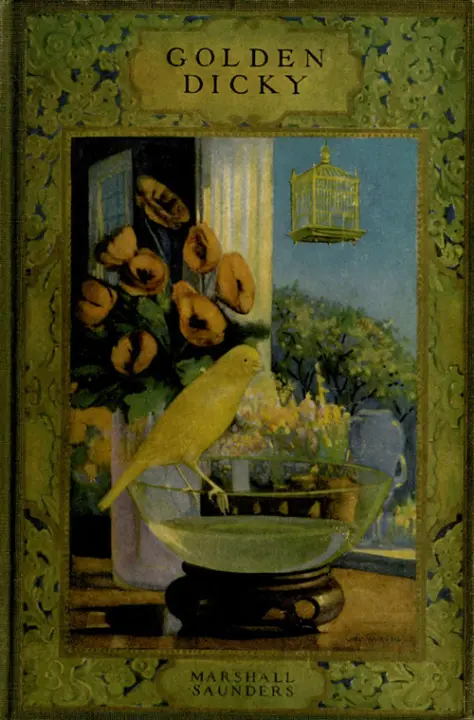
Marshall Saunders
Marshall Saunders
BEHIND THE BOOK
This eBook is for the use of anyone anywhere in the United States and most other parts of the world at no cost and with almost no restrictions whatsoever. You may copy it, give it away or re-use it under the terms of the Project Gutenberg License included with this eBook or online at www.gutenberg.org. If you are not located in the United States, you will have to check the laws of the country where you are located before using this eBook. Read the source licence.
The original source file, including credits and licence, is retained by this library. Request an original-format copy at no charge. Please include the book title and Project Gutenberg identifier #69707.
KEEP YOUR CURIOSITY GOING
Coulson Kernahan

Maurice Baring
Frances Wright
Cécile Tormay

Frederic Jesup Stimson

W. H. P. (William Henry Pope) Jarvis