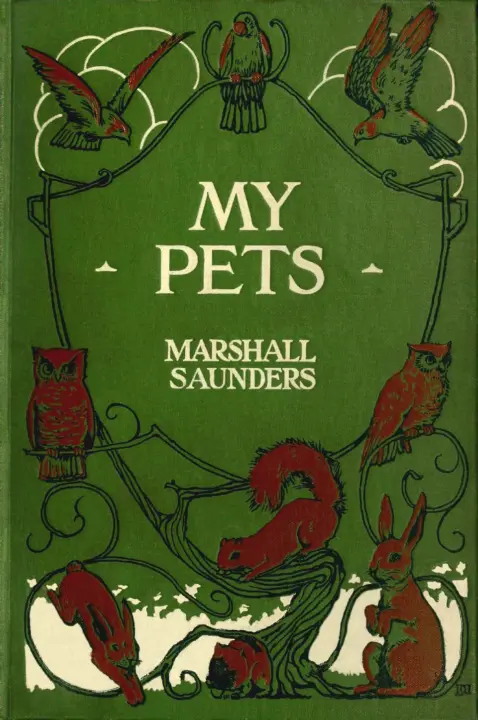
My pets
Marshall Saunders
THE CLASSIC COLLECTION · 1905
"Princess Sukey: The story of a pigeon and her human friends" by Marshall Saunders is a children's novel written in the early 20th century. The story revolves around Princess Sukey, a Jacobin pigeon who begins her life frail and abandoned but is rescued by a boy named Titus Sancroft. The book explores themes of compassion and friendship through the bond between the pigeon and her human companions, particularly focusing on how they navigate their troubles together. The opening of the story introduces Princess Sukey as she dreams by the fire, reflecting on her past and the series of events that led her to her new home. As a sickly chick, she is discarded by her father and nearly left to die when she is discovered by young Titus, who insists on saving her. Supported by a comical series of interactions with Titus, his grandfather Judge Sancroft, and the household staff, the narrative sets the stage for the unfolding relationship between the characters and Princess Sukey. It hints at the themes of kindness toward animals and the emotional journeys of both the boy and the bird as they cope with life’s challenges. The beginnings of friendship and the contrast between wealth and poverty become apparent, suggesting a rich layering of narrative to come.
Introduction adapted from the source catalogue; source summaries may be automatically generated.
Free to read · English · 84,299 words · No account needed
MAKE TIME FOR A GOOD BOOK
On by default. Untick to stop anonymous reading totals. Each page counts after 10 seconds in view. How this works.
Anonymous counting is on unless you have switched it off.
Titus sprang forward, took him by the sleeve, and led him past the group of frightened maids to a safe corner by the hall window.
From there he went on with his story.
“W-w-was in m-m-my room in my bed, s-s-sound asleep, d-dreaming of home and m-m-mother. S-s-sir,” and he turned to the Judge, “w-w-we lived in a little house b-b-by a running brook, n-n-near a w-w-wood. I woke up, s-s-sir, c-c-crying. Then I heard a s-s-sound, sir, l-l-like the sounds of o-o-old times.”
“Well?” said the Judge, encouragingly.
“I-I-I got up, sir; I put on m-m-my gown a-a-and s-s-slippers; I-I-I went out in the h-h-hall, sir.”
“And what happened?”
“Th-th-the burglars must h-h-have been waiting, s-s-sir. They j-j-jumped on me from behind. Th-th-they struck me on the h-h-head with their sharp knives, s-s-sir.”
“Did you see them?” asked the Judge, sharply.
“I-I-I thought I saw one, sir. He was all in b-b-black, sir, and he d-d-dug his knife in me.”
The Judge looked mystified. If it had been the middle of the night he would have believed Higby’s story, but early in the evening he could not for a moment suppose that any thieves would rush out and attack a person who was simply walking along a hall. However, he turned to the boys.
“Come upstairs with me and we will make a thorough search.”
“Wait a minute, please, sir,” said Dallas. “May I ask Higby what the sound was that drew him from his bed?”
“T-t-the sound of owls, sir,” stammered Higby, “of little ow-ow-owls sittin’ on the trees an’ hootin.’”
Dallas gave Titus a queer look, and the latter immediately burst out
laughing.
“’Pon my word; poor old Higby,” gasped Titus. “You’ve been fooled.”
The manservant looked at him indignantly, while Dallas turned to the Judge, who was waiting for an explanation.
“You told me not to keep my birds so closely, sir, so I let them do pretty much as they please. I open my window every night at dusk. They must have got in through some other window into the hall. It is a habit of owls to pounce on anything furry or hairy.”
“I know that,” said the Judge, with a hearty laugh. “I’ve heard of their descending on the fur caps of hunters. Well! well! poor old Higby,” and he turned to him. “Come, now, get over your fright. Those were only little birds that attacked you—Master Dallas’s little owls.”
Higby was in a speechless rage. He did not dare to get angry with the Judge, but he did not for a moment believe that his assailant had been a bird.
Your reading position is saved on this browser. Take it to another device with a library code. Reading pages adapt to text, rather than matching a printed edition.
Marshall Saunders
Marshall Saunders
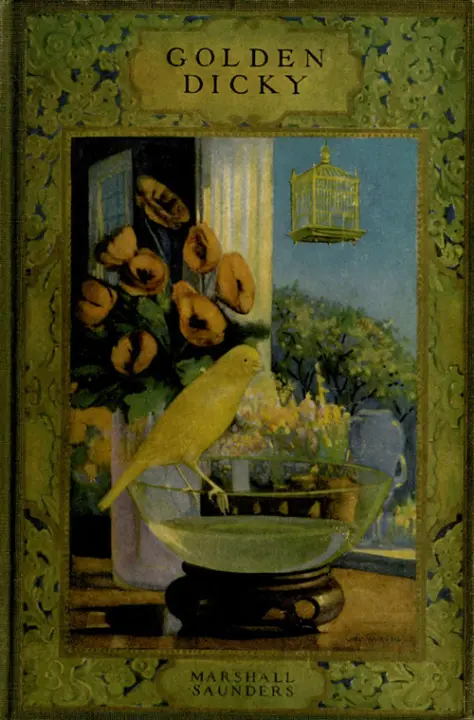
Marshall Saunders
Marshall Saunders
BEHIND THE BOOK
This eBook is for the use of anyone anywhere in the United States and most other parts of the world at no cost and with almost no restrictions whatsoever. You may copy it, give it away or re-use it under the terms of the Project Gutenberg License included with this eBook or online at www.gutenberg.org. If you are not located in the United States, you will have to check the laws of the country where you are located before using this eBook. Read the source licence.
The original source file, including credits and licence, is retained by this library. Request an original-format copy at no charge. Please include the book title and Project Gutenberg identifier #69707.
KEEP YOUR CURIOSITY GOING
Coulson Kernahan

Maurice Baring
Frances Wright
Cécile Tormay

Frederic Jesup Stimson

W. H. P. (William Henry Pope) Jarvis