THE CLASSIC COLLECTION✦A dead man’s diaryCLASSIC FREE BOOKS
A dead man’s diary
Coulson Kernahan
THE CLASSIC COLLECTION · 1913
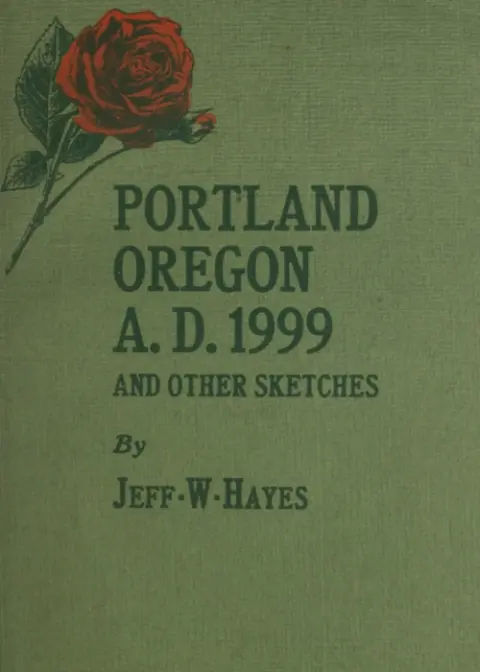
"Portland, Oregon, A.D. 1999, and Other Sketches" by J. W. Hayes is a collection of speculative fiction written in the early 20th century. The book examines a futuristic vision of Portland, Oregon, with a blend of prophecy and social commentary, all narrated through the voice of a remarkable elderly woman who recounts her life experiences and burgeoning visions of the future. The sketches present a vivid portrayal of anticipated technological and societal advancements that reflect the author's aspirations for a better world. The opening of the work introduces readers to an intriguing character: a bright and intelligent woman who, at 86 years old, recalls her life from the past and visions of the future. Through her reminiscing, she shares tales of her journey from Virginia to Oregon and begins to unveil prophecies about life in Portland in the year 1999. As she describes extraordinary inventions like aerial transportation, revolutionary societal changes, and an optimistic picture of the city's transformation, the reader is invited to explore a future where progress and harmony abound. This intriguing blend of reflection and futurism sets the stage for the subsequent sketches, each exploring different aspects of societal evolution in a uniquely speculative context.
Introduction adapted from the source catalogue; source summaries may be automatically generated.
Free to read · English · 27,389 words · No account needed
MAKE TIME FOR A GOOD BOOK
On by default. Untick to stop anonymous reading totals. Each page counts after 10 seconds in view. How this works.
Anonymous counting is on unless you have switched it off.
"All right, you need not say 'night message,' omit the place from, date, all punctuations, 'sig' and cut 'em to the bone," came from St. Louis, "and mind you, hurry up," taunted Moxon.
This was probably the first time in his life that Albert Ayres was requested to "hurry up," he being used to hear the opposite, "to slow up," and his black eyes snapped in anticipation of the fun he was about to have.
His key flew open and a fire of dots and dashes ensued, which to a layman might sound like shot poured into a tin horn.
The reputation of the whole office seemed to be at stake, and all gathered around to see, what was rightly thought would be an unparalleled feat of rapid transmission.
Moxon took the first message, Day the second, Wheeler the third, while the writer handled the fourth, each rotating in this manner, filling in dates, destinations, etc., awaiting his turn to copy the next message.
The excitement was intense when it was announced that 12 messages had been received in five minutes.
There were no breaks, or interruptions, and at 12:55 A. M., precisely 55 minutes from the starting time, the 120 messages were received and were en route to New York, accomplishing, probably, the most unequalled feat of fast sending ever attempted.
The matter was kept an office secret and Moxon received much credit. It never leaked out how his tact secured ready co-operation and enabled him to cope with a difficult situation.
While traveling recently through the South, the writer was marooned for several hours near Horse Cave, in Kentucky. The Cumberland River was very high, swamping the darkies' cabins en route, compelling the colored people to take refuge on their roofs, where they waited "fo' de ribber to go down."
The negroes accepted the situation very cheerfully, many playing their banjoes and singing olden time melodies and making light of their predicament.
Almost involuntarily, I began humming "My Old Kentucky Home" and my thoughts were of the "yellow fields o' corn," when a voice behind me inquired, "Do you like that song?" I assured him that the tune was all right, but the words were a trifle silly.
"Well, I don't think so," he remarked, "the words and air are both very sweet to me, and if you'll make room for me, I'll tell you how that song compelled me to make a trip of 2,000 miles."
Space was given him and he began his narrative.
"It was five years ago that I was induced to go west by the alluring advertisements of the railroad company, who related how easy it was to speedily get rich in Colorado.
Your reading position is saved on this browser. Take it to another device with a library code. Reading pages adapt to text, rather than matching a printed edition.
BEHIND THE BOOK
This eBook is for the use of anyone anywhere in the United States and most other parts of the world at no cost and with almost no restrictions whatsoever. You may copy it, give it away or re-use it under the terms of the Project Gutenberg License included with this eBook or online at www.gutenberg.org. If you are not located in the United States, you will have to check the laws of the country where you are located before using this eBook. Read the source licence.
The original source file, including credits and licence, is retained by this library. Request an original-format copy at no charge. Please include the book title and Project Gutenberg identifier #62495.
KEEP YOUR CURIOSITY GOING
Coulson Kernahan

Maurice Baring
Frances Wright
Cécile Tormay
Francis Greenleaf Allinson & Anne C. E. (Anne Crosby Emery) Allinson

Frederic Jesup Stimson