THE CLASSIC COLLECTION✦A dead man’s diaryCLASSIC FREE BOOKS
A dead man’s diary
Coulson Kernahan
THE CLASSIC COLLECTION · 1913
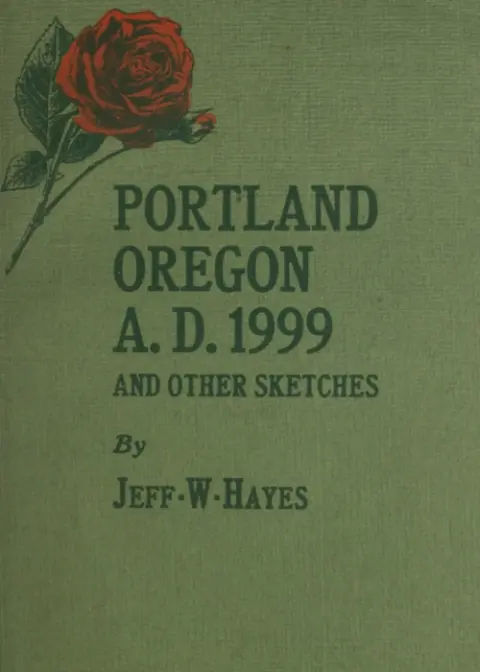
"Portland, Oregon, A.D. 1999, and Other Sketches" by J. W. Hayes is a collection of speculative fiction written in the early 20th century. The book examines a futuristic vision of Portland, Oregon, with a blend of prophecy and social commentary, all narrated through the voice of a remarkable elderly woman who recounts her life experiences and burgeoning visions of the future. The sketches present a vivid portrayal of anticipated technological and societal advancements that reflect the author's aspirations for a better world. The opening of the work introduces readers to an intriguing character: a bright and intelligent woman who, at 86 years old, recalls her life from the past and visions of the future. Through her reminiscing, she shares tales of her journey from Virginia to Oregon and begins to unveil prophecies about life in Portland in the year 1999. As she describes extraordinary inventions like aerial transportation, revolutionary societal changes, and an optimistic picture of the city's transformation, the reader is invited to explore a future where progress and harmony abound. This intriguing blend of reflection and futurism sets the stage for the subsequent sketches, each exploring different aspects of societal evolution in a uniquely speculative context.
Introduction adapted from the source catalogue; source summaries may be automatically generated.
Free to read · English · 27,389 words · No account needed
MAKE TIME FOR A GOOD BOOK
On by default. Untick to stop anonymous reading totals. Each page counts after 10 seconds in view. How this works.
Anonymous counting is on unless you have switched it off.
I need $20 very badly today; may I draw the same?
Signed, M. D. Crain, Operator.
Then Manager Crain would reply:
To M. D. Crain, Operator.
Yes, Mark, you certainly can draw $20, as you deserve it.
Signed, M. D. Crain, Manager.
After this formula had been gone through and properly signed and filed, the Colonel would draw the money, but not before.
In the 70's there was an operator named Robert C. Hayes, who worked in Cincinnati, St. Louis, Chicago and Omaha. "Bob," as he was called, was a great operator and was in demand in emergency cases and it was no wonder that Charles Selden selected him as one of those to assist during the national convention held in Cincinnati in 1876.
The convention had been in progress for several days and everybody was tired and worn out with expectancy.
One afternoon Hayes, Tom Dudley and Bob Irwin were allowed 30 minutes for luncheon. Upon their return, the doors of the convention hall opened and a mass of excited men rushed out, yelling, "Hayes!" "Hayes!" "Hayes!" "Bob" Hayes immediately left his comrades and flew down the street.
"What's the matter?" cried Tom Dudley after the fleeing man.
"Oh, hush! hush!" cried back the fleeting Hayes, "don't you hear my
creditors yelling after me."
It seems the convention had just nominated Rutherford B. Hayes for the presidency and that alone was the cause of the tumult.
Robt. C. Hayes now holds a prominent position with the Burlington road in Omaha and his friends still tell this story on him.
George Lawton, affectionately known to the telegraph fraternity as "Old Farmer" Lawton, is a familiar figure in the Denver office where he holds the position of assistant manager.
"Farmer" Lawton has worked in Denver, lo, these many years. He loves to reminisce and his stories are good.
Back in the 70's the "Farmer" used to copy press from "Nip" Jones, at Cheyenne, for the Denver papers. "Nip" was a fast but erratic sender, his speed varying according to his mood.
"Farmer" Lawton had been "breaking" a good deal one night, when Jones petulantly remarked: "I say, 'Farmer,' how is it that some nights you take me all right and other nights you break every little while?"
"Farmer" Lawton's artless reply was, "Why, don't you see, 'Nip,' you send faster some nights than you do others."
When Mr. A. B. Cowan was chief operator of the Chicago office he found himself, on an occasion, needing some help in the printer's room and he engaged a young Jewess, named Henrietta, to work as automatic operator. The newcomer proved to be very trustworthy, full of snap, energetic and intelligent.
Your reading position is saved on this browser. Take it to another device with a library code. Reading pages adapt to text, rather than matching a printed edition.
BEHIND THE BOOK
This eBook is for the use of anyone anywhere in the United States and most other parts of the world at no cost and with almost no restrictions whatsoever. You may copy it, give it away or re-use it under the terms of the Project Gutenberg License included with this eBook or online at www.gutenberg.org. If you are not located in the United States, you will have to check the laws of the country where you are located before using this eBook. Read the source licence.
The original source file, including credits and licence, is retained by this library. Request an original-format copy at no charge. Please include the book title and Project Gutenberg identifier #62495.
KEEP YOUR CURIOSITY GOING
Coulson Kernahan

Maurice Baring
Frances Wright
Cécile Tormay
Francis Greenleaf Allinson & Anne C. E. (Anne Crosby Emery) Allinson

Frederic Jesup Stimson