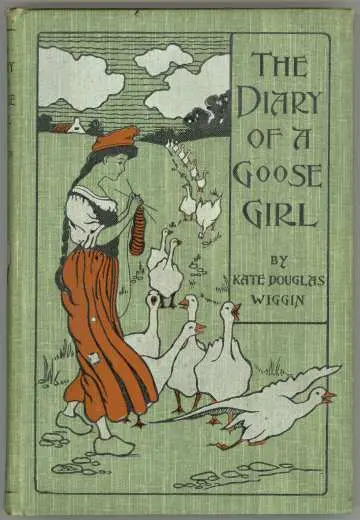
The Diary of a Goose Girl
Kate Douglas Smith Wiggin
THE CLASSIC COLLECTION · 1893
"Polly Oliver's Problem" by Kate Douglas Smith Wiggin is a novel written in the late 19th century. The story introduces readers to Polly Oliver, a spirited young girl who grapples with her desire for independence while supporting her ailing mother and managing a household filled with boarders. The novel reflects themes of personal growth, the challenges of young adulthood, and the intricacies of familial love, set against the backdrop of California's picturesque landscapes. The opening of the novel centers on Polly's strong-willed nature and her humorous determination to rid her household of the boarders who disrupt her aspirations for a more joyful family life. With a firm declaration that "the boarders must go," Polly shares her whimsical strategies for evicting them, all while displaying her vibrant personality and wit. The dynamic between Polly and her gentle mother is highlighted as they navigate the difficulties of managing their lives after the loss of Polly's father, setting the stage for Polly's evolving roles as a young woman striving for a better future. Through her playful musings and earnest commitments to her mother, Polly begins to envision a life beyond the constraints of their current situation.
Introduction adapted from the source catalogue; source summaries may be automatically generated.
Free to read · English · 43,431 words · No account needed
MAKE TIME FOR A GOOD BOOK
On by default. Untick to stop anonymous reading totals. Each page counts after 10 seconds in view. How this works.
Anonymous counting is on unless you have switched it off.
As the summer wore away, Mrs. Oliver daily grew more and more languid, until at length she was forced to ask a widowed neighbor, Mrs. Chadwick, to come and take the housekeeping cares until she should feel stronger. But beef-tea and drives, salt-water bathing and tonics, seemed to do no good, and at length there came a day when she had not sufficient strength to sit up.
The sight of her mother actually in bed in the daytime gave Polly a sensation as of a cold hand clutching at her heart, and she ran for Dr. Edgerton in an agony of fear. But good "Dr. George" (as he was always called, because he began practice when his father, the old doctor, was still living) came home with her, cheered her by his hopeful view of the case, and asked her to call at his office that afternoon for some remedies.
After dinner was over, Polly kissed her sleeping mother, laid a rose on her pillow for good-by, and stole out of the room.
Her heart was heavy as she walked into the office where the doctor sat
alone at his desk.
"Good-day, my dear!" he said cordially, as he looked up, for she was one of his prime favorites. "Bless my soul, how you do grow, child! Why you are almost a woman!"
"I am quite a woman," said Polly, with a choking sensation in her throat; "and you have something to say to me, Dr. George, or you would n't have asked me to leave mamma and come here this stifling day; you would have sent the medicine by your office-boy."
Dr. George laid down his pen in mild, amazement. "You are a woman, in every sense of the word, my dear! Bless my soul, how you do hit it occasionally, you sprig of a girl! Now, sit by that window, and we 'll talk. What I wanted to say to you is this, Polly. Your mother must have an entire change. Six months ago I tried to send her to a rest-cure, but she refused to go anywhere without you, saying that you were her best tonic."
Two tears ran down Polly's cheeks.
"Tell me that again, please," she said softly, looking out of the
window.
"She said--if you will have the very words, and all of them--that you were sun and stimulant, fresh air, medicine, and nourishment, and that she could not exist without those indispensables, even in a rest-cure."
Polly's head went down on the windowsill in a sudden passion of tears.
"Hoity-toity! that 's a queer way of receiving a compliment, young
woman!"
She tried to smile through her April shower.
Your reading position is saved on this browser. Take it to another device with a library code. Reading pages adapt to text, rather than matching a printed edition.
Kate Douglas Smith Wiggin
Kate Douglas Smith Wiggin
Kate Douglas Smith Wiggin
Kate Douglas Smith Wiggin & Nora Archibald Smith
BEHIND THE BOOK
This eBook is for the use of anyone anywhere in the United States and most other parts of the world at no cost and with almost no restrictions whatsoever. You may copy it, give it away or re-use it under the terms of the Project Gutenberg License included with this eBook or online at www.gutenberg.org. If you are not located in the United States, you will have to check the laws of the country where you are located before using this eBook. Read the source licence.
The original source file, including credits and licence, is retained by this library. Request an original-format copy at no charge. Please include the book title and Project Gutenberg identifier #15630.
KEEP YOUR CURIOSITY GOING
Coulson Kernahan

Maurice Baring
Frances Wright
Cécile Tormay

Frederic Jesup Stimson

W. H. P. (William Henry Pope) Jarvis