
Letters to a Friend, Written to Mrs. Ezra S. Carr, 1866-1879
John Muir
THE CLASSIC COLLECTION · 1906
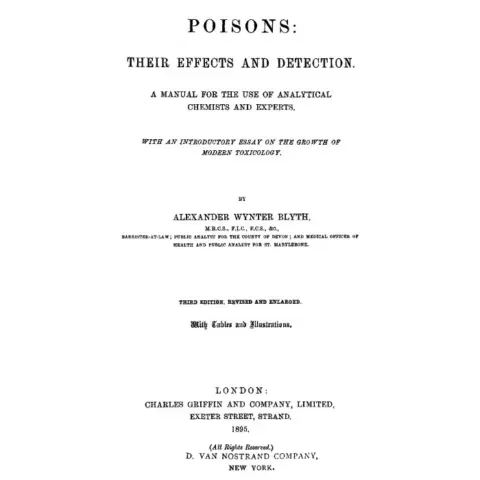
"Poisons, Their Effects and Detection" by Alexander Wynter Blyth is a scientific publication written in the late 19th century. This work serves as a comprehensive manual for analytical chemists and forensic experts, detailing the nature, effects, and detection methods of various toxic substances. It explores the historical context of poison knowledge, its physiological effects, and diagnostics, proving essential for anyone involved in toxicology or forensic medicine. The beginning of this manual outlines the origins of poison knowledge, highlighting the significance of the word "toxicology" and its connection to ancient practices involving poisons used on weaponry. It references mythological figures associated with poison, such as Hecate and Medea, and sets a tone of intrigue surrounding early toxicological research. Blyth emphasizes how ancient civilizations perceived poisons and the supernatural beliefs attached to them, paving the way through history to modern understandings of toxins and their effects on health and life.
Introduction adapted from the source catalogue; source summaries may be automatically generated.
Free to read · English · 336,607 words · No account needed
MAKE TIME FOR A GOOD BOOK
On by default. Untick to stop anonymous reading totals. Each page counts after 10 seconds in view. How this works.
Anonymous counting is on unless you have switched it off.
The chief preparations of lead which may be met with in the arts, in addition to the oxides and the carbonate, are--
The =Nitrate of Lead=, much used in calico-printing.
The =Pyrolignite of Lead=, which is an impure acetate used in
dyeing; and
The =Sulphate of Lead= is a by-product in the preparation of acetate of aluminium for dyeing.
The alloys containing lead are extremely numerous; but, according to the experiments of Knapp,[822] the small quantity of lead in those used for household purposes has no hygienic importance.
[822] Dingl. Polytech. Journ., vol. ccxx. pp. 446-453.
§ 778. =Statistics of Lead-Poisoning.=--In the ten years, 1883 to 1892, no less than 1043 persons died from the effects of lead; of these, 3 only were suicidal, the remaining 1040 were mainly from the manufacture of white lead or from the use of lead in the arts or from the accidental contamination of food or drink.
The following table shows in what manner the 1040 were distributed as to
age and sex:--
Ages, 0-1 1-5 5-15 15-25 25-65 65 and Total above Males, ... 4 14 44 733 36 831 Females, 3 5 ... 68 129 4 209 --------------------------------------------- Total, 3 9 14 112 862 40 1040 ---------------------------------------------
§ 779. =Lead as a Poison.=--All the compounds of lead are said to be poisonous; but this statement cannot be regarded as entirely correct, for the sulphocyanide has been proved by experiment not to be so,[823] and the sulphide is also probably inactive. In the treatment of cases of lead-poisoning, the flowers of sulphur given internally appear to be successful.[824]
[823] Eulenberg, Gewerbe Hygiene, p. 712.
[824] Mohr’s Toxicologie, p. 78.
Lead-poisoning, either in its obscure form (producing uric acid in the blood, and, as a consequence, indigestion and other evils), or in the acute form (as lead colic and various nervous affections), is most frequent among those who are habitually exposed to the influence of the metal in its different preparations, viz., workers of lead, house-painters, artists, gilders, workers of arsenic, workers of gold, calico-printers, colourists, type-founders, type-setters, shot-founders, potters, faience makers, braziers, and many others.[825] In white-lead factories so large a number of the employés suffer from poisoning that it has excited more than once the attention of the Government.[826]
[825] The attention which the use of lead in the arts has always excited is evident from the fact that one of the oldest works on Trade Hygiene (by Stockhausen) is entitled, De lithargyrii fumo noxio, morbifico ejusque metallico frequentiori morbo vulgo dicto hüttenkatze, Gaslar, 1556.
[826] A departmental committee, appointed to inquire into the white lead and allied industries, in a report presented to the Home Secretary stated:--
Your reading position is saved on this browser. Take it to another device with a library code. Reading pages adapt to text, rather than matching a printed edition.
BEHIND THE BOOK
This eBook is for the use of anyone anywhere in the United States and most other parts of the world at no cost and with almost no restrictions whatsoever. You may copy it, give it away or re-use it under the terms of the Project Gutenberg License included with this eBook or online at www.gutenberg.org. If you are not located in the United States, you will have to check the laws of the country where you are located before using this eBook. Read the source licence.
The original source file, including credits and licence, is retained by this library. Request an original-format copy at no charge. Please include the book title and Project Gutenberg identifier #42709.
KEEP YOUR CURIOSITY GOING
John Muir

Asa Gray
Asa Gray

Florence Nightingale
Elizabeth Robins Pennell
Denison Olmsted