
Letters to a Friend, Written to Mrs. Ezra S. Carr, 1866-1879
John Muir
THE CLASSIC COLLECTION · 1906
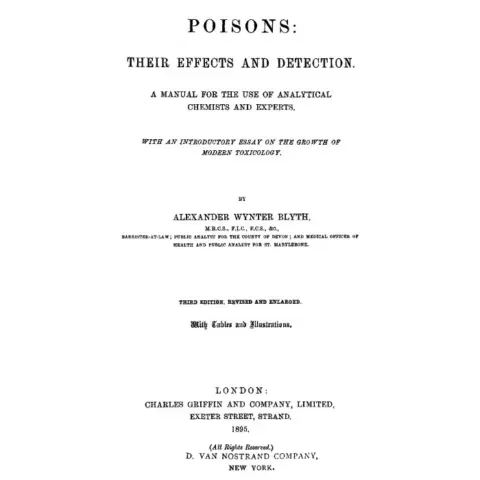
"Poisons, Their Effects and Detection" by Alexander Wynter Blyth is a scientific publication written in the late 19th century. This work serves as a comprehensive manual for analytical chemists and forensic experts, detailing the nature, effects, and detection methods of various toxic substances. It explores the historical context of poison knowledge, its physiological effects, and diagnostics, proving essential for anyone involved in toxicology or forensic medicine. The beginning of this manual outlines the origins of poison knowledge, highlighting the significance of the word "toxicology" and its connection to ancient practices involving poisons used on weaponry. It references mythological figures associated with poison, such as Hecate and Medea, and sets a tone of intrigue surrounding early toxicological research. Blyth emphasizes how ancient civilizations perceived poisons and the supernatural beliefs attached to them, paving the way through history to modern understandings of toxins and their effects on health and life.
Introduction adapted from the source catalogue; source summaries may be automatically generated.
Free to read · English · 336,607 words · No account needed
MAKE TIME FOR A GOOD BOOK
On by default. Untick to stop anonymous reading totals. Each page counts after 10 seconds in view. How this works.
Anonymous counting is on unless you have switched it off.
The quack medicines composed of lead are not very numerous.
Liebert’s =Cosmetique Infaillible= is said to have for its basis
nitrate of lead.
One of “=Ali Ahmed’s Treasures of the Desert=,” viz., the antiseptic malagma, is a plaster made up of lead plaster 37·5 per cent., frankincense 25 per cent., salad oil 25 per cent., beeswax 12·5 per cent.
=Lewis’ Silver Cream= contains white precipitate and a salt of lead.
=Goulard’s Balsam= is made by triturating acetate of lead with hot
oil of turpentine.
There are various ointments in use made up of litharge. Some herbalists in the country (from cases that have come under the writer’s own knowledge) apply to cancerous ulcers, &c., a liniment of linseed and other common oils mixed with litharge and acetate of lead.
Acetate of lead may also be found as a constituent of various
eye-waters.
(3) =Preparations of Lead used in the Arts, &c.=:--
=Ledoyen’s Disinfecting Fluid= has for its basis nitrate of lead.
In various hair-dyes the following are all used:--Litharge, lime, and starch; lime and carbonate of lead; lime and acetate of lead; litharge, lime, and potassic bicarbonate. The detection of lead in the hair thus treated is extremely easy; it may be dissolved out by dilute nitric acid.
=Lead Pigments.=--The principal pigments of lead are white, yellow,
and red.
=White Pigments=:--
=White Lead=, =Flake White Ceruse=, =Mineral White=, are so many different names for the carbonate of lead already described.
=Newcastle White= is white lead made with molasses vinegar.
=Nottingham White.=--White lead made with alegar (sour ale), often, however, replaced by permanent white, i.e., sulphate of baryta.
=Miniature Painters’ White=, =White Precipitate of Lead=, is simply
lead sulphate.
=Pattison’s White= is an oxychloride of lead, PbCl₂PbO.
=Yellow Pigments=:--
=Chrome Yellow= may be a fairly pure chromate of lead, or it may be mixed with sulphates of lead, barium, and calcium. The pigment known as “Cologne yellow” consists of 25 parts of lead chromate, 15 of lead sulphate, and 60 of calcic sulphate. The easiest method of analysing chrome yellow is to extract with boiling hydrochloric acid in the presence of alcohol, which dissolves the chromium as chloride, and leaves undissolved chloride of lead, sulphate of lead, and other substances insoluble in ClH. Every grain of chromate of lead should yield 0·24 grain of oxide of chromium, and 0·4 grain of chloride of lead.
=Turner’s Yellow=, =Cassella Yellow=, =Patent Yellow=, is an oxychloride of lead (PbCl₂7PbO) extremely fusible.
=Dutch Pink= sometimes contains white lead.
=Red Pigments=:--
=Chrome Red= is a bichromate of lead.
=Red Lead= or =Minium= is the red oxide of lead.
=Orange Red= is an oxide prepared by calcining the carbonate.
Your reading position is saved on this browser. Take it to another device with a library code. Reading pages adapt to text, rather than matching a printed edition.
BEHIND THE BOOK
This eBook is for the use of anyone anywhere in the United States and most other parts of the world at no cost and with almost no restrictions whatsoever. You may copy it, give it away or re-use it under the terms of the Project Gutenberg License included with this eBook or online at www.gutenberg.org. If you are not located in the United States, you will have to check the laws of the country where you are located before using this eBook. Read the source licence.
The original source file, including credits and licence, is retained by this library. Request an original-format copy at no charge. Please include the book title and Project Gutenberg identifier #42709.
KEEP YOUR CURIOSITY GOING
John Muir

Asa Gray
Asa Gray

Florence Nightingale
Elizabeth Robins Pennell
Denison Olmsted