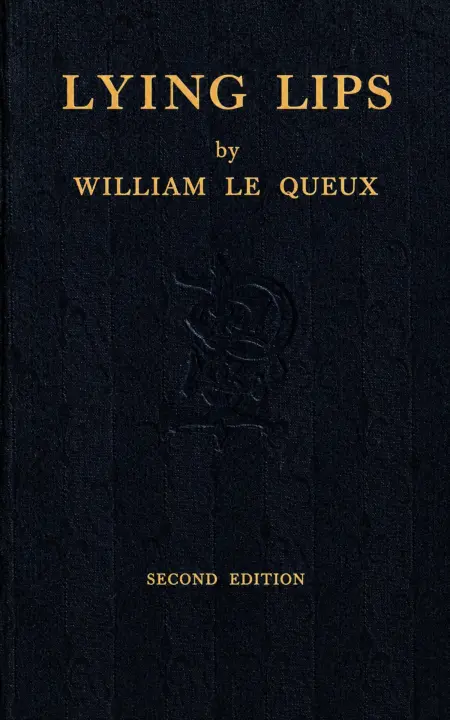
Lying lips
William Le Queux
THE CLASSIC COLLECTION · 1927
Poison shadows by William Le Queux is a mystery novel written in the early 20th century. It follows Sibell Dare, a young heiress pressured by her scheming aunt, Lady Wyndcliffe, and her guardian to marry for money, even as she loves the capable but penniless Dr. Brinsley Otway. When Sibell unexpectedly inherits a fortune on condition she live in the long-shuttered Guest House at Hampton Court—an old Tudor residence shadowed by sudden deaths—eerie signs and unexplained illnesses blur the line between poison plot and haunting. The atmosphere mixes high-society manipulation, gambling and blackmail with a creeping, possibly scientific, menace.
The opening of the novel sets the stakes and the mystery: at a Belgian seaside resort, Sibell’s aunt and guardian coldly plan to sell her into marriage with rich Gussie Gretton, but Sibell refuses, devoted to Otway. Back in England she learns she has inherited her uncle’s wealth if she reopens and resides in the Guest House, a storied place linked to abrupt deaths; a local antiquary confirms the legends, and when agents force the door, an auctioneer collapses with a sudden heart seizure in the great room. A constable later reports seeing a fleeting dull green light within the locked house. Sibell tours the dust-choked rooms with Otway, who discovers rare books on poisons, then collapses that night after biting a peach she sent—yet expert analysis finds no toxin, and doctors waver between mysterious poisoning and heart failure as he hovers near death before slowly improving. Meanwhile, Lady Wyndcliffe, plotting a Riviera escape and debating inviting Otway, reveals to her domineering butler-confidant a dangerous secret past and fear of a man named Rupert, hinting that the social intrigue around Sibell is entangled with deeper, darker designs.
Introduction adapted from the source catalogue; source summaries may be automatically generated.
Free to read · English · 82,451 words · No account needed
MAKE TIME FOR A GOOD BOOK
On by default. Untick to stop anonymous reading totals. Each page counts after 10 seconds in view. How this works.
Anonymous counting is on unless you have switched it off.
At seven o’clock on the following morning, just as it was getting light, the milkman, in the habit of leaving the usual half-pint for Mr. Farmer at the Guest House, found a scrap of paper beneath the jug, while the front door stood ajar, which was unusual.
The scribbled words in pencil which the man deciphered were, “Come in
at once. Am very ill!”
Without ado, the man put down his can, and, entering the hall, cried:
“Mr. Farmer! Where are you?”
Hearing a groan along the passage, he quickly found the small, stuffy room where, on the bed, lay the stout caretaker, half dressed, writhing in apparent pain.
“Fetch a doctor, quick!” he gasped. “I’ve been taken ill.”
“How long ago?” asked the man in alarm.
“I--I don’t know. Get Dr. Truman. He lives just across the bridge. Quick as you can--quick--quick--as--you--can!” And he drew a long breath and stretched his arms over his head.
The milkman lost not a moment, and within a quarter of an hour the local, middle-aged practitioner stood at the prostrate man’s side, asking him to describe his symptoms.
“My heart seems so funny,” the stricken man managed to gasp.
“Have you ever suffered from heart before?” inquired the medical man.
“Never.”
“Then I must take your blood pressure,” he said, producing from his bag the band of webbing which he strapped upon the man’s bare arm, and then proceeded to pump air into it, watching the telltale dial intently. Three times he repeated it, so that there should be no error. Afterwards he sounded his patient with his stethoscope, his countenance assuming a grave look after listening for a few moments in various spots on his broad chest.
“Never had such an attack before, eh?” he asked. “Been exerting
yourself unduly?”
“Not in the least,” Farmer replied in a thin, weak voice quite unusual to him. “It’s morning--isn’t it?”
“Yes,” replied the doctor. “About seven.”
“Then I haven’t been to bed. I recollect coming over funny-like just as I was undressing, about eleven o’clock. But I didn’t know anything else till I awoke and saw it was half-past six. Then I managed to write a note and put it under the milk-jug.”
“I found it when I got here,” explained the milkman, standing beside the doctor. “It ain’t like Mr. Farmer to be ill,” he added.
But Dr. Truman continued his investigations, asking many questions of the prostrate man, each reply seeming to puzzle him the more.
“You remain here,” he said to the milkman. “I’ll go back and get some mixture that will ease him.”
Your reading position is saved on this browser. Take it to another device with a library code. Reading pages adapt to text, rather than matching a printed edition.
William Le Queux
William Le Queux
William Le Queux
William Le Queux
BEHIND THE BOOK
This eBook is for the use of anyone anywhere in the United States and most other parts of the world at no cost and with almost no restrictions whatsoever. You may copy it, give it away or re-use it under the terms of the Project Gutenberg License included with this eBook or online at www.gutenberg.org. If you are not located in the United States, you will have to check the laws of the country where you are located before using this eBook. Read the source licence.
The original source file, including credits and licence, is retained by this library. Request an original-format copy at no charge. Please include the book title and Project Gutenberg identifier #77378.
KEEP YOUR CURIOSITY GOING
Coulson Kernahan

Maurice Baring
Frances Wright
Cécile Tormay

Frederic Jesup Stimson

W. H. P. (William Henry Pope) Jarvis