
Slang and its analogues past and present, volume 4 [of 7]
John Stephen Farmer & William Ernest Henley
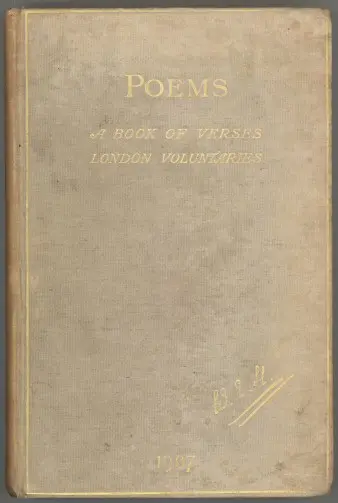
THE CLASSIC COLLECTION · 1898
"Poems" by William Ernest Henley is a collection of poetry likely written during the late 19th century. The work focuses on various themes ranging from the personal struggles of life, death, and the human condition to the beauty and trials of nature, as well as the complexities of love and friendship. The opening portion of the book features a series of poems set in a hospital, depicting the thoughts and emotions of a patient undergoing surgery. The verses explore feelings of fear, vulnerability, and the stark reality of medical settings, from the coldness of the hospital atmosphere to the physical and mental turmoil faced by the patients. Henley provides vivid imagery through reflections on characters such as the old-fashioned nurse and various other staff members, capturing a range of human experiences during moments of crisis and introspection. This intimate glimpse into the intersection of life and death establishes a powerful emotional tone that invites readers to contemplate their own existence and relationships.
Introduction adapted from the source catalogue; source summaries may be automatically generated.
Free to read · English · 24,359 words · No account needed
MAKE TIME FOR A GOOD BOOK
On by default. Untick to stop anonymous reading totals. Each page counts after 10 seconds in view. How this works.
Anonymous counting is on unless you have switched it off.
Of ice and glass the tinkle,
Pellucid, silver-shrill;
Peaches without a wrinkle;
Cherries and snow at will,
From china bowls that fill
The senses with a sweet
Incuriousness of heat;
A melon’s dripping sherds;
Cream-clotted strawberries;
Dusk dairies set with curds—
To live, I think of these!
Vale-lily and periwinkle;
Wet stone-crop on the sill;
The look of leaves a-twinkle
With windlets clear and still;
The feel of a forest rill
That wimples fresh and fleet
About one’s naked feet;
The muzzles of drinking herds;
Lush flags and bulrushes;
The chirp of rain-bound birds—
To live, I think of these!
Envoy
Dark aisles, new packs of cards,
Mermaidens’ tails, cool swards,
Dawn dews and starlit seas,
White marbles, whiter words—
To live, I think of these!
GOLD or silver, every day,
Dies to gray.
There are knots in every skein.
Hours of work and hours of play
Fade away
Into one immense Inane.
Shadow and substance, chaff and grain,
Are as vain
As the foam or as the spray.
Life goes crooning, faint and fain,
One refrain:
‘If it could be always May!’
Though the earth be green and gay,
Though, they say,
Man the cup of heaven may drain;
Though, his little world to sway,
He display
Hoard on hoard of pith and brain:
Autumn brings a mist and rain
That constrain
Him and his to know decay,
Where undimmed the lights that wane
Would remain,
If it could be always May.
Yea, alas, must turn to Nay,
Flesh to clay.
Chance and Time are ever twain.
Men may scoff, and men may pray,
But they pay
Every pleasure with a pain.
Life may soar, and Fortune deign
To explain
Where her prizes hide and stay;
But we lack the lusty train
We should gain,
If it could be always May.
Envoy
Time, the pedagogue, his cane
Might retain,
But his charges all would stray
Truanting in every lane—
Jack with Jane—
If it could be always May.
FOOLS may pine, and sots may swill,
Cynics gibe, and prophets rail,
Moralists may scourge and drill,
Preachers prose, and fainthearts quail.
Let them whine, or threat, or wail!
Till the touch of Circumstance
Down to darkness sink the scale,
Fate’s a fiddler, Life’s a dance.
What if skies be wan and chill?
What if winds be harsh and stale?
Presently the east will thrill,
And the sad and shrunken sail,
Bellying with a kindly gale,
Bear you sunwards, while your chance
Sends you back the hopeful hail:—
‘Fate’s a fiddler, Life’s a dance.’
Your reading position is saved on this browser. Take it to another device with a library code. Reading pages adapt to text, rather than matching a printed edition.
John Stephen Farmer & William Ernest Henley

John Stephen Farmer & William Ernest Henley

John Stephen Farmer & William Ernest Henley

John Stephen Farmer & William Ernest Henley
BEHIND THE BOOK
This eBook is for the use of anyone anywhere in the United States and most other parts of the world at no cost and with almost no restrictions whatsoever. You may copy it, give it away or re-use it under the terms of the Project Gutenberg License included with this eBook or online at www.gutenberg.org. If you are not located in the United States, you will have to check the laws of the country where you are located before using this eBook. Read the source licence.
The original source file, including credits and licence, is retained by this library. Request an original-format copy at no charge. Please include the book title and Project Gutenberg identifier #1568.
KEEP YOUR CURIOSITY GOING

Eric Mackay
Edmund Gosse
Sophia Margaretta Hensley
Gilbert Parker
George MacDonald

Elizabeth Bibesco