
Slang and its analogues past and present, volume 4 [of 7]
John Stephen Farmer & William Ernest Henley
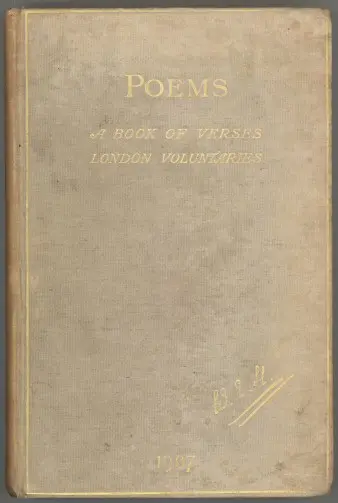
THE CLASSIC COLLECTION · 1898
"Poems" by William Ernest Henley is a collection of poetry likely written during the late 19th century. The work focuses on various themes ranging from the personal struggles of life, death, and the human condition to the beauty and trials of nature, as well as the complexities of love and friendship. The opening portion of the book features a series of poems set in a hospital, depicting the thoughts and emotions of a patient undergoing surgery. The verses explore feelings of fear, vulnerability, and the stark reality of medical settings, from the coldness of the hospital atmosphere to the physical and mental turmoil faced by the patients. Henley provides vivid imagery through reflections on characters such as the old-fashioned nurse and various other staff members, capturing a range of human experiences during moments of crisis and introspection. This intimate glimpse into the intersection of life and death establishes a powerful emotional tone that invites readers to contemplate their own existence and relationships.
Introduction adapted from the source catalogue; source summaries may be automatically generated.
Free to read · English · 24,359 words · No account needed
MAKE TIME FOR A GOOD BOOK
On by default. Untick to stop anonymous reading totals. Each page counts after 10 seconds in view. How this works.
Anonymous counting is on unless you have switched it off.
WHAT have I done for you,
England, my England?
What is there I would not do,
England, my own?
With your glorious eyes austere,
As the Lord were walking near,
Whispering terrible things and dear
As the Song on your bugles blown,
England—
Round the world on your bugles blown!
Where shall the watchful Sun,
England, my England,
Match the master-work you’ve done,
England, my own?
When shall he rejoice agen
Such a breed of mighty men
As come forward, one to ten,
To the Song on your bugles blown,
England—
Down the years on your bugles blown?
Ever the faith endures,
England, my England:—
‘Take and break us: we are yours,
‘England, my own!
‘Life is good, and joy runs high
‘Between English earth and sky:
‘Death is death; but we shall die
‘To the Song on your bugles blown,
‘England—
‘To the stars on your bugles blown!
They call you proud and hard,
England, my England:
You with worlds to watch and ward,
England, my own!
You whose mailed hand keeps the keys
Of such teeming destinies
You could know nor dread nor ease
Were the Song on your bugles blown,
England,
Round the Pit on your bugles blown!
Mother of Ships whose might,
England, my England,
Is the fierce old Sea’s delight,
England, my own,
Chosen daughter of the Lord,
Spouse-in-Chief of the ancient sword,
There’s the menace of the Word
In the Song on your bugles blown,
England—
Out of heaven on your bugles blown!
These, to you now, O, more than ever now—
Now that the Ancient Enemy
Has passed, and we, we two that are one, have seen
A piece of perfect Life
Turn to so ravishing a shape of Death
The Arch-Discomforter might well have smiled
In pity and pride,
Even as he bore his lovely and innocent spoil
From those home-kingdoms he left desolate!
Poor windlestraws
On the great, sullen, roaring pool of Time
And Chance and Change, I know!
But they are yours, as I am, till we attain
That end for which me make, we two that are one:
A little, exquisite Ghost
Between us, smiling with the serenest eyes
Seen in this world, and calling, calling still
In that clear voice whose infinite subtleties
Of sweetness, thrilling back across the grave,
Break the poor heart to hear:—
‘Come, Dadsie, come!
Mama, how long—how long!’
July 1897.
Your reading position is saved on this browser. Take it to another device with a library code. Reading pages adapt to text, rather than matching a printed edition.
John Stephen Farmer & William Ernest Henley

John Stephen Farmer & William Ernest Henley

John Stephen Farmer & William Ernest Henley

John Stephen Farmer & William Ernest Henley
BEHIND THE BOOK
This eBook is for the use of anyone anywhere in the United States and most other parts of the world at no cost and with almost no restrictions whatsoever. You may copy it, give it away or re-use it under the terms of the Project Gutenberg License included with this eBook or online at www.gutenberg.org. If you are not located in the United States, you will have to check the laws of the country where you are located before using this eBook. Read the source licence.
The original source file, including credits and licence, is retained by this library. Request an original-format copy at no charge. Please include the book title and Project Gutenberg identifier #1568.
KEEP YOUR CURIOSITY GOING

Eric Mackay
Edmund Gosse
Sophia Margaretta Hensley
Gilbert Parker
George MacDonald

Elizabeth Bibesco