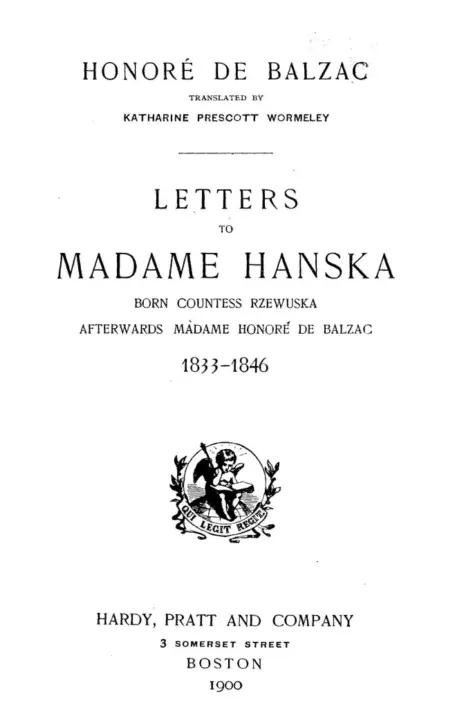
Letters to Madame Hanska, born Countess Rzewuska, afterwards Madame Honoré de Balzac, 1833-1846
Honoré de Balzac
THE CLASSIC COLLECTION · 1840
"Pierrette" by Honoré de Balzac is a novel written during the early 19th century, characterized by its exploration of human emotions and social dynamics. The narrative centers around the titular character, Pierrette Lorrain, a fragile and delicate young girl as she navigates the complexities of her life following the loss of her parents and her arrival at the home of her distant relatives, the Rogrons, in Provins. At the start of the novel, we are introduced to Pierrette and the initial interactions that will define her future. She arrives in Provins after the tragic circumstances of losing her mother and being placed in the care of her cousin, Sylvie Rogron. The Rogrons, who harbor their own selfish ambitions and resentments, greet Pierrette with indifference, treating her more like an obligation than a cherished family member. The opening sets the stage for the conflicts that will arise within this household, framing Pierrette's struggles against the emotional and social isolation she faces in her new environment. Balzac's keen observations of the intricacies of character and the societal pressures of the time suggest that Pierrette's fate will be intimately intertwined with the darker motivations of those around her.
Introduction adapted from the source catalogue; source summaries may be automatically generated.
Free to read · English · 51,492 words · No account needed
MAKE TIME FOR A GOOD BOOK
On by default. Untick to stop anonymous reading totals. Each page counts after 10 seconds in view. How this works.
Anonymous counting is on unless you have switched it off.
“No, cousin.”
“I was looking at you all,” said the deputy-judge, “and I can swear that Pierrette saw no one’s hand but the colonel’s.”
“Pooh!” said Gouraud, alarmed, “little girls know how to slide their eyes into everything.”
“Ah!” exclaimed Sylvie.
“Yes,” continued Gouraud. “I dare say she looked into your hand to play you a trick. Didn’t you, little one?”
“No,” said the truthful Breton, “I wouldn’t do such a thing; if I had, it would have been in my cousin’s interests.”
“You know you are a story-teller and a little fool,” cried Sylvie. “After what happened this morning do you suppose I can believe a word you say? You are a--”
Pierrette did not wait for Sylvie to finish her sentence; foreseeing a torrent of insults, she rushed away without a light and ran to her room. Sylvie turned white with anger and muttered between her teeth, “She shall pay for this!”
“Shall you pay for the misere?” said Madame de Chargeboeuf.
As she spoke Pierrette struck her head against the door of the passage which some one had left open.
“Good! I’m glad of it,” cried Sylvie, as they heard the blow.
“She must be hurt,” said Desfondrilles.
“She deserves it,” replied Sylvie.
“It was a bad blow,” said Mademoiselle Habert.
Sylvie thought she might escape paying her misere if she went to see after Pierrette, but Madame de Chargeboeuf stopped her.
“Pay us first,” she said, laughing; “you will forget it when you come
back.”
The remark, based on the old maid’s trickery and her bad faith in paying her debts at cards was approved by the others. Sylvie sat down and thought no more of Pierrette,--an indifference which surprised no one. When the game was over, about half past nine o’clock, she flung herself into an easy chair at the corner of the fireplace and did not even rise as her guests departed. The colonel was torturing her; she did not know what to think of him.
“Men are so false!” she cried, as she went to bed.
Pierrette had given herself a frightful blow on the head, just above the ear, at the spot where young girls part their hair when they put their “front hair” in curlpapers. The next day there was a large swelling.
“God has punished you,” said Sylvie at the breakfast table. “You disobeyed me; you treated me with disrespect in leaving the room before I had finished my sentence; you got what you deserved.”
“Nevertheless,” said Rogron, “she ought to put on a compress of salt and
water.”
“Oh, it is nothing at all, cousin,” said Pierrette.
Your reading position is saved on this browser. Take it to another device with a library code. Reading pages adapt to text, rather than matching a printed edition.
Honoré de Balzac
Honoré de Balzac
Honoré de Balzac
Honoré de Balzac
BEHIND THE BOOK
This eBook is for the use of anyone anywhere in the United States and most other parts of the world at no cost and with almost no restrictions whatsoever. You may copy it, give it away or re-use it under the terms of the Project Gutenberg License included with this eBook or online at www.gutenberg.org. If you are not located in the United States, you will have to check the laws of the country where you are located before using this eBook. Read the source licence.
The original source file, including credits and licence, is retained by this library. Request an original-format copy at no charge. Please include the book title and Project Gutenberg identifier #1704.
KEEP YOUR CURIOSITY GOING
Coulson Kernahan

Maurice Baring
Frances Wright
Cécile Tormay

Frederic Jesup Stimson

W. H. P. (William Henry Pope) Jarvis