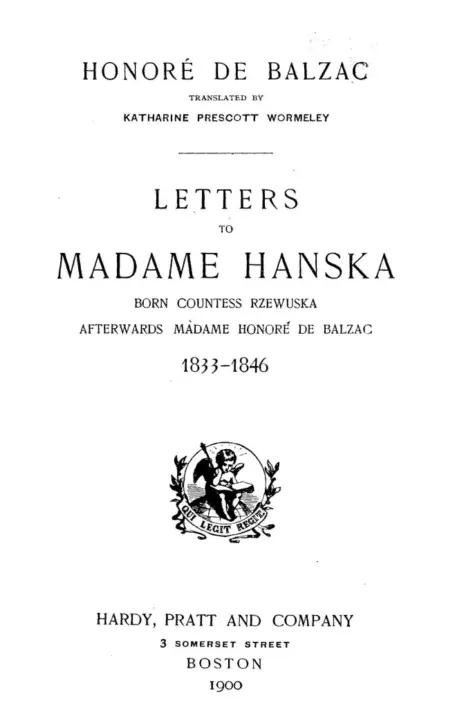
Letters to Madame Hanska, born Countess Rzewuska, afterwards Madame Honoré de Balzac, 1833-1846
Honoré de Balzac
THE CLASSIC COLLECTION · 1840
"Pierrette" by Honoré de Balzac is a novel written during the early 19th century, characterized by its exploration of human emotions and social dynamics. The narrative centers around the titular character, Pierrette Lorrain, a fragile and delicate young girl as she navigates the complexities of her life following the loss of her parents and her arrival at the home of her distant relatives, the Rogrons, in Provins. At the start of the novel, we are introduced to Pierrette and the initial interactions that will define her future. She arrives in Provins after the tragic circumstances of losing her mother and being placed in the care of her cousin, Sylvie Rogron. The Rogrons, who harbor their own selfish ambitions and resentments, greet Pierrette with indifference, treating her more like an obligation than a cherished family member. The opening sets the stage for the conflicts that will arise within this household, framing Pierrette's struggles against the emotional and social isolation she faces in her new environment. Balzac's keen observations of the intricacies of character and the societal pressures of the time suggest that Pierrette's fate will be intimately intertwined with the darker motivations of those around her.
Introduction adapted from the source catalogue; source summaries may be automatically generated.
Free to read · English · 51,492 words · No account needed
MAKE TIME FOR A GOOD BOOK
On by default. Untick to stop anonymous reading totals. Each page counts after 10 seconds in view. How this works.
Anonymous counting is on unless you have switched it off.
One evening, which marked the beginning of Pierrette’s second phase of life in her cousin’s house, the child, whom the three guests had not seen during the evening, came into the room to kiss her relatives and say good-night to the company. Sylvie turned her cheek coldly to the pretty creature, as if to avoid kissing her. The motion was so cruelly significant that the tears sprang to Pierrette’s eyes.
“Did you prick yourself, little girl?” said the atrocious Vinet.
“What is the matter?” asked Sylvie, severely.
“Nothing,” said the poor child, going up to Rogron.
“Nothing?” said Sylvie, “that’s nonsense; nobody cries for nothing.”
“What is it, my little darling?” said Madame Vinet.
“My rich cousin isn’t as kind to me as my poor grandmother was,” sobbed
Pierrette.
“Your grandmother took your money,” said Sylvie, “and your cousin will
leave you hers.”
The colonel and the lawyer glanced at each other.
“I would rather be robbed and loved,” said Pierrette.
“Then you shall be sent back whence you came.”
“But what has the dear little thing done?” asked Madame Vinet.
Vinet gave his wife the terrible, fixed, cold look with which men enforce their absolute dominion. The hapless helot, punished incessantly for not having the one thing that was wanted of her, a fortune, took up her cards.
“What has she done?” said Sylvie, throwing up her head with such violence that the yellow wall-flowers in her cap nodded. “She is always looking about to annoy us. She opened my watch to see the inside, and meddled with the wheel and broke the mainspring. Mademoiselle pays no heed to what is said to her. I am all day long telling her to take care of things, and I might just as well talk to that lamp.”
Pierrette, ashamed at being reproved before strangers, crept softly out
of the room.
“I am thinking all the time how to subdue that child,” said Rogron.
“Isn’t she old enough to go to school?” asked Madame Vinet.
Again she was silenced by a look from her husband, who had been careful to tell her nothing of his own or the colonel’s schemes.
“This is what comes of taking charge of other people’s children!” cried the colonel. “You may still have some of your own, you or your brother. Why don’t you both marry?”
Sylvie smiled agreeably on the colonel. For the first time in her life she met a man to whom the idea that she could marry did not seem absurd.
“Madame Vinet is right,” cried Rogron; “perhaps teaching would keep Pierrette quiet. A master wouldn’t cost much.”
Your reading position is saved on this browser. Take it to another device with a library code. Reading pages adapt to text, rather than matching a printed edition.
Honoré de Balzac
Honoré de Balzac
Honoré de Balzac
Honoré de Balzac
BEHIND THE BOOK
This eBook is for the use of anyone anywhere in the United States and most other parts of the world at no cost and with almost no restrictions whatsoever. You may copy it, give it away or re-use it under the terms of the Project Gutenberg License included with this eBook or online at www.gutenberg.org. If you are not located in the United States, you will have to check the laws of the country where you are located before using this eBook. Read the source licence.
The original source file, including credits and licence, is retained by this library. Request an original-format copy at no charge. Please include the book title and Project Gutenberg identifier #1704.
KEEP YOUR CURIOSITY GOING
Coulson Kernahan

Maurice Baring
Frances Wright
Cécile Tormay

Frederic Jesup Stimson

W. H. P. (William Henry Pope) Jarvis