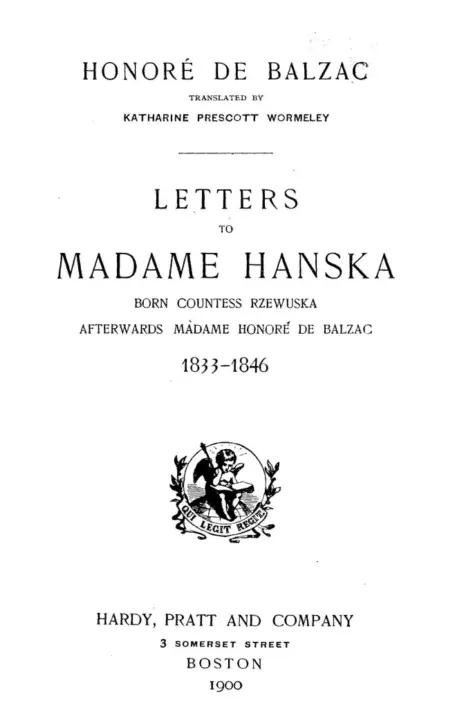
Letters to Madame Hanska, born Countess Rzewuska, afterwards Madame Honoré de Balzac, 1833-1846
Honoré de Balzac
THE CLASSIC COLLECTION · 1840
"Pierrette" by Honoré de Balzac is a novel written during the early 19th century, characterized by its exploration of human emotions and social dynamics. The narrative centers around the titular character, Pierrette Lorrain, a fragile and delicate young girl as she navigates the complexities of her life following the loss of her parents and her arrival at the home of her distant relatives, the Rogrons, in Provins. At the start of the novel, we are introduced to Pierrette and the initial interactions that will define her future. She arrives in Provins after the tragic circumstances of losing her mother and being placed in the care of her cousin, Sylvie Rogron. The Rogrons, who harbor their own selfish ambitions and resentments, greet Pierrette with indifference, treating her more like an obligation than a cherished family member. The opening sets the stage for the conflicts that will arise within this household, framing Pierrette's struggles against the emotional and social isolation she faces in her new environment. Balzac's keen observations of the intricacies of character and the societal pressures of the time suggest that Pierrette's fate will be intimately intertwined with the darker motivations of those around her.
Introduction adapted from the source catalogue; source summaries may be automatically generated.
Free to read · English · 51,492 words · No account needed
MAKE TIME FOR A GOOD BOOK
On by default. Untick to stop anonymous reading totals. Each page counts after 10 seconds in view. How this works.
Anonymous counting is on unless you have switched it off.
“A lover, Pierrette, is a man who loves us and wishes to marry us.”
“Ah,” said Pierrette, “when that happens in Brittany we call the young
man a suitor.”
“Well, remember that in owning your feelings for a man you do no wrong, my dear. The wrong is in hiding them. Have you pleased some of the men who visit here?”
“I don’t think so, cousin.”
“Do you love any of them?”
“No.”
“Certain?”
“Quite certain.”
“Look at me, Pierrette.”
Pierrette looked at Sylvie.
“A man called to you this morning in the square.”
Pierrette lowered her eyes.
“You went to your window, you opened it, and you spoke to him.”
“No cousin, I went to look out and I saw a peasant.”
“Pierrette, you have much improved since you made your first communion; you have become pious and obedient, you love God and your relations; I am satisfied with you. I don’t say this to puff you up with pride.”
The horrible creature had mistaken despondency, submission, the silence of wretchedness, for virtues!
The sweetest of all consolations to suffering souls, to martyrs, to artists, in the worst of that divine agony which hatred and envy force upon them, is to meet with praise where they have hitherto found censure and injustice. Pierrette raised her grateful eyes to her cousin, feeling that she could almost forgive her for the sufferings she had caused.
“But if it is all hypocrisy, if I find you a serpent that I have warmed in my bosom, you will be a wicked girl, an infamous creature!”
“I think I have nothing to reproach myself with,” said Pierrette, with a painful revulsion of her heart at the sudden change from unexpected praise to the tones of the hyena.
“You know that to lie is a mortal sin?”
“Yes, cousin.”
“Well, you are now under the eye of God,” said the old maid, with a solemn gesture towards the sky; “swear to me that you did not know that peasant.”
“I will not swear,” said Pierrette.
“Ha! he was no peasant, you little viper.”
Pierrette rushed away like a frightened fawn terrified at her tone. Sylvie called her in a dreadful voice.
“The bell is ringing,” she answered.
“Artful wretch!” thought Sylvie. “She is depraved in mind; and now I am certain the little adder has wound herself round the colonel. She has heard us say he was a baron. To be a baroness! little fool! Ah! I’ll get rid of her, I’ll apprentice her out, and soon too!”
Your reading position is saved on this browser. Take it to another device with a library code. Reading pages adapt to text, rather than matching a printed edition.
Honoré de Balzac
Honoré de Balzac
Honoré de Balzac
Honoré de Balzac
BEHIND THE BOOK
This eBook is for the use of anyone anywhere in the United States and most other parts of the world at no cost and with almost no restrictions whatsoever. You may copy it, give it away or re-use it under the terms of the Project Gutenberg License included with this eBook or online at www.gutenberg.org. If you are not located in the United States, you will have to check the laws of the country where you are located before using this eBook. Read the source licence.
The original source file, including credits and licence, is retained by this library. Request an original-format copy at no charge. Please include the book title and Project Gutenberg identifier #1704.
KEEP YOUR CURIOSITY GOING
Coulson Kernahan

Maurice Baring
Frances Wright
Cécile Tormay

Frederic Jesup Stimson

W. H. P. (William Henry Pope) Jarvis