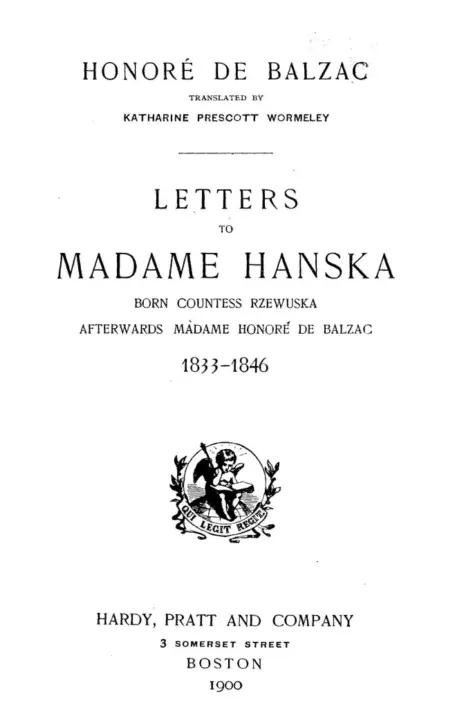
Letters to Madame Hanska, born Countess Rzewuska, afterwards Madame Honoré de Balzac, 1833-1846
Honoré de Balzac
THE CLASSIC COLLECTION · 1840
"Pierrette" by Honoré de Balzac is a novel written during the early 19th century, characterized by its exploration of human emotions and social dynamics. The narrative centers around the titular character, Pierrette Lorrain, a fragile and delicate young girl as she navigates the complexities of her life following the loss of her parents and her arrival at the home of her distant relatives, the Rogrons, in Provins. At the start of the novel, we are introduced to Pierrette and the initial interactions that will define her future. She arrives in Provins after the tragic circumstances of losing her mother and being placed in the care of her cousin, Sylvie Rogron. The Rogrons, who harbor their own selfish ambitions and resentments, greet Pierrette with indifference, treating her more like an obligation than a cherished family member. The opening sets the stage for the conflicts that will arise within this household, framing Pierrette's struggles against the emotional and social isolation she faces in her new environment. Balzac's keen observations of the intricacies of character and the societal pressures of the time suggest that Pierrette's fate will be intimately intertwined with the darker motivations of those around her.
Introduction adapted from the source catalogue; source summaries may be automatically generated.
Free to read · English · 51,492 words · No account needed
MAKE TIME FOR A GOOD BOOK
On by default. Untick to stop anonymous reading totals. Each page counts after 10 seconds in view. How this works.
Anonymous counting is on unless you have switched it off.
The Lorrains and Brigaut knew so little of life that the girl had not a penny when she arrived in Paris. The conductor, to whom she had mentioned her rich friends, paid her expenses at the hotel, and made the conductor of the Provins diligence pay him, telling him to take good care of the girl and to see that the charges were paid by the family, exactly as though she were a case of goods. Four days after her departure from Nantes, about nine o’clock of a Monday night, a kind old conductor of the Messageries-royales, took Pierrette by the hand, and while the porters were discharging in the Grand’Rue the packages and passengers for Provins, he led the little girl, whose only baggage was a bundle containing two dresses, two chemises, and two pairs of stockings, to Mademoiselle Rogron’s house, which was pointed out to him by the director at the coach office.
“Good-evening, mademoiselle and the rest of the company. I’ve brought you a cousin, and here she is; and a nice little girl too, upon my word. You have forty-seven francs to pay me, and sign my book.”
Mademoiselle Sylvie and her brother were dumb with pleasure and
amazement.
“Excuse me,” said the conductor, “the coach is waiting. Sign my book and pay me forty-seven francs, sixty centimes, and whatever you please for myself and the conductor from Nantes; we’ve taken care of the little girl as if she were our own; and paid for her beds and her food, also her fare to Provins, and other little things.”
“Forty-seven francs, twelve sous!” said Sylvie.
“You are not going to dispute it?” cried the man.
“Where’s the bill?” said Rogron.
“Bill! look at the book.”
“Stop talking, and pay him,” said Sylvie, “You see there’s nothing else
to be done.”
Rogron went to get the money, and gave the man forty-seven francs,
twelve sous.
“And nothing for my comrade and me?” said the conductor.
Sylvie took two francs from the depths of the old velvet bag which held
her keys.
“Thank you, no,” said the man; “keep ‘em yourself. We would rather care for the little one for her own sake.” He picked up his book and departed, saying to the servant-girl: “What a pair! it seems there are crocodiles out of Egypt!”
“Such men are always brutal,” said Sylvie, who overhead the words.
“They took good care of the little girl, anyhow,” said Adele with her
hands on her hips.
“We don’t have to live with him,” remarked Rogron.
“Where’s the little one to sleep?” asked Adele.
Your reading position is saved on this browser. Take it to another device with a library code. Reading pages adapt to text, rather than matching a printed edition.
Honoré de Balzac
Honoré de Balzac
Honoré de Balzac
Honoré de Balzac
BEHIND THE BOOK
This eBook is for the use of anyone anywhere in the United States and most other parts of the world at no cost and with almost no restrictions whatsoever. You may copy it, give it away or re-use it under the terms of the Project Gutenberg License included with this eBook or online at www.gutenberg.org. If you are not located in the United States, you will have to check the laws of the country where you are located before using this eBook. Read the source licence.
The original source file, including credits and licence, is retained by this library. Request an original-format copy at no charge. Please include the book title and Project Gutenberg identifier #1704.
KEEP YOUR CURIOSITY GOING
Coulson Kernahan

Maurice Baring
Frances Wright
Cécile Tormay

Frederic Jesup Stimson

W. H. P. (William Henry Pope) Jarvis