
Last letters from the living dead man
David Patterson (Spirit) Hatch
THE CLASSIC COLLECTION · 1899
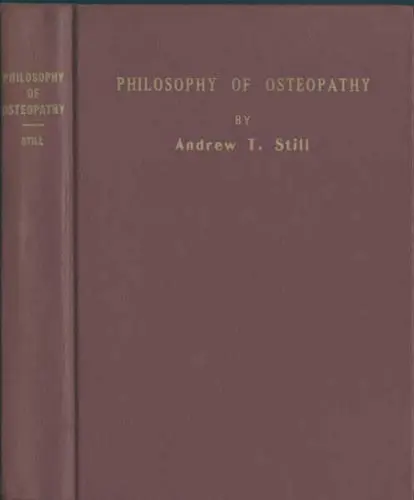
"Philosophy of Osteopathy" by A. T. Still is a scientific publication written in the late 19th century. The book explores the principles and philosophy behind osteopathy, aiming to provide a foundation for the practice and understanding of this medical science without relying on traditional medical approaches. It seeks to establish a new way of viewing health and disease through a detailed understanding of anatomy and the body's natural functions. The opening of this treatise sets the stage for its exploration of osteopathy by addressing the author's journey in developing these ideas. A. T. Still declares his intention to provide a comprehensive framework for understanding the body's systems, emphasizing the importance of anatomy as a core component of osteopathic practice. He critiques traditional medicine, distancing his philosophy from drug-based approaches and asserting the need for a deeper comprehension of the body's normal and abnormal states. The text stresses the necessity of an artistic view of anatomy, encouraging practitioners to visualize the human body in its entirety and understand the interconnections between its various systems. Overall, the beginning of the book serves as a foundation for the detailed principles that will be elaborated upon in later chapters.
Introduction adapted from the source catalogue; source summaries may be automatically generated.
Free to read · English · 59,795 words · No account needed
MAKE TIME FOR A GOOD BOOK
On by default. Untick to stop anonymous reading totals. Each page counts after 10 seconds in view. How this works.
Anonymous counting is on unless you have switched it off.
A student of life must take in all parts, and study their uses and relations to other parts and systems. We lay much stress on the uses of blood and the powers of the nerves, but have we any evidence that they are of more vital importance than the lymphatics? If not let us halt at this universal system of irrigation and study its great uses in sustaining animal life. Where are they situated in the body? Answer by, where are they not? No space is so small as to be out of connection with the lymphatics, with their nerves, secretory and excretory ducts. Thus the system of lymphatics is complete and universal in the whole body. After beholding the lymphatics distributed along all nerves, blood channels, muscles, glands and all organs of the body, from the brain to the soles of the feet, all loaded to fullness with watery liquids, we certainly can make but one conclusion as to their use, which would be to mingle with and carry out all impurities of the body, by first mixing with such substances and reducing them to that degree of fluids in fineness, that could pass through the smallest tubes of the excretory system, and by that method free the body from all deposits of either solids or fluids, and leave nourishment.
A question: Why is he too fat and she only skin and bone, while a third is just right? If one is just right, why not all? If we get fat by a natural process why not reverse the process and stop at any desirable point in flesh size? I believe the law of life is simple and natural in both respects if wisely understood. Have we nerves of motion to carry food to all parts, organs, glands and muscles? Have we channels to convey to all? Have we fluids to suit all demands? Have we brain power equal to all force needed? Is blood formed sufficiently to fill all demands? Does that blood contain fat, water, muscle, skin, hair and all kinds to suit each division, organ, and nerve? If so and blood has builded too much flesh, can it not take that bulk away by returning blood to gas and other fluids? Can that which has been done be done again? If yes be the correct answer, then we should hope to return blood, fat, flesh and bone to gas and pass them away while in gaseous condition, and do away with all unnatural size or lack of size. I believe that it is natural to build and destroy all material form from the lowest animated being to the greatest rolling world. I believe no world could be constructed without strict obedience to a governing law, which gives size by addition and reduces that size by subtraction. Thus a fat man is builded by great addition, and if desired can be reduced by much subtraction, which is simply a rule of numbers. We multiply to enlarge, also subtract when we wish a reduction. Turn your eye for a time to the supply trains of nature. When the crop is abundant, the lading would be great, and when the seasons do not suit, the crops are short or shorter to no lading at all. Thus we have the fat man and the lean man. Is it not reasonable as a conclusion of the most exacting philosophy that the train of cars that can bring loads of stone, brick and mortar until a great bulk is formed, can also carry away until this bulk disappears in part or all? This being my conclusion I will say by many years of careful observation of the work of creating bodies and destroying the same, that to add to is the law of giving size, and to subtract from is the law of reduction. Both are natural, and both can be made practical in the reduction or addition of flesh, when found too great in quantity, or we can add to and give size to the starving muscle through the action of the motor and nutrient system conveyed to, and appropriated from the laboratory in which all bodily substances are formed. Thus the philosophy is absolute, and the sky is clear to proceed with addition and subtraction of flesh. I believe I am prepared to say at this time that I understand the nervous system well enough to direct the laboratory of nature and cause it through its skilled arts to unload, or reduce, he who is over-burdened with a super-abundance of flesh, and add to the scanty muscle a sufficiency to give power of comfortable locomotion and other forces, by opening the gate of the supply trains of nutrition.
Your reading position is saved on this browser. Take it to another device with a library code. Reading pages adapt to text, rather than matching a printed edition.
BEHIND THE BOOK
This eBook is for the use of anyone anywhere in the United States and most other parts of the world at no cost and with almost no restrictions whatsoever. You may copy it, give it away or re-use it under the terms of the Project Gutenberg License included with this eBook or online at www.gutenberg.org. If you are not located in the United States, you will have to check the laws of the country where you are located before using this eBook. Read the source licence.
The original source file, including credits and licence, is retained by this library. Request an original-format copy at no charge. Please include the book title and Project Gutenberg identifier #25864.
KEEP YOUR CURIOSITY GOING
David Patterson (Spirit) Hatch
Coulson Kernahan

Ralph Waldo Emerson
Frances Wright

Edwin Abbott Abbott

Joseph Droz