
Last letters from the living dead man
David Patterson (Spirit) Hatch
THE CLASSIC COLLECTION · 1899
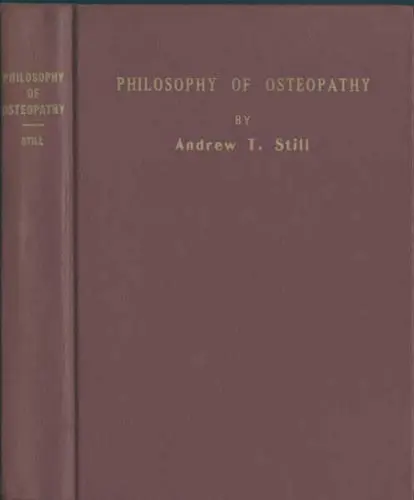
"Philosophy of Osteopathy" by A. T. Still is a scientific publication written in the late 19th century. The book explores the principles and philosophy behind osteopathy, aiming to provide a foundation for the practice and understanding of this medical science without relying on traditional medical approaches. It seeks to establish a new way of viewing health and disease through a detailed understanding of anatomy and the body's natural functions. The opening of this treatise sets the stage for its exploration of osteopathy by addressing the author's journey in developing these ideas. A. T. Still declares his intention to provide a comprehensive framework for understanding the body's systems, emphasizing the importance of anatomy as a core component of osteopathic practice. He critiques traditional medicine, distancing his philosophy from drug-based approaches and asserting the need for a deeper comprehension of the body's normal and abnormal states. The text stresses the necessity of an artistic view of anatomy, encouraging practitioners to visualize the human body in its entirety and understand the interconnections between its various systems. Overall, the beginning of the book serves as a foundation for the detailed principles that will be elaborated upon in later chapters.
Introduction adapted from the source catalogue; source summaries may be automatically generated.
Free to read · English · 59,795 words · No account needed
MAKE TIME FOR A GOOD BOOK
On by default. Untick to stop anonymous reading totals. Each page counts after 10 seconds in view. How this works.
Anonymous counting is on unless you have switched it off.
Divisions of the Body--Searching for the Cause--Duty of the Osteopathic Explorer--Classification and Division--The Abnormal--Nerve Powers--Witnesses to Examine--Abnormal Growths--Cerebro Spinal Fluid--Body in Perfect Health--Chemistry--Nature's Chemistry.
After many long years, treating and trying to teach the student of Osteopathy how to hunt for and find the local causes of diseases, not contagious, or infectious, I have succeeded in planning and suggesting a method, which I am sure the doctor can easily follow, and find any diversion from the normal, that would interfere with the nerves, veins, and arteries, of any organ or limb of the body. I have formulated a simple mental diagram that divides the body into three parts, chest, upper and lower limbs. The first division takes in head, neck, chest, abdomen and pelvis. The second division takes in head, neck, lower and upper arm and hand. The third division takes in foot, leg, thigh, pelvis and lumbar vertebra. I make this division for the purpose of holding the explorer to the limits of all supplies. In the ellipse of the chest is found all vital supplies; then from that center of life we have two branches only, one of the arm, and one of the lower limb. In each division we have five points of exploration.[1]
[Footnote 1: Explore: (1) To seek for or after: to strive to attain by search; to look wisely and carefully for; to search through or into; to penetrate or range over for discovery; to examine thoroughly; as, to explore new countries or seas; to explore the depths of science; "hidden frauds (to) explore."--WEBSTER.]
To illustrate, we will take the lower limb, whether there is lameness, soreness, gouty, rheumatic, neuralgic, swollen, shrunken, feverish, cold, smooth and glassy, sores, ulcers, erysipelas, milkleg, varicose veins, or any defect that the patient may complain of, who is the only reliable book or being of symptomatology. For convenience we will divide that lower limb into five parts, the foot, leg, thigh, pelvis and lumbar region. The patient (symptomatologist) tells us he has a pain in front, center and under part of foot. Now the doctor or bird dog, can find quails of reason in but one field that would lead him to the cause. As this field is divided into five parts and the hunter has carefully searched four divisions, he will find the cause or causes in the fifth and none other. If a dislocated bone is not found in the foot after ascertaining that there has been no crushing by falling bodies, horses feet, stepping on glass, nails and other things that would penetrate the foot, and irritate by being broken off, closed and remaining in the flesh; we will explore the leg for the quail, ascertain if the articulation is normal at ankle and knee. If we find the bone is not broken, the leg has no splinters of wood, nor injured flesh by bites from dogs or other animals, nor any other substance that would injure the leg, we are prepared to pass on and explore another place for pain in the foot. We go on to division No. 3 or the thigh division, and ascertain if the thigh is normal in all conditions, properly in socket, with all muscles, ligaments and nerves unoppressed. There are but two more divisions left for exploration, and they are the most important and interesting of the five, the pelvis and lumbar, through which all the nerves of the limb pass. We must stop at pelvis and observe carefully that there is no twist of ligaments before going to lumbar, which is the last of the five divisions. If we have found nothing in the previous four, and have explored them as carefully as we should, we have but one brush heap left, and that one contains the quail that we have been hunting for. As the lumbar contains and conveys all nerve forces to the pelvis from the brain and all divisions of the lower limbs, we will now examine the articulations of that part of the spine, and in that we are very certain to find the cause if we have made no mistake in our examination in the preceding divisions of the limb. As we enter the exploration of this part of the spine we must remember that we are about to deal with the many divisions of the nerves of the cauda equina. The great question before us, comes after this form. What would wound or bruise any division of nerves that would lead by the way of the great or lesser sciatic, to a bone in the front and under side of the foot? Jars, strains, twists, and dislocations, must be carefully searched for. A partial dislocation of one side of the spine would produce a twist which would throw one muscle on to another and another, straining ligaments, producing conjestion and inflammation, or some irritation that would lead to a suspension of the fluids necessary to the harmonious vitality of the foot, which is the great and only cause by which the suffering is produced in a foreign land, which we call a famine in the foot.
Your reading position is saved on this browser. Take it to another device with a library code. Reading pages adapt to text, rather than matching a printed edition.
BEHIND THE BOOK
This eBook is for the use of anyone anywhere in the United States and most other parts of the world at no cost and with almost no restrictions whatsoever. You may copy it, give it away or re-use it under the terms of the Project Gutenberg License included with this eBook or online at www.gutenberg.org. If you are not located in the United States, you will have to check the laws of the country where you are located before using this eBook. Read the source licence.
The original source file, including credits and licence, is retained by this library. Request an original-format copy at no charge. Please include the book title and Project Gutenberg identifier #25864.
KEEP YOUR CURIOSITY GOING
David Patterson (Spirit) Hatch
Coulson Kernahan

Ralph Waldo Emerson
Frances Wright

Edwin Abbott Abbott

Joseph Droz