
Last letters from the living dead man
David Patterson (Spirit) Hatch
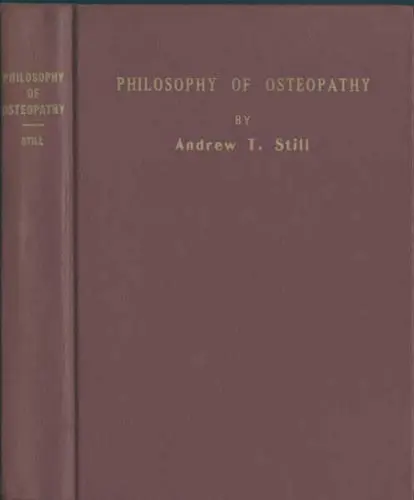
THE CLASSIC COLLECTION · 1899
"Philosophy of Osteopathy" by A. T. Still is a scientific publication written in the late 19th century. The book explores the principles and philosophy behind osteopathy, aiming to provide a foundation for the practice and understanding of this medical science without relying on traditional medical approaches. It seeks to establish a new way of viewing health and disease through a detailed understanding of anatomy and the body's natural functions. The opening of this treatise sets the stage for its exploration of osteopathy by addressing the author's journey in developing these ideas. A. T. Still declares his intention to provide a comprehensive framework for understanding the body's systems, emphasizing the importance of anatomy as a core component of osteopathic practice. He critiques traditional medicine, distancing his philosophy from drug-based approaches and asserting the need for a deeper comprehension of the body's normal and abnormal states. The text stresses the necessity of an artistic view of anatomy, encouraging practitioners to visualize the human body in its entirety and understand the interconnections between its various systems. Overall, the beginning of the book serves as a foundation for the detailed principles that will be elaborated upon in later chapters.
Introduction adapted from the source catalogue; source summaries may be automatically generated.
Free to read · English · 59,795 words · No account needed
MAKE TIME FOR A GOOD BOOK
On by default. Untick to stop anonymous reading totals. Each page counts after 10 seconds in view. How this works.
Anonymous counting is on unless you have switched it off.
Pneumonia begins by its oedematous accumulations of dead atoms, even to the death of the whole body, all having found a start in atoms only.
We will close this chapter by propounding a few questions which the Osteopath should keep in mind.
Are the human and animal forms complete as working machines?
Has nature furnished man with powers to make his bones; give them the needed shapes of durable material, strong in kind?
Does a section in nature's law provide fastenings to hold these to one
another?
Then another question arises: How will this body move, and where and how
is the force applied?
Where and how is this force obtained?
How is it generated and supplied to these parts of motion?
What makes these muscles, ligaments, nerves, veins, arteries?
Are they self-forming, or has nature prepared machinery to make them?
Does animal life contain knowledge and force to construct all of the
parts of man?
Can it run the machine after it has finished it?
By what power does it move?
Is there a blood vessel running to all parts of this body to supply all
these demands?
If it has a battery of force, where is it?
What does it use for force?
Is it electricity? If so how does it collect and use this substance?
How does it convey its powers to any or all places?
How does the man keep warm without fire?
How does he build and lose flesh all the time?
Where and how is the supply made and delivered to proper places?
How is it applied and what holds it to its place when adjusted?
What makes it build the house of life?
Do demand and supply govern the work? If not, what does?
Are the laws of animal life sufficient to do all this work of building and repairing wastes and keep it in running condition?
If it does, what can man do or suggest to help it?
Is this machine capable of being run fast or slow if need be?
Does man have in him some kind of chemical laboratory that can turn out such products as he needs to fill all his physical demands?
If by heat, exercise, or any other cause he gets warm, can that
chemistry cool him to normal?
If too cold can it warm him? Can it adjust him to heat and cold?
If so, how is it done? Is the law of life and longevity fully vindicated
in man's make up?
Your reading position is saved on this browser. Take it to another device with a library code. Reading pages adapt to text, rather than matching a printed edition.
BEHIND THE BOOK
This eBook is for the use of anyone anywhere in the United States and most other parts of the world at no cost and with almost no restrictions whatsoever. You may copy it, give it away or re-use it under the terms of the Project Gutenberg License included with this eBook or online at www.gutenberg.org. If you are not located in the United States, you will have to check the laws of the country where you are located before using this eBook. Read the source licence.
The original source file, including credits and licence, is retained by this library. Request an original-format copy at no charge. Please include the book title and Project Gutenberg identifier #25864.
KEEP YOUR CURIOSITY GOING
David Patterson (Spirit) Hatch
Coulson Kernahan

Ralph Waldo Emerson
Frances Wright

Edwin Abbott Abbott

Joseph Droz