THE CLASSIC COLLECTION✦An outlaw’s diary: the CommuneCLASSIC FREE BOOKS
An outlaw’s diary: the Commune
Cécile Tormay
THE CLASSIC COLLECTION · 1919
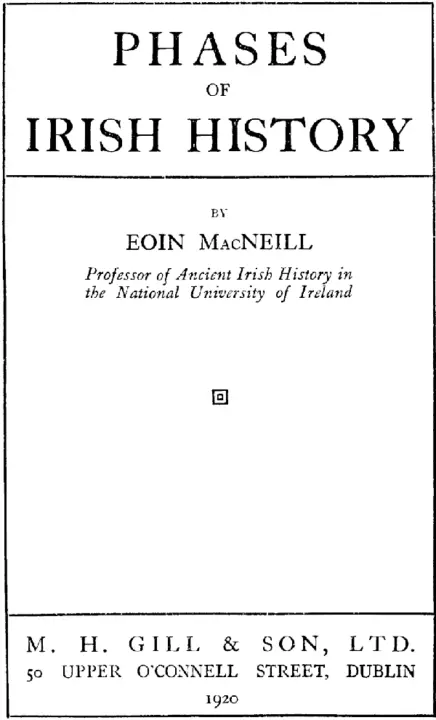
"Phases of Irish History" by Eoin MacNeill is a historical account written in the early 20th century. The work delves into the complex historical narrative of Ireland, particularly focusing on the discussion of Celtic identity and the historical understanding of the Irish people and their language. MacNeill's approach is analytical, using various historical texts and archaeological evidence to trace the lineage and cultural evolution of the Irish. The opening of the text introduces the author's perspective on the ancient Irish as part of the Celtic people, addressing common misconceptions regarding their racial identity. He emphasizes that Celtic identity is primarily linguistic rather than racial, highlighting that the ancient Irish and British lacked awareness of their Celtic kinship. MacNeill critiques traditional genealogical accounts and argues for a recognition of Celtic consciousness, setting the stage for a broader exploration of Ireland's history and its connections to pre-Christian and contemporary cultures. This opening serves as a prologue to the subsequent chapters, which promise to explore various epochs of Irish history in greater detail.
Introduction adapted from the source catalogue; source summaries may be automatically generated.
Free to read · English · 95,296 words · No account needed
MAKE TIME FOR A GOOD BOOK
On by default. Untick to stop anonymous reading totals. Each page counts after 10 seconds in view. How this works.
Anonymous counting is on unless you have switched it off.
Of this Galian stock came Fionn and Oisin and Oscar and all their kindred, according to some accounts. They were of the sept Ui Tairsigh, one of the three folks who, says Mael Muru, are not of the Gaedhil. This sept dwelt at Drumcree in the barony of Delvin in Westmeath. Their name and existence as a sept is probably not so ancient as the time of Fionn, but we may suppose that in their own time they claimed descent from the family of Fionn, from Clann Bhaoisgne.
Other possible instances of occupation-castes are found in the names Céchtraighe "plough-folk," Corbraighe and Corbetrighe "chariot-folk" (Carbantorigion, the name of a town of the Selgovae in southern Scotland), Gruthraighe "curd-folk," Lusraighe "herb-folk," Medraighe "weight or balance-folk," Rosraighe "linseed-folk," Rothraighe "wheel-folk," Sciathraighe "shield-folk."
The tinker clans of recent times in Ireland and Scotland may well be survivals of some of these ancient industrial communities.
It is certain that ancient tribes remained in every part of Ireland after their conquest by the Gaels, and retained in some measure during the early Christian period in Ireland their ancient organisation, often under their own ancient lines of chiefs. This is matter of strictly historical record, and if any similar records had existed and were still extant in Britain, we should hear less of the cheap and easy history of successive populations, each of them completely exterminating those that inhabited the land before them. Writers on history would not find themselves flatly contradicting ethnologists on the strength of their own gratuitous assumptions, when ethnologists say that the modern English race is largely composed of descendants of the primitive inhabitants.
On this subject of primitive races, there is one point which, in passing, I desire to bring out. One of the founders of the modern study of ethnology, Quatrefages, has given a good illustration of a sort of scientific method akin to some that we have had already under consideration. A glance at the map showed him that Ireland represented a north-western limit of the likely spread of the human race in remote times. The migratory movements of antiquity were thought to have, generally speaking, a western trend in Europe. Ireland besides was an island, which in the distant past must have been reached through Britain. Conclusion: Ireland was the place in which to look for primitive European types, and in Ireland the surest place to find the primitive types must be the extreme north-western part. Accordingly, M. Quatrefages packed his portmanteau in Paris and labelled it for Belmullet. This kind of scientific quest is usually successful. It succeeds after the manner of the schoolboy who, before entering into the intricacies of a question in algebra, takes the precaution of providing himself with the answer from the end of the book. M. Quatrefages found the Mayo seaboard swarming with a primitive race of men. I do not propose to examine his discoveries in detail. Anyone who is curious about them is referred to the late Dr. Hogan's little book on "The Irish People," which is the source of my information. In a paper contributed by me to the Royal Irish Academy's "Clare Island Survey," on the Place-names and Family-names of Clare Island, I showed that nearly half of the families now living there could be traced to an earlier home in distant parts of Ireland. I pointed out that in remote ages, the parts of the sea that adjoin the land and the parts of the land that adjoin the sea must have afforded the freest highway for movements of population. It must have been so in the glacial period and during its decline, when the scanty population must have lived a life like that of the modern Eskimos who travel long journeys in their canoes and change their habitation at will. It must have been so in the barren period that succeeded the age of ice, when animal and vegetable food was much more abundant on the sea-shore than inland. And it must have been so in the succeeding forest period, when the inland regions became difficult to traverse. In fact, until men became tillers of the ground and road-makers, the sea-edge was their grand highway. Hence it is that the population of the seaboard is always the most mixed and variable. The place to look for the least movement and least variation is inland, especially in deeply wooded, swampy or mountain areas, which offer the least attraction to newcomers and from which an older population is hardest to dislodge. And this, I think, is also the lesson of ethnological research conducted without foregone conclusions. In all western Europe, there is no region that contains a larger proportion of a late-coming population than the Orkneys, Shetlands and Hebrides and distant Iceland, the uttermost extremes of the north-west.
Your reading position is saved on this browser. Take it to another device with a library code. Reading pages adapt to text, rather than matching a printed edition.
BEHIND THE BOOK
This eBook is for the use of anyone anywhere in the United States and most other parts of the world at no cost and with almost no restrictions whatsoever. You may copy it, give it away or re-use it under the terms of the Project Gutenberg License included with this eBook or online at www.gutenberg.org. If you are not located in the United States, you will have to check the laws of the country where you are located before using this eBook. Read the source licence.
The original source file, including credits and licence, is retained by this library. Request an original-format copy at no charge. Please include the book title and Project Gutenberg identifier #48952.
KEEP YOUR CURIOSITY GOING
Cécile Tormay

Moritz Busch
John L. Ransom
Frances Wright
Cécile Tormay

Mabel Potter Daggett