THE CLASSIC COLLECTION✦An outlaw’s diary: the CommuneCLASSIC FREE BOOKS
An outlaw’s diary: the Commune
Cécile Tormay
THE CLASSIC COLLECTION · 1919
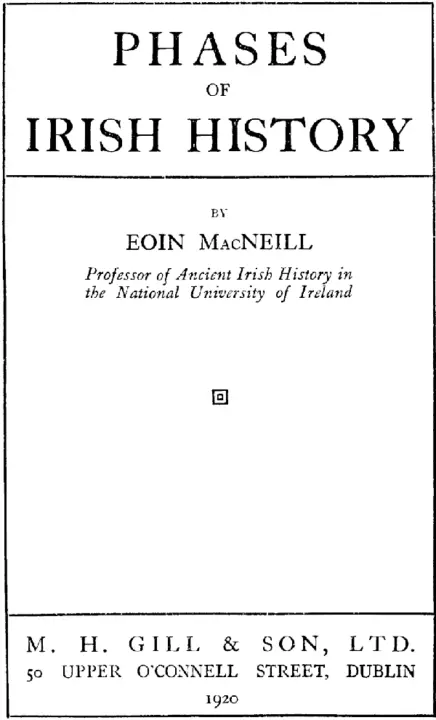
"Phases of Irish History" by Eoin MacNeill is a historical account written in the early 20th century. The work delves into the complex historical narrative of Ireland, particularly focusing on the discussion of Celtic identity and the historical understanding of the Irish people and their language. MacNeill's approach is analytical, using various historical texts and archaeological evidence to trace the lineage and cultural evolution of the Irish. The opening of the text introduces the author's perspective on the ancient Irish as part of the Celtic people, addressing common misconceptions regarding their racial identity. He emphasizes that Celtic identity is primarily linguistic rather than racial, highlighting that the ancient Irish and British lacked awareness of their Celtic kinship. MacNeill critiques traditional genealogical accounts and argues for a recognition of Celtic consciousness, setting the stage for a broader exploration of Ireland's history and its connections to pre-Christian and contemporary cultures. This opening serves as a prologue to the subsequent chapters, which promise to explore various epochs of Irish history in greater detail.
Introduction adapted from the source catalogue; source summaries may be automatically generated.
Free to read · English · 95,296 words · No account needed
MAKE TIME FOR A GOOD BOOK
On by default. Untick to stop anonymous reading totals. Each page counts after 10 seconds in view. How this works.
Anonymous counting is on unless you have switched it off.
Dáirine, 162
Dál Araidhe, 185
Dál gCais, "Dalcassians," rising power of, 266, 268
Dál Riada, 185, 194-200, 203
Danes arrive in Ireland, 253
Danish kings of the Hebrides, 212
Dathi=Nath-Í, 157
De Burgh family, their alleged change in policy, 340
Déclán (Diaglán), Saint, 161
Derbfine (Deirḃḟine), significance of, 230, 290
Dési, Déisi, migration of, 109, 128
Druim Ceata, assembly of, 197
Dublin first fortified, 251;
becomes seat of Norse kingdom, 252;
battle of, 264
Dumbarton, "stronghold of the Britons," 198, 204;
captured by Dublin Norsemen, 255
Dynastic polity, 177
Eblana, Eblani, 137
Ecclesiastical reform, 281-288
Éire, Ériu, origin of the name, 67
Emain (an Eaṁain, "the Navan"), 115
England before the Anglo-Norman invasion of Ireland, 305;
racial type now prevalent in, 39
English invade Ireland, A.D. 684, 201
English power recovered through firearms and artillery, 347
Eochu Feidlech (Eoċaiḋ Feiḋleac), 118
Eochu MacLuchtai (Eoċaiḋ mac Luċta), king of
Munster, 103, 104
Eterscél (Eidirsgéal), king of Ireland, 109
Eoghanachta, origin of, 127;
states of, 186;
maximum power and decline of, 260-262
Érainn, Érna, "Erneans," 65-68, 104 (--Iverni)
"erenagh"=airchinnech
Etruscan alphabet in Cisalpine Gaul, 167
Eusebius, Irish writers influenced by, 89
Feidhlimidh, king of Munster, 259
Feidhlimidh, king of Connacht, career of, 328
Fer Diad (Fear Diaḋ), 79
Fergus (Fearġus) defends the Galians, 81
Fergus mac Eire, 116, 194
Fiachu Sroibtine (Fiaċa Sraiftine), 124
Fiana, 150
Find Fili (Fionn File), king of South Leinster, 104, 106, 110
Fionn Bheara a Celtic god, 87
Fir Bolg, 77, 79
Fir Domhnann, 79
Fir Iboth (iḃoṫ), 74 (=Ebudeans)
FitzGerald, Maurice, career of, 328
Five-fold division of Ireland in ancient tradition, 102
Flemish settlers in Ireland, 303
Fochairt, battle of, 338
Fochla, kingdom of the, 185
Fomori (Foṁoraiġ), 85, 87
Gabhair in Leinster between the two ancient provinces, 107
Gaelic settlements in Britain, origin of, 46
Gaels, legendary origin of, 90
Galians (Gaileoin), 80, 104
Gall-Ghaedhil or Norse-Irish, 211, 252
Gallógláich, "galloglasses," 326;
commanders of, 334;
first record of, 336;
spread of, 341
Gaulish settlers in Ireland, 128
Genealogies help to explain the annals, 179, 183, 194
Geography in ancient Irish schools, 92
Germans and Celts, early relations between, 15-25
Glacial period in Ireland, 69
Gold in ancient Ireland, 71
Gormlaith, career of, 262
Government of an Irish state, character of, 352
Grants of land, 297; to Gallóglach commanders, 335
Grants of lordship, 177
Greek alphabet used in Gaul, 167
Greek in ancient Irish schools, 243
Hakon, king of Norway, loses control of Hebrides, 216;
Irish sovereignty offered to, 332
Heathen lore, ancient Irish, 176
Hebrides, 74
Hebridean forces, 325;
first appearance in Ireland, 329
Heptarchy in Ireland, 113
"herenagh"--airchinnech
Hiberni, Hibernia, origin of the names, 67
History of Ireland, how constructed by ancient writers, 89, 98;
earliest documents of, 114, 175;
distorted views of, 347
Your reading position is saved on this browser. Take it to another device with a library code. Reading pages adapt to text, rather than matching a printed edition.
BEHIND THE BOOK
This eBook is for the use of anyone anywhere in the United States and most other parts of the world at no cost and with almost no restrictions whatsoever. You may copy it, give it away or re-use it under the terms of the Project Gutenberg License included with this eBook or online at www.gutenberg.org. If you are not located in the United States, you will have to check the laws of the country where you are located before using this eBook. Read the source licence.
The original source file, including credits and licence, is retained by this library. Request an original-format copy at no charge. Please include the book title and Project Gutenberg identifier #48952.
KEEP YOUR CURIOSITY GOING
Cécile Tormay

Moritz Busch
John L. Ransom
Frances Wright
Cécile Tormay

Mabel Potter Daggett